The Pharmaceutical industry in Bangladesh has come a long way – from depending solely on international imports to its current capacity to export worldwide. Behind this national success lies a combination of bold policy reform, visionary advocacy, entrepreneurial growth and workplace culture that values human wellbeing.
Bangladesh’s pharmaceutical transformation
Early struggle
After independence in 1971, the country faced a scarcity of locally manufactured medicines. More than 80% of the market was controlled by foreign brands. According to a 1981 assessment by the World Health Organization (WHO), the national drug supply was “poorly regulated” and filled with irrational, even harmful, medicines. Essential drugs were costly and often unavailable in rural areas.
1982: A turning point in drug governance
The National Drug Policy (NDP) was issued in 1982, which restricted unnecessary imports of pharmaceutical products and encouraged their domestic production. This bold move reshaped the health sector by nurturing local expertise, ensuring the affordability and availability of medicine for millions of Bangladeshis. Key reforms under the NDP (1982) include:
-
The government banned around 1,700 harmful and irrational drugs.
-
An essential medicine list was introduced to align with global standards.
-
Regulation strengthened under the Directorate General of Drug Administration (DGDA).
-
Space was created for local manufacturers to grow and ensure an affordable medicine supply.
The above policy reform laid the foundation for what would later become one of Bangladesh’s strongest industrial sectors.
The influence of Dr Zafrullah Chowdhury
Although the NDP (1982) was groundbreaking, its early implementation was market-driven and ordinary people did not benefit much from it. In such a situation, Dr Zafrullah advocated for an equitable drug governance and sought to align the policy with WHO standards. He also emphasized that irrational overseas drugs in the local market should be controlled so that the local pharmaceutical industries can grow. His initiatives, grounded in the rural healthcare work, challenged the existing NDP, which ultimately resulted in a revised version of the policy recognizing Bangladesh as a model for rational drug policy globally.
A Sector on the Rise: Self-Sufficiency and Global Reach
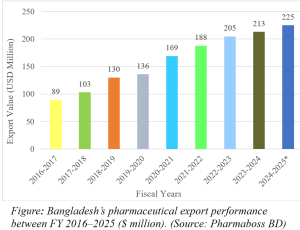 Once the policy environment encouraged local entrepreneurship, the pharmaceutical industry grew steadily over the past four decades. Production expanded from basic generics to biosimilars, oncology drugs, vaccines and high-tech formulations. Currently, according to the Bangladesh Investment Development Authority (BIDA, 2024), the pharmaceutical industry in Bangladesh meets nearly 98% of its local demands, with exports to over 150 countries across Asia, Africa and Latin America.
This growth of the local pharmaceutical industry has made a significant contribution to Bangladesh’s measurable improvements in maternal and child health, including controlling communicable diseases, which were the main reasons for the country’s higher mortality rate. Maternal mortality, infant and under-five mortality have declined significantly due to the availability of essential medicines, alongside vaccination and strong primary care. According to the Bangladesh Demographic and Health Survey (BDHS), the country’s infant mortality rate fell from an estimated 150 per 1000 live births in 1980 to 65 per 1000 live births in 2004. Routine immunization and treatment for common childhood illnesses have driven down infant and child deaths. Besides, local pharmaceutical industry now plays a crucial role in addressing the country’s growing burden of non-communicable diseases (NCDs). According to the data compiled by Industrial Promotion and Development Company (IPDC, 2025), around 95% of cancer medicines are now produced locally, compared to a high dependence just 15 years ago. This rapid growth in domestic oncology manufacturing has led to a 10-12-fold reduction in the price of several life-saving cancer drugs.
Such growth supports Bangladesh’s progress towards SDG 3 (Good health and wellbeing). Both public-private efforts in the production of medicines ensured availability, affordability and accessibility of life-saving treatments across urban and rural Bangladesh. Success in the health sector not only ensured national health security but also created thousands of job opportunities for the citizens and significantly contributed to the growth of the national Gross Domestic Product (GDP).
Beyond Business: Responsible growth and industry-wide ethics
An important but often overlooked part of Bangladesh’s pharmaceutical success is how companies treat their employees and communities. Leading pharmaceutical firms regularly organize medical campaigns, donate essential medicines, maintain environmental compliances, practice ethical labour standards and engage in community outreach. Many invest heavily in employee welfare through housing, health coverage, structured training, stable employment and fair compensation. These reflect more than business strategy. Across the sector, welfare, corporate social responsibility (CSR) and ethical standards have become widely adopted practices-not isolated achievements.
HPL: A case study

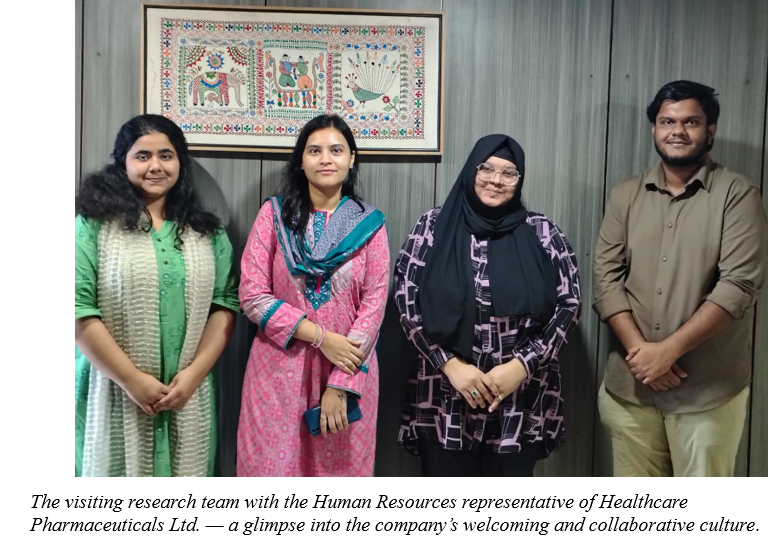
The authors visited the HPL headquarters located in Banglamotor, Dhaka on 3 November and spoke to a Deputy Manager of the company and an HR official from whom the visitors received valuable insights about the background and evolution of the company. It was clear from the interviews that the company thrived over time due to having a clear vision and care for its staff including a commitment to society at large.
Early development
 HPL was founded in 1988 by Mr Alauddin Ahmed, initially in partnership with Roche (Switzerland), which provided valuable training in world-class standards for medicine storage, distribution and ethical conduct. In 1996, HPL took a bold move by establishing its own state-of-the-art manufacturing plant, transforming it from a distributor into a fully-fledged manufacturer. Within 5 years, in 2001, HPL transformed from a representative of a foreign brand to an independent local manufacturer. HPL reports on its website that over the two decades, it expanded its product line to more than 570 branded products and 250 generics, covering nearly all therapeutic classes, including antibiotics, antivirals, cardiovascular and oncology drugs, antidiabetics and respiratory treatments
A culture of care
An HR professional who has been there for more than 8 years mentioned, “It is a workplace that values people before profit.” She again mentioned that the company offers multiple facilities to support employees’ well-being, which includes health insurance coverage for employees, their spouses, and children. Other facilities include transportation, canteen meals at highly subsidized rates, and accommodation at the plant location for employees and so on. At the plant, workers receive two meals per shift: a snack and lunch for the day shift, and a snack and dinner for the night shift. Besides, HPL’s policies reflect a commitment to gender equality and family support. They provide 120 days of paid maternity leave and seven days of paid paternity leave, along with a breastfeeding corner at the workplace. These welfare practices are aligned with HR standards observed across several major pharmaceutical firms in Bangladesh
After the visit, it appeared to the authors that HPL successfully fosters an open and accessible workplace environment. Junior officers can directly approach senior management if needed. According to the interviewed HR official, “our Deputy Managing Director is very encouraging in direct communication; even if an executive needs a signature, they can go directly to him.”
Investing in training and future leaders
Every new field recruit undergoes a 45-day comprehensive training programme covering technical, behavioural and leadership skills. Company bears all associated costs, including meals and materials. Additionally, employees can propose to the company for any additional training, conducted by internal experts or external guests, whenever they feel the need.
This practice not only strengthens individual careers but also sustains institutional memory and culture.
Values that ensure integrity
Apart from the opportunities it offers to its employees, HPL adheres to five core values, which include –
-
Respect people
-
Ensure Justice
-
Innovate Constantly
-
Delight Customers
-
Operate Responsibly
To identify challenges and improve working conditions, the management conducts an ‘annual workplace culture survey’ to hear the voices of employees. Transparency and accountability are ensured through this participatory practice.
“Job security is robust here, but if any of the values are violated, the company takes it seriously. Otherwise, they always give opportunities, chances to learn, provide guidance and training for self-development”, said the HR.
Corporate responsibility and social impact
In addition, during the interview with the authors, HPL expressed its commitments to community service initiatives such as:
-
medicine donations,
-
rural health campaigns,
-
awareness programs,
-
environmental management through proper waste treatment.
HPL’s history suggests that its Managing Director, Md. Alauddin was recognized for his philanthropic work in education, healthcare and community development, including establishing schools, orphanages, and hospitals. An entire neighbourhood in Kushtia-Alauddin Nagar- is named in his honour. These community -focused actions are part of broader CSR traditions in Bangladesh’s pharmaceutical sector.
Challenges Bangladesh’s pharmaceutical industry must confront
-
Higher dependency on imported raw materials. According to the Bangladesh Association of Pharmaceutical Industries (BAPI), more than 80% of Active Pharmaceutical Ingredients (APIs) are still imported.
-
Limited high-end research and development.
-
The DGDA needs expanded laboratory capacity, digital systems and trained inspectors to meet international compliance requirements.
-
After Least Developed Country (LDC) graduation, stricter intellectual-property rules may increase the license costs.
A Broader reflection: From factories to health futures
The growth of Healthcare Pharmaceuticals Ltd. mirrors the advancement of Bangladesh’s pharmaceutical industry, which was built on resilience, innovation and the drive to serve humanity. Companies like HPL show how corporate responsibility directly strengthens national health outcomes by prioritizing worker welfare, nurturing internal leadership and upholding ethical standards. Especially, as Bangladesh is graduating from LDC status, companies like HPL will play a crucial role in maintaining global competitiveness. With such a strong pharmaceutical foundation, the country can reduce its reliance on imported active pharmaceutical ingredients (APIs). The experience of HPL illustrates that long-term success is not driven by profit, but by creating value for employees, patients and communities alike.
Sabiha Binta Siraj
Sabiha Binta Siraj is a final year student of Population of Public Health Sciences (PPHS) at the Department of Social Relations, East West University (EWU), Bangladesh. She has presented her research on menstrual health, loneliness, and mental health at three international conferences. An EWU merit scholarship and UTAship recipient, Sabiha is currently working on menopausal coping strategies among Bangladeshi women and knowledge, attitudes, and practices (KAP) of vaping among university students.

Sajidul Haque
Sajidul Haque is a Public Health student in the Department of Social Relations at East West University and currently serves as Vice President of the East West University Health and Wellbeing Club. His interests include health systems, social determinants of health, and public health advocacy, with a strong commitment to community engagement and population wellbeing.
Israt Jahan Labonno
Israt Jahan Labonno is an undergraduate student pursuing a Bachelor’s degree in Population and Public Health Sciences at East West University, Bangladesh. She has worked as a teaching assistant and research assistant, and has a background in academic writing with previous experience contributing to research work. Her interests focus on public health topics.