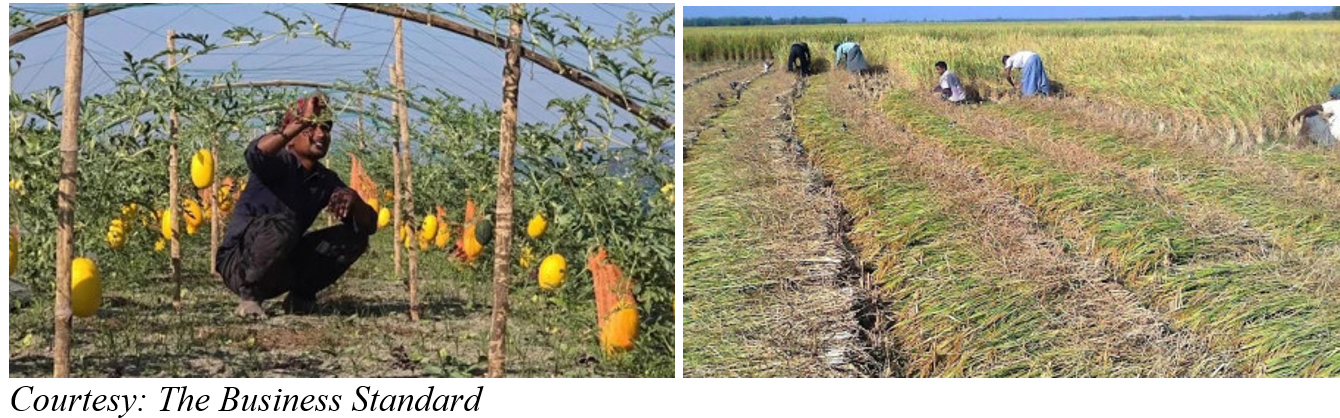
Bangladesh is a country where the soil tells stories, and its people mirror the strength of that very earth. From post-independence struggles to modern agri-business success, the story of Bangladesh’s agriculture is one of faith, hard work and transformation.
Since our independence in 1971, when Bangladesh rose from the ashes of war, its farmlands were broken, and its people were hungry. Yet, from those same fields came Bangladesh’s greatest strength – its farmers. They tilled the land, mended the soil, and slowly turned scarcity into self-sufficiency. Over the last 45 years, through high yield varieties, improved irrigation and modern farming techniques, Bangladesh has turned agriculture into one of its strongest pillars. Today, agriculture contributes over 15% to the country’s GDP and employs around 43% of the population, remaining at the heart of Bangladesh’s economy and culture.
Production of major crops as rice, jute, wheat, and potato has grown dramatically. In the early 1970s, total food grain production was around 108 lakh metric tons by 2015, it had tripled, ensuring national food security and lifting millions out of poverty. Improved seeds, scientific methods, and government support have driven this transformation, turning traditional farming into a modern, efficient system.
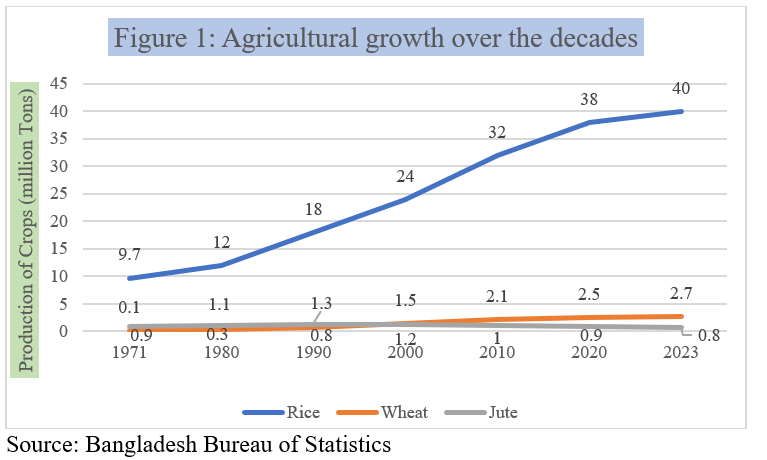
Figure 1 presents decade-wise production data for rice, wheat, and jute to show how Bangladesh’s agriculture grew after independence and with each crop following a distinct trend. Rice production shows a consistent increase across every decade, rising from about 10 million tons in the 1970s to 40 million tons in the 2020s. During the same period, wheat production has been moderate. It increased marginally during the 1980s and 1990s, reaching over 1.5 million tons, but then production increased more rapidly in recent decades due to better varieties and improved winter season farming practices. Jute, known as our Golden Fibre, shows a gradual declining production trend, especially after the 1990s.
Once dependent on uncertain rainfall and traditional methods, the nation now stands proudly among Asia’s top agricultural producers. Food grain output has tripled since independence, rising from about 11 million tons in the 1970s to over 36 million tons today. Through expanded irrigation, high-yield seeds, and scientific innovation, Bangladesh has achieved near self-sufficiency in food and made remarkable gains in crops like rice, jute, vegetables, and fish. Modern mechanization, efficient fertilizer use, and farmer education have empowered millions in rural areas, turning agriculture into a key driver of economic growth, export potential, and national resilience. Thus, what was once a story of struggle has become a story of strength. It proves that when science meets the spirit of the soil, a nation flourishes.
The agriculture sector employs, directly or indirectly, approximately 40% of the total labour force and accounts for about 13 to 14% of the country’s GDP. Rice is everywhere, but one will also find wheat, jute, vegetables, fruits, and plenty of fish. Still, farmers have a tough time. Land is fragmented and small in size, and floods strike almost every season, while finding enough workers is not easy, and machines are not always available. All this slows things down. But the story is changing. These days, one sees more machines in the fields, better seeds, and smarter ways to use water. Farmers are starting to get more out of their land and handle the weather a bit better. Agriculture still means everything for food, for jobs out in the countryside, and for the whole economy. And honestly, as people keep picking up new methods, there is a lot more room to grow.
4th Industrial Revolution in Bangladesh’s agriculture
Farming in our country does not look the way it used to. The Fourth Industrial Revolution is changing everything. We are talking about a wave of new technology: Artificial Intelligence, big data, cloud computing and biotech in agriculture. Instead of relying on backbreaking work and guesswork, farmers now use smart sensors, drones, and connected gadgets to check soil health, moisture, crop growth, and weather as it happens. All that real-time information helps them use water, fertilizer, pesticides in a smarter way and lay out the best times to plant and harvest. One day, perhaps not in distant future, AI driven automated machines will take on jobs like planting, weeding, and harvesting to solve the seasonal labour shortages.
In addition, the whole supply chain is getting a makeover. Digital platforms, phone apps, and blockchain let farmers track their produce all the way to markets, keep quality high, meet food safety standards, and even connect directly with buyers. That means more money in their pockets and less need for middlemen. On top of that, biotech delivers crop varieties that handle odd weather, pests, and diseases, so farmers can count on good harvests even when the climate throws a curveball. Smart irrigation and precision feeding mean less waste and less water use that helps the environment.
By leaning and using these new tools, our agriculture is becoming stronger, smarter, and more resilient. This transformation was made possible by a blend of farmer resilience, policy support and more importantly private sector innovation. Behind this success stand the dedication of Bangladesh’s farmers and resilient people who turned a post war struggle into a story of progress. There are many enterprises working and growing in this field and contributing to growth of our agriculture economy. These include ACI, Ispahani, Laal Teer Seed, Supreme Seed, Brac Agro for producing seeds and Kazi Farms, Paragon in Poultry and Farm. Among the enterprises, Advanced Chemical Industries (ACI) Limited stands out, connecting science, sustainability, and human effort in the agri-business sector of Bangladesh. And they have established their footprint in every part of the agricultural sector from seed to fertilizers, pesticides, farming tools and even tractors and modern machinery. Their consistent efforts toward developing seeds, enhancing crop protection expanding mechanization, and supporting farmers show how committed they are to advancing the overall agro sector.
ACI’s Contributions to Agricultural Development
 ACI- Advanced Chemical Industries (ACI) began in 1968 as a branch of Imperial Chemical Industries (ICI). After Bangladesh’s independence, Dr. M. Anis-Ud-Dowla took over the company, later rebranding it as ACI Ltd in 1992 and making it a public limited company in 1993. Today, ACI has a strong involvement in agribusiness through seeds, fertilizers, machinery, and crop protection products. Its agribusiness division supports farmers with modern technologies, improved inputs, and training, helping strengthen Bangladesh’s agricultural development.
ACI’s agriculture machineries and pricing
ACI Motors Ltd. is part of ACI PLC, and they are all about bringing modern technology to farming in Bangladesh. Since 2007, they have been helping farmers get their hands on everything from tractors and power tillers to reapers, mini-combine harvesters, rice transplanters, water pumps etc. They offer after-sales support, spare parts, and even financing plans that make it possible for smaller farmers to actually afford this equipment. When farmers switch to machines, things really change in the fields. Suddenly, jobs like preparing land, planting, and harvesting take way less time and effort. ACI Motors goes a step further by helping local entrepreneurs rent out machines to other farmers, which means more jobs and extra income in rural communities. At the end of the day, ACI Motors is a real driving force behind the shift to modern farming in Bangladesh.
ACI Motors not only sells farm equipment, but also focuses on the demand of the farmers. ACI built machineries to handle the country’s unique soil and terrain, making tough jobs easier, faster, and less physically draining. By making these tools available, ACI Motors gives farmers a real shot at running more successful operations, sparking rural businesses, and boosting local economies.
Many small and mid-sized farmers simply cannot pay for these machines outright. To get around that, ACI Motors offers hire-purchase and instalment plans. They also rent out machines to farmers who cannot buy them, so even those with just a little land can use modern equipment without breaking the bank.
ACI is helping to change the way farming works in Bangladesh by making it more productive, more reliable, and open to new ideas. By supporting farmers and local service providers, they are laying the groundwork for a stronger agricultural sector and for a stronger country.
ACI’s distinct competitive position in the agricultural market

ACI really sets itself apart in Bangladesh’s agricultural world. They do not just sell seeds or fertilizers – they cover everything. Think of top-notch seeds, crop protection, and the latest machines like tractors, harvesters, and rice transplanters. They always work for the improvement of Bangladesh’s agriculture by continuously investing in R&D and innovating new climate-smart ways to boost yields. ACI has one of the biggest rural distribution networks in the country that ensures a strong supply chain of ACI’s agriculture products. In addition, they have an extensive network for after-sales service. They are known for their commitment to providing service within 6 hours anywhere in Bangladesh. They provide farmer training, real-world demos, and share new tech. This not only helps the farmers learn more about modern farming but also helps ACI maintain continuous trust with the farmers. These strategies help ACI to stand out from its competitors. Overall, it shows how smart business and innovation can breathe new life into an old industry, improve people’s lives, and shape the future of farming here.
Employee benefits and welfare practices at ACI
As we know, farmers are like family to the agricultural sector. Similarly, as a corporate company working in this field, ACI’s employees are also considered family members. That is why ACI holds a responsibility toward its workers and offers various employee benefits. ACI follows national labour laws and provides key benefits like compulsory provident fund (CPF), gratuity, festival bonuses, WPPF, and Group Life Insurance. Employees also get 120 days of maternity leave, performance bonuses, LFA, transport facilities, subsidized lunch, mobile allowances, scholarships, and hospitalization support. During COVID-19, ACI ensured strict safety measures and offered medical and emergency assistance to protect its employees. ACI ensures convenient mobility facilities for its employees – sales representatives receive transport allowances, territory staff are provided with a two-wheeler, and managers get the benefits of four-wheelers. In addition, the head office employees are offered pick and drop services, for which they contribute only 0.75 taka per kilometre. And a subsidized lunch benefit, where the company provides 80% and their employees all over Bangladesh, including the factory workers, pay 20% cost as Tk 550 only. They also provide entitlements as a mobile allowance. For the junior management employee’s children, ACI has scholarship opportunities according to academic performance.
Corporate social responsibility and community engagement
Every year, ACI rolls up its sleeves and gets involved in all sorts of CSR projects. They donate to government welfare funds and run programmes to make sure people in need do not get left out in the cold. When floods or disasters hit, they step up with relief. They run awareness days, for example, Diabetes Awareness, Anti-Drug campaigns, the kind of stuff that actually sticks with people. Out in the countryside, they train farmers on fertilizers, machines, and eco-friendly farming. A lot of this training comes straight from their own employees, who volunteer to teach. The company does not let that go unnoticed, either. They reward these efforts, which does a couple of things at once: it helps the country’s agriculture grow and keeps their team feeling appreciated.
Challenges and strategic responses by ACI
ACI is running into a real problem these days. Young graduates are not interested in working in agriculture anymore. Not long ago, the company had no trouble hiring skilled people for field jobs. Now, finding anyone willing to get their hands dirty out there is a struggle. Most of Gen-Z is not lining up for these roles. ACI is promoting and making these jobs more appealing by offering career growth, good pay, and the chance to build something in the long term. This will bring a new wave of “Agriculturists” not only for ACI but also for the agriculture sector of Bangladesh.
Conclusion
Therefore, the soil of Bangladesh has always held the power to create life, hope, and progress. From the struggles of post-independence to today’s era of modern agriculture, the journey has been extraordinary. ACI has not only grown as a company but has grown with the nation, supporting farmers, valuing employees, and standing strong in every challenge. As Bangladesh moves toward a smarter, greener agriculture future, ACI continues to carry the spirit of the soil forward, proving that when innovation meets humanity, a nation truly thrives.

Marufa Alam Raha
Aspiring economist and writer from Bangladesh. She completed her HSC in Business Studies at Viqarunnisa Noon School and College and is now pursuing her higher studies in Economics at East West University. With a strong interest in social issues, public policy, and economic trends, Marufa actively engages in academic research, debating, and article writing. She aims to simplify complex ideas and present them in an insightful and engaging manner for readers, connecting real-world issues with thoughtful analysis.

Mahanaz Azra Akin
An Economics student at East West Univerity with a keen interest in social and economic issues. Completed schooling at SV Government Girls’ High School and higher secondary studies at Holy Cross College. Enjoying writing articles that combine analytical insight with clear and engaging communication, aiming to make complex topics accessible to readers.

Sanjana Taranom Samia
An Economics student, currently in 2nd semester at East West University. Completed higher secondary from Shaheed Bir Uttam Lt. Anwar Girls College studying in the Humanities group and earlier studied Science at Kishorganj Girls High School. Passionate about economics, social issues, and research, and enjoys writing articles that explore contemporary topics with clarity and insight.