The Middle East ceasefire agreement in early April offered a tantalizing glimpse of relief for global energy markets, but the promise of stability has proven to be a mirage. Within days of the United States, Iran, and Israel agreeing to a fragile two-week pause in hostilities, it became apparent that the truce was more of a diplomatic placeholder than a genuine restoration of maritime order. Even as the ink dried on the accord, only a handful of non-tanker vessels had been allowed to transit, and the Strait of Hormuz—the artery through which nearly a fifth of the world’s oil passes—remained effectively constricted.
By April 10, the US President was publicly accusing Tehran of doing a “very poor job” of reopening the chokepoint and of breaching the terms of the agreement, while the UK Prime Minister’s office was calling for “a practical plan” to get shipping moving again. For Bangladesh, which sources a significant proportion of its imported fuel and LNG through these same waters, the episode has been a brutal reminder of how quickly the promise of stability can give way to the harsh realities of a geopolitical standoff. The critical question is not whether the current ceasefire holds for another week or another month, but whether the economy is structurally capable of absorbing the next shock when it inevitably arrives.
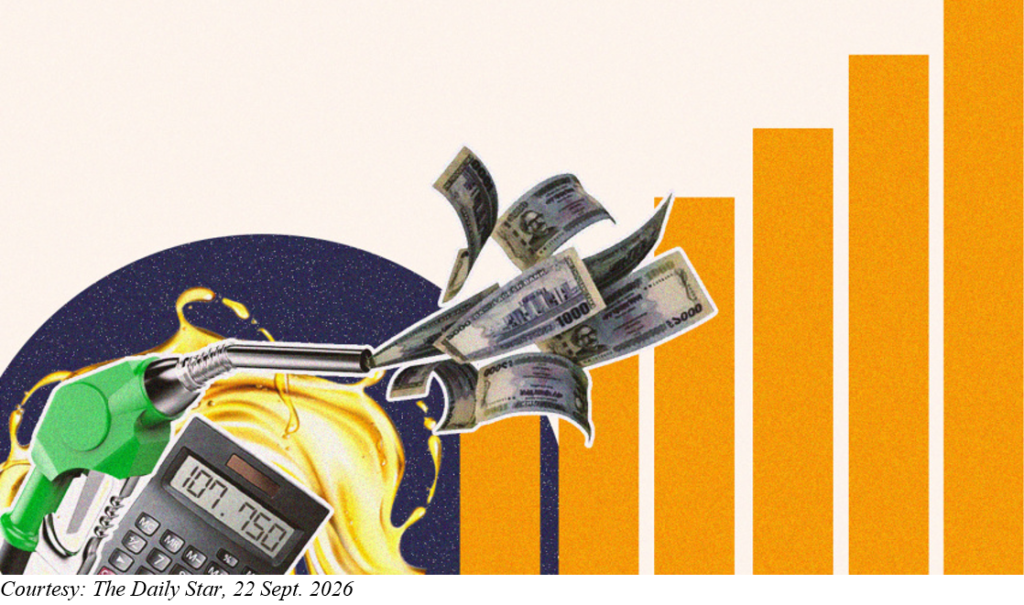
The government’s immediate policy response has been to shield consumers from the full force of the price spike through a massive and expanding subsidy regime. As of early April, the exchequer was absorbing a daily fuel subsidy of Tk 167 crore to keep diesel at Tk 100 per litre, a price that bears almost no relation to the soaring cost of procurement on international spot markets.
When accounting for all petroleum products, the fiscal haemorrhage is staggering; analysis projects the total subsidy bill for the current fiscal year will touch Tk 36,000 crore, a figure that is likely to climb if the Hormuz crisis drags on or if the fragile ceasefire collapses completely. This is not a targeted intervention designed to cushion the poorest households from the shock. It is a blanket, untargeted transfer that benefits everyone who purchases fuel—from the owner of a private SUV to the operator of a diesel-guzzling industrial generator. In economic terms, this is an extremely regressive and inefficient use of scarce fiscal resources. The funds being poured into subsidising fossil fuel consumption are being diverted away from public investment in health, education, and infrastructure, and they are being financed through increased borrowing that places upward pressure on interest rates and crowds out private sector credit.
The second-order effects of this policy are already cascading through the real economy in ways that are far more insidious than the headline subsidy figure suggests. By holding domestic prices artificially low, the government has inadvertently created a powerful incentive for panic-buying and hoarding. When consumers and businesses understand that the price they pay today is lower than the price they might pay tomorrow—and certainly lower than the international market price—they have every reason to stockpile as much fuel as their storage capacity allows. This behaviour amplifies the initial supply shock, creating artificial shortages and long queues at petrol stations that are entirely avoidable.

The agricultural sector, which relies heavily on diesel-powered irrigation pumps, has been particularly hard hit. Farmers who cannot access the fuel in the subsidized price have either to buy it at higher cost from the black market or worse still, have to stop following the irrigation schedule due to non-availability of fuel, putting their boro rice harvest at stake, thus endangering food security. The ready-made garment sector, the backbone of the country’s export earnings, has seen output contract by an estimated 20 to 30% as factories struggle with erratic gas pressure and soaring electricity costs, even with subsidised diesel. This loss of potential productivity is not factored in the daily subsidy amounts of the government, but it is much deeper and more long-lasting in the sense that it drains out the vitality of the economy of the nation.
What Bangladesh needed to do and needs to do very urgently is a fundamental rethink on its pricing and strategy. In the present scenario of pricing being done in an ad hoc manner to respond to international pressures, what happens is a very vicious cycle gets set into motion. International pressure builds up on the government, fuel prices rise in response to the pressure, and once international pressures get reduced due to softer conditions or due to an upcoming election, there comes a reversal of price policy.
In fact, the government had prepared a price revision mechanism on a formula basis under the supervision of the International Monetary Fund that had envisaged revising fuel prices after every three months depending upon international and domestic prices, but it has been put aside. It would allow global price signals to do the work of rationing demand, rather than leaving that task to the chaotic and inequitable forces of black markets and long queues. The Centre for Policy Dialogue has even demonstrated that a properly calibrated market-based model could, over the medium term, reduce fuel prices for consumers by Tk 10 to 15 per litre, while simultaneously curbing the scope for pilferage and misappropriation.
Equally critical is the need to build a genuine buffer against future shocks. Bangladesh has depots and working inventory, but it lacks a clearly ring-fenced strategic petroleum reserve that could sustain the economy through a temporary disruption. As the Centre for Policy Dialogue has argued, developing such a reserve should be a central plank of the medium-term energy strategy, allowing the government to avoid the costly and desperate scramble for spot market cargoes at double or triple the normal price.
In the longer term, the only durable solution is to reduce the economy’s exposure to the volatile geopolitics of the Persian Gulf by diversifying energy sources and suppliers. This means accelerating the development of domestic natural gas resources, particularly in the Bhola region and in offshore blocks, and making a far more concerted push into renewable energy. The current crisis has laid bare the profound vulnerability of an economy that is tethered to a single, volatile chokepoint. The ceasefire, however long it lasts, offers a narrow window of opportunity. If Bangladesh uses that window not just to manage the current crisis but to fundamentally strengthen its economic and strategic resilience, it will have learned a valuable lesson. If it does not, it will simply be waiting for the next shock to arrive.

K.M. Arshad
Undergraduate Student of The Department of Economics, University of Dhaka