
On 16 September, the government unveiled a sweeping list of economic, energy, welfare and infrastructure initiatives. Among others, these initiatives are expected to create jobs for youths. Job initiatives include youth financing, education and overseas employment.
The youth financing scheme includes a Tk. 500 million (50 crore) special loan fund of the Bangladesh Bank for an upazila-based programme with 5,000 promising entrepreneurs expected to receive start-up capital annually; collateral-free, interest-free digital “e-loans” for marginal and small entrepreneurs and opening nationwide access to an online start-up fund.
Also, technical education will become compulsory from Grade Six and for National University students, while the “Alpha” project will provide practical employment skills to around 4.5 million (45 lakh) people. The government spokesperson also mentioned that the government has signed an agreement with China on modernising technical education to meet the industry need.
Earlier, on 2 August, the government instructed the state-owned banks to fill vacant posts within 180 days. On 11 August, the Bangladesh Bank announced that Tk. 10 billion (1,000 crore) special fund – Tk. 5 billion (500 crore) for low-interest loans and Tk. 5 billion (500 crore) for grants – with an aim of creating 5,000 youth entrepreneurs.
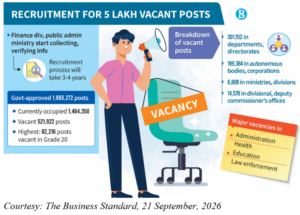 As part of its strategies to fulfil its election promise to end the country’s unemployment crisis within 5 years by creating 10 million (1 crore) new jobs, the government has fast-tracked filling vacant posts in public enterprises and corporations. It has recently launched a fresh initiative to fill around 0.52 million (5.2 lakh) vacant posts across various government institutions and regulatory bodies, such as the Microcredit Regulatory Authority and the Office of the Comptroller and Auditor General.
The government’s accelerated job initiatives also include Tk. 600 billion (60,000 crore) stimulus package for the private sector – Tk. 200 billion (20,000 crore) for re-opening closed factories, and Tk. 100 billion (10,000 crore) for agriculture and rural economic activities, Tk. 50 billion (5,000 crore) for the cottage, micro, small and medium enterprise (CMSME) sector, Tk. 30 billion (3,000 crore) for export diversification and Tk 30 billion (3,000 crore) for the North Bengal Agricultural Hub initiative.
Background
The background for these initiatives is the growth of the labour force to 71.7 million (7.17 crore) where 2.62 million (26.2 lakh) remain unemployed as the Finance Minister mentioned in parliament on 11 September, referring to the Bangladesh Bureau of Statistics (BBS)’s Labour Force Survey 2024. The minister also said another 50 million (5.04 crore) people were outside the labour force altogether among whom around 38 million (3.801 crore) were women who were neither employed nor counted as unemployed in 2024. Undoubtedly, this is quite a bleak picture.
Data from international agencies reveal a starker picture. For example, the World Bank estimates Bangladesh’s total labour force at 74.74 million in 2025, roughly 3 million more than the BBS estimates. A 2025 World Bank review finds that from 2013 to 2022, Bangladesh’s working-age population grew at an average rate of 1.5%, while during the same period, employment growth was only 0.2%. Thus, according to the International Labour Organization (ILO) data, the employment rate – the indicator of the extent to which available labour resources (people available to work) are being used – remains low at around 56.8% while the informal employment rate is as high as 84%.
The situation is more challenging for young people, who face additional hurdles in transitioning from education to employment, often with inadequate market-relevant skills. According to the ILO approximately 2 million to 2.2 million young people enter the labour force every year in Bangladesh. However, the insufficient growth of formal jobs traps 92.7% of working youth and 98.5% per cent of young women in informal employment without social protection and fundamental rights at work. Thus, they face significant decent work deficits, including low wages, poor working conditions. Regrettably the highest unemployment rates are among those who have completed tertiary education at 27.8% overall (32.6% women). Furthermore, alarmingly 22% of young people (aged 15-29) – 27.1% young female and 16.2% young male – are not in education, employment, or training (NEET).
The situation is likely become more challenging as the World Bank projects a grimmer outlook. It predicts nearly 600,000 job losses and higher inflation due to the war in the Middle-east, while at least 5,000 Bangladeshi workers lost jobs in Lebanon alone, according to the media report.
An assessment
This assessment is based on the media report as the government did not release any policy document paper showing how various figures are derived. We also do not know how each policy action will work to achieve the ultimate goal; nor do we know whether various actions will work in tandem, maximizing synergies and minimizing trade-offs or conflicts. Implementation plans and sequencing as well as financing mechanism (especially sources) are also not adequately explained.
Therefore, in the absence of information about the co-ordination mechanism among various implementation agencies, consistency or coherence between different aspects of the policy package and integration of them, we cannot assess the likely overall effectiveness of the announced policy packages.
However, we can still make observations based on past experiences and analytical perspectives. To begin with, some of the initiatives mentioned, such as Saudi scholarships for 509 meritorious students a year can be doubtful given that Saudi Arabia faces a severe economic downturn with a 4.8% GDP contraction in Q2 2026, according to the Oxford Economics analysis. The same can be said about the expected overseas jobs, especially in the Middle-East, where jobs for Bangladeshis has already hit 5-year low. Although Malaysia agreed to reopen its labour market for Bangladeshi workers following the Prime Minister’s visit, the Malaysian government has not yet clarified several crucial elements of the recruitment mechanism to Dhaka.
The numbers also do not seem to add up. For example, while the policy announcement mentions Tk. 50 crore for financing 5,000 promising youth entrepreneurs, for the same objective the Bangladesh Bank has set aside Tk. 1,000 crore. This is a huge discrepancy, exposing internal inconsistencies.
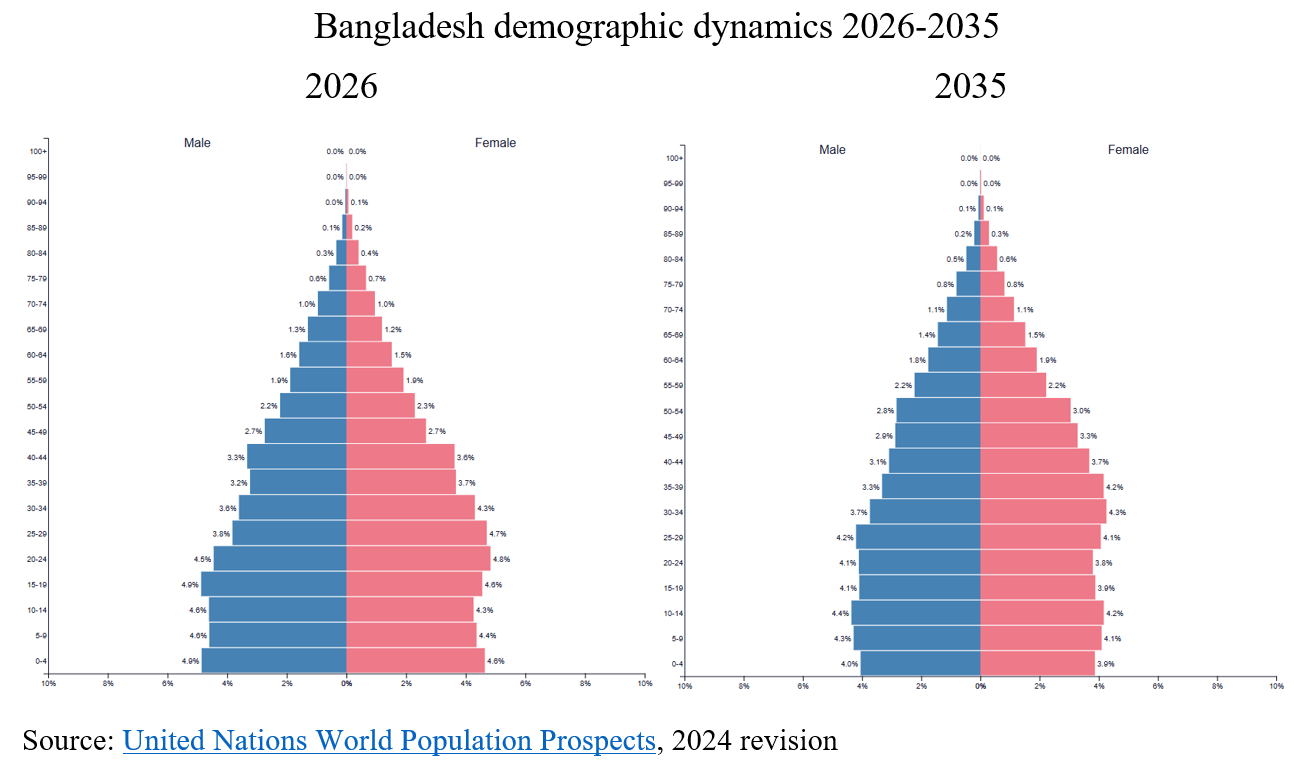
One serious limitation is its lack of linkage with the demographic dynamics of the country. Bangladesh is currently at the peak of its youth population bulge – nearly 28% of its population is in the age bracket of 15-29. By 2035 it is projected to decline to 24%. The announced policy package does not provide strategies for reaping “demographic dividend” before it is too late and turns into a “demographic curse”. The speed of job creations must be high enough to absorb not only the pool of existing unemployed, but also the new entrants into the labour force.
We know that sustainable productive and decent job creations can only happen through sustained rapid growth of the economy accompanied by dynamic structural transformation which entails creative destruction. That is, an economy must progressively move up the productivity ladder – from lower value-added to higher value-added; from lower skill to higher skill intensive; from less complex to more complex activities. This means education and skill development measures which are not consistent with the country’s structural transformation strategies are likely to create more educated unemployment. That is, the success of the announced policy package will depend on complementary reforms in banking governance, energy supply, and industrial policy.
Using the above analytical framework, one can question whether the initiative to fill vacant positions at government institutions is appropriate. Public institutions in Bangladesh have historically been overstaffed, as successive governments have regarded them as repositories of jobs. There is no indication that the government has conducted any rigorous analysis to assess whether these jobs are genuinely required. These posts should not be filled simply because they are vacant without ensuring that the recruitment will improve service delivery; and if these jobs are at state-owned enterprises, they must be linked to productivity and profitability. In the absence of such rigorous criteria, the mass public-sector recruitment drive is likely to cause serious challenges for long-term fiscal and structural sustainability.
The instruction to the state-owned commercial banks (SoCBs) to fill vacant positions is likely to cause serious long-term damage to the economy which could ultimately undermine the job creation objective. Severe balance-sheet distress across Bangladesh’s five major SoCBs continues to deepen as non-performing loans (NPLs) surged by Tk6,304 crore in the first six months of 2026, from Tk145,000 crore in December 2025 to a staggering Tk151,000 crore at the end of June. Asking these financially struggling SoCBs to fill their vacant posts only increases their financial distress. They may survive through government’s (i.e., Bangladesh Bank’s) injecting capital. But actions also undermine trust in the banking sector. A banking crisis may turn into a full-blown economic crisis.
Job creation is not an automatic outcome of credit expansion. It depends on whether the financed activities are genuinely productive and whether they operate in an enabling environment. Therefore, one can raise serious concerns about the Tk. 60 thousand crore stimulus package in an economy suffering from serious structural bottlenecks, such as energy, logistics and infrastructure. It is highly likely that a large-scale injection of funds into a structurally bottlenecked economy will raise inflation and thus threaten macroeconomic stability adversely affecting investment climate.
More importantly, the effectiveness of this strategy hinges critically on the viability of the targeted enterprises. It presupposes that closed factories are victims of temporary shocks; but most of them are structurally uncompetitive or burdened by chronic mismanagement. Injecting fresh credit into such entities is against the principle of creative destruction as an integral part of a dynamic structural adjustment process. Thus, this initiative risks creating ‘zombie firms’, surviving on subsidized finance but failing to generate sustainable returns. This not only locks capital into unproductive uses, but also increases the future burden of NPLs on the banking system.
The interest rate structure of the package also warrants close scrutiny. Loans priced between 4% and 7% are a significant departure from prevailing market rates, e.g., borrowing cost in excess of 15% particularly for SMEs. While such low interest rates may encourage investment, but also may lead to misallocation of resources, with borrowers prioritizing access to cheap funds over productive efficiency.
The absence of a credit guarantee mechanism raises concerns about risk distribution. Banks are expected to bear the credit risk associated with lending under the scheme, even when financing distressed enterprises. This could lead to a cautious lending behaviour, limiting the reach of the programme. On the other hand, if banks are compelled to lend under pressure, it could worsen future asset quality problems.
One may also raise concerns about the programme’s long-term fiscal implications as it relies on government’s annual subsidy of around Tk3,000 crore. This highlights the importance of ensuring that the stimulus generates tangible economic returns. However, liquidity alone cannot drive investment if confidence remains low due political instability, lack of regulatory clarity, and deteriorating law and order situation.
Finally, the governance framework will play a critical role in determining the stimulus package’s success. It will require a disciplined approach to implementation, with clear beneficiary selection criteria and robust monitoring and evaluation mechanisms. The proposal to use escrow accounts and strict monitoring mechanisms is a step in the right direction. However, effective monitoring requires institutional capacity and transparency. Past experiences with refinance schemes in Bangladesh suggest that weak oversight can lead to misuse of funds and limited impact.
An alternative plan: Expanding Bangladesh National Cadet Corps (BNCC)
On 11 November, 2025 Professor Yunus called for enhancing the quality and inclusivity of the Bangladesh National Cadet Corps (BNCC) as part of a long-term vision to engage the nation’s youth in leadership, discipline, and national development. Ten days later on 21 November, 2025 during his address observing the Armed Forces Day, Professor Yunus announced the Interim Government’s decision to expand the BNCC with a view to engaging students and youth in national defence and welfare initiatives.
The BNCC was raised in 1979 by merging different existing similar programmes, University Officers’ Training Corps (UOTC), Junior Cadets Corps (JCC) and Bangladesh Cadet Corps (BCC). It was an initiative of President Ziaur Rahman as he envisioned that the youth of the country would devote themselves in development works in peacetime and form the second line of defence forces of the country during emergency.
Unfortunately, although the BNCC has emerged as a highly successful programme, it remained limited and faces numerous challenges. The stated strategy of the National Education Policy 2010 that “Branches of BNCC will be opened in all colleges and universities of the country” (p. 45), never materialized.
The Interim Government’s decision to expand BNCC was based on detailed analysis of fiscal cost and implementation issues guided by Special Assistant Anisuzzaman Chowdhury. The programme targets around 2.49 million (roughly 25 lakh) youth consisting of HSC level students and SSC-passed dropouts. With 2 years cadetship, the participants will receive 6 months of regular training, followed by 18 months of refresher and other vocational/technical training. As incentives, SSC-passed dropouts will receive Tk. 500 daily allowance, while HDC students will receive academic credit (GPA).
Beginning with 0.27 million (2.5 lakhs) trainees annually, the programme will reach 2.1 million (21 lakh) per year in the 8th year, with the budget increasing from Tk. 1,217 crore to Tk. 7,750 crore. This will have a minimum fiscal impact as money can come from reallocation of funds from a variety of existing youth related programmes run independently by different ministries in an un-coordinated manner.
By 2030, the programme envisions a skilled and disciplined patriotic youth work force of over 3 million which should boost investment climate. The estimated return on investment of Tk 1,217 crore and associated benefits are:
- Approximately 20% of trained youth (50,000) are expected to be directly employed in the Armed Forces, Paramilitary Forces and Police.
- A significant number, at least 60%, gaining productive employment, either as an entrepreneur or as skilled workers.
- The remaining 40% highly motivated ones will seek higher degrees.
There are also ancillary benefits, such as a significant drop in the demand for job-irrelevant university degrees, thus reducing the prospect of educated unemployed. This will also raise the quality of higher education as only highly motivated ones will proceed to enrol. Needless to stress that this will directly impact on the propensity of youth getting involved in anti-social activities.
This one programme, thus, has the potential to address several burning issues, currently challenging the nation. Because of its multi-faceted nature involving several ministries, it is envisioned that it should be implemented and monitored from the Prime Minister’s Office. The details of the programme can be obtained from the Directorate of BNCC.

Anis (Anisuzzaman) Chowdhury, an alumnus of Jahangirnar University and University of Manitoba, is a macro-development economist with close to 100 publications in international journals and two dozen books, including Moulana Bhashani: Leader of the Toiling Masses and Moulana Bhashani: his Creed and Politics. Currently an adjunct professor, he was a professor of economics (2001-2008), Western Sydney University. He served as Director of Economic and Statistics Divisions of UN-ESCAP (Bangkok, 2012-2015) and retired from the UN Headquarters (New York) in 2016 after serving as Chief in the Financing for Development Office. He regularly writes opinion pieces on global socio-economic-political issues. He serves on the editorial boards of several academic journals.