Volume 4, Issue 2 contains 11 articles, mostly focused on structural issues confronting Bangladesh. A special feature of this issue is articles by university students and young writers as part of Global Bangladesh’s mission to encourage and mentor emerging authors and researchers – a practice introduced in Volume 3, Issue 4 (December 2025).
M.G. Quibria’s article “Diversifying the export base,” highlights the overdependence of Bangladesh’s exports on ready-made garments (RMG). According to the author, the country’s failure to diversify in nearly five decades has been due to anti-export bias policy regime and the policy capture by the garment lobby that denies other potential sectors the same benefits that the RMG sector enjoys. In the presence of external forces and market failures, the author argues, Bangladesh must pursue strategic industry policy to diversify its export basket. The author identifies seven sectors in which Bangladesh have potential comparative advantages, and suggests a number of measures for accelerating skill development to support structural transformation. These include a compulsory payroll levy on business and a structured salary and benefit package to attract back skilled Bangladeshi diaspora living and working abroad.
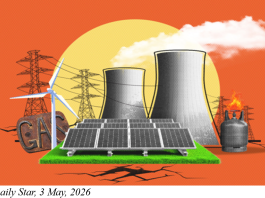
In his article, “Bangladesh’s energy crisis: Costly external dependence and limited alternatives”, Saleh Rashid Khan explores the nature of the energy crisis in Bangladesh. The crisis, according to the author, is a consequence of over-reliance on imported fossil fuels and liquified natural gas (LNG) and unfavourable long-term contracts with foreign suppliers. The author highlights the potential of using solar energy. Indeed, Bangladesh can learn from the experience of Pakistan, which has been experiencing a boom in the use of solar energy, based on Chinese-made cheap solar panels. He also argues for re-negotiating unfavourable energy supply contracts. The aim of the energy policy, according to the author, is not total energy self-sufficiency, which is unrealistic, but should be a stronger capacity to withstand external pressure without losing policy autonomy. This would require more than better fuel management, and demand smarter diplomacy, more careful contract design, and a clearer commitment to putting Bangladesh’s long-term interests first.
In, “From liberation to renewal: Rethinking Bangladesh’s state, identity, and future after July 2024”, Ghulam Suhrawardi narrates the historical roots of Bangladesh’s quest for autonomy and independence since the Moghul rule. He differentiates the independence movement of 1971 and the July movement of 2024, and argues that the July revolution was a response to the unfulfilled promises of the 1971. According to him, July made us question everything we thought we knew about the Bangladeshi state: What does it mean to be sovereign? Did we really achieve what we set out to do in 1971? What does justice truly look like for the people of Bangladesh? Furthermore, he describes how the July movement has rekindled the debate concerning national identity involving politics, culture, and religion in Bangladesh.
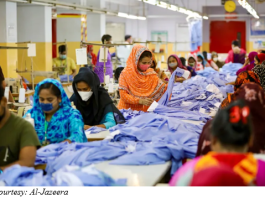
Israt Jahan Eshita, a BBA student (East West University), vividly depicts the daily life of Antora, a garment worker whose salary significantly falls short of the living wage. Garments account for more than 80% of the exports of Bangladesh. Bangladesh is now the second-largest garment-exporting country in the world. The contribution of over four million garment workers behind this success cannot be overrated. Yet, the working and living conditions of a typical garment worker remain vulnerable, as exposed in Israt’s narrative of Antora’s daily life struggle living with her CNG driver husband and two children in a one-room living quarter, and sharing other amenities, like a bathroom with others. Unfortunately, average RMG workers like Antora are forced into accepting such sub-standard life as there are no better alternatives due to the country’s failure to diversify – a point highlighted in the lead article by M.G. Quibria.
Fariza Khan Aishy, an undergraduate Economics student (East West University) and H.M. Saif Noor (a young professional), examine the potential of Bangladesh’s shrimp sector and challenges it faces. Their article highlights that Bangladesh is a major producer and exporter of fish, and shrimp makes up a major export product. However, like any other economic activity, the sector’s development confronts significant trade-offs in terms of socio-economic and environmental effects. Fariza Khan Aishy and Saif Noor suggest strategies for addressing the challenges of shrimp cultivation in Bangladesh as the country desperately needs to diversify away from the RMG sector.
Rifah Tasnia Ahona, an Economics student (East West University) and MD. Samin Aziz (a Civil Engineering graduate from Ahsanullah University of Science and Technology) explore various issues concerning the introduction and adoption of artificial intelligence (AI) in Bangladesh’s financial sector. They conduct case studies of four major private sector commercial banks to identify the status and barriers of AI introduction and adoption. Despite AI emerging as a transformational, general-purpose technological revolution with opportunities, there are challenges, such as lack of skilled workforce, limited technological infrastructure, high implementation cost, cybersecurity and data privacy. Digital divides in access among various socio-economic groups and negative perceptions among the general mass are also major barriers. Nevertheless, the authors are optimistic and confident that as Bangladesh moves toward a digital future, the successful introduction of AI into the finance sector will not only modernize banking services, but also contribute significantly to sustained economic growth and national development.
Raisa Mehzabeen, a young professional, discusses nutritional issues among the children of Bangladesh, especially the double burden of malnutrition characterized by the coexistence of undernutrition and overnutrition (a form of malnutrition resulting from excessive energy and nutrient intake) within the same populations, communities, households, and even individuals. She argues that nutritional deficiency remains a major problem affecting about 25% of children despite Bangladesh’s remarkable progress in economic development, witnessing significant increases in per capita income. Raisa Mehjabeen draws attention to the adverse consequences of nutritional deficiency – both under and over nutrition. She highlights the role of the innovative organization like Nutrition for Change in raising awareness about nutrition, lead exposure, and ultra-processed food. She calls for “nutrition-smart” governance and national strategies concerning nutrition focusing on the environment, regulating processed food industry and local level budgeting.
Nazifa Anjum Nitu, an undergraduate Economics student (East West University), exposes the worsening mental health situation in Bangladesh in recent years, especially among young people and students. She also highlights the economic cost of mental health crisis because of reduced productivity and absenteeism, besides the burden of treatment expenses. Yet, according to her, the infrastructure to tackle this crisis is quite weak. In light of this, Nazifa explores the pros and cons of using AI for mental health support. Based on a survey of university students she provides recommendations concerning government policies toward mental health.
Sabiha Binta Siraj, Israt Jahan Labonno and Sajidul Haque, Population and Public Health Sciences students (East West University), explore the pervasive inequity in Bangladesh’s healthcare system, characterized by a lack of universal health insurance, low budgetary allocation for healthcare and high out-of-pocket expenditure on healthcare. They provide a case study of the community health insurance schemes introduced by the Gonoshasthaya Kendra for the general population and garment workers. Drawing on the lessons learnt from the community health insurance schemes of the Gonoshasthaya Kendra and Rwanda, they argue that universal health insurance is feasible and desirable in Bangladesh to address systemic and pervasive health inequity. Thus, they call for strengthening and expanding the current health insurance schemes in Bangladesh.
Preservation and promotion of Bengali culture is a major component of the lives of the Bangladeshi diaspora community. Mohsin Ali narrates the vibrant cultural activities in Ottawa led by several organizations, such as the Bangladesh High Commission, the Bengali Community Service Centre of Canada, and the Bangladesh Association of Ottawa Valley. Notable events include the celebration of Independence Day, Victory Day, International Mother Language Day, and Bengali New Year. These organizations also organize picnics and fairs, which promote the traditional food culture of Bangladesh.
Finally, Mohammad Zaman, a regular contributor to Global Bangladesh, provides a riveting account of his trip with his life-partner for nearly half a century, Habiba, to Egypt, a country rich in history. The article provides glimpses of cities such as Cairo, Alexandria, and Luxor. It highlights various archaeological sites, including the pyramids of Giza and Memphis. It also describes a cruise trip from Luxor to Aswan along the magnificent Nile River.
Note: The deadline for submission of articles to the September Issue of Global Bangladesh is 15 September, 2026.