Nature of the crisis
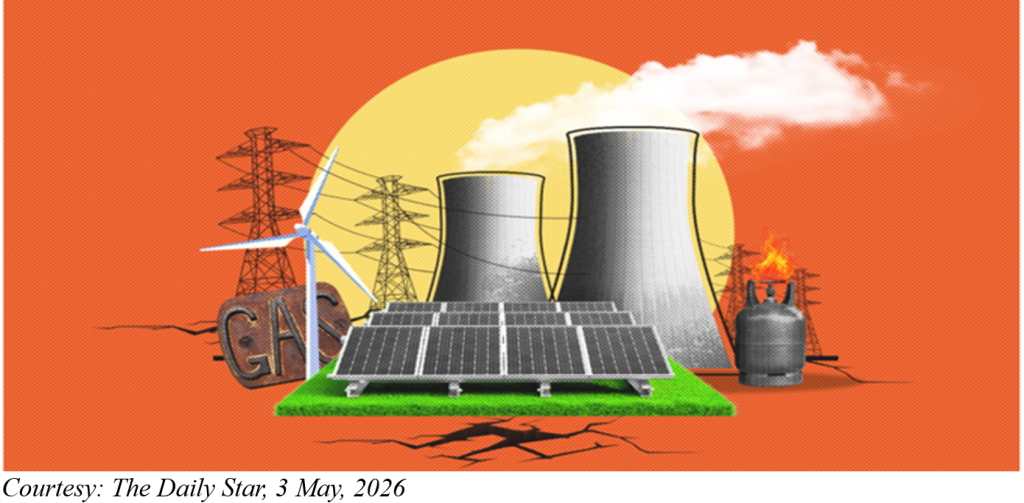
Bangladesh’s energy crisis stems from three closely connected problems. First, the country depends heavily on imported fossil fuels, much of them sourced from the Middle East, leaving it exposed to geopolitical instability and supply disruptions. Second, this dependence is compounded by long-term, inflexible procurement contracts that limit Bangladesh’s ability to respond to changing market conditions. These arrangements heighten the country’s exposure to swings in petroleum and LNG prices, can force it to pay more even when domestic demand is weak, and increase vulnerability to fluctuations in the U.S. dollar. Third, Bangladesh has only limited scope to expand alternative energy sources because of its small land area and flat alluvial topography, which constrain large-scale hydropower and wind power development, though solar power, especially rooftop solar panels, remains a more promising option. Taken together, these factors show that the energy crisis is not simply a matter of import dependence. It is also an economic, technical, and strategic challenge that raises a broader question: how far can reliance on external energy sources restrict national policy choices?
Historical evolution of Bangladesh’s energy vulnerability
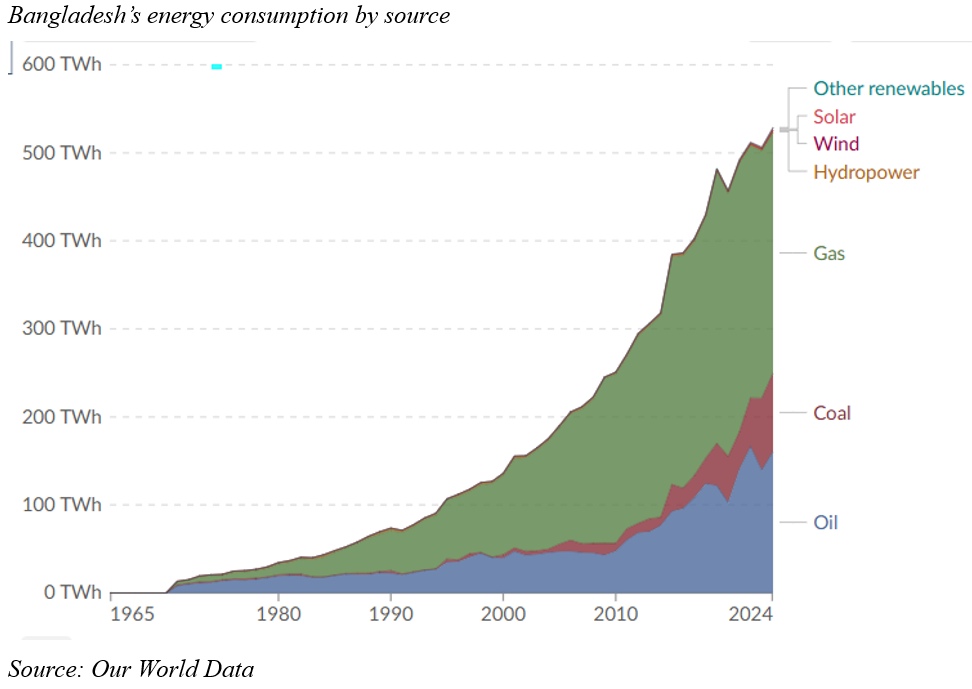
In the 1960s, optimistic projections suggested that the natural gas reserves discovered in the Sylhet region of what was then East Pakistan might last as long as 250 years. In retrospect, those estimates proved overly optimistic, especially once Bangladesh began to industrialize rapidly after independence. From 1971 onward, natural gas became the foundation of the country’s energy system. It powered most electricity generation, supplied fertilizer production, and for decades accounted for roughly 80 to 90 percent of total power generation. Proven gas reserves were estimated at about 30 trillion cubic feet (TCF) or 850 billion cubic meters, creating an early sense of abundance that discouraged timely diversification.
 Bangladesh also possesses no meaningful petroleum reserves and only limited coal resources. The Barapukuria coal mine in Dinajpur, though symbolically important, contributes only a small fraction of the fuel needed for coal-based generation. As power demand expanded, domestic gas production increasingly failed to keep pace. In response, Bangladesh turned more heavily to imported energy. LNG imports began in 2018 and marked a decisive move toward external dependence, tying the country more closely to global spot markets and long-term supply contracts. At the same time, Bangladesh expanded coal-based generation and increased cross-border electricity imports, particularly from India. The result was a more diversified energy mix, but one that also became more vulnerable to external pressures.
Today, more than half of the country’s primary energy supply is imported, exposing it to price volatility, currency depreciation, and geopolitical disruption. These risks became starkly visible after 2021, when turbulence in global LNG markets, rising fuel costs, and domestic fiscal pressures revealed the fragility of this import-dependent system. As Bangladesh has moved beyond least-developed-country status, sustaining economic growth has become closely tied to managing this dependence. Renewable alternatives remain limited. Hydropower potential is constrained by the country’s flat alluvial topography, and the Karnafuli hydro-dam on Kaptai Lake still provides less than 1 percent of national electricity consumption. Solar energy has shown the greatest promise, particularly through the proposed deployment of more than five million rooftop solar panels in off-grid rural areas. Nuclear power may offer some diversification in the future, though the Rooppur Nuclear Power Plant, located on the Padma River in Ishwardi Upazila of Pabna District, remains in the commissioning and pre-operational stage rather than in full commercial operation.
Annual consumption profile
Bangladesh’s energy vulnerability can be seen through the following annual energy consumption data.
- Natural gas: Bangladesh uses about 1.5–1.6 trillion cubic feet of natural gas each year. Although natural gas remains the backbone of the energy system and the largest single source of electricity generation, domestic production no longer meets demand, making imported LNG an increasingly important part of the national gas balance.
- Petroleum: Bangladesh consumes roughly 6.7–7.0 million metric tons of petroleum products each year, with diesel accounting for the largest share of use in transport, irrigation, industry, and backup power generation.
- Coal: Bangladesh now uses coal on a much larger scale in the power sector than in the past, with coal-fired generation capacity exceeding 7,700 MW, but domestic coal output remains negligible—only a few thousand metric tons.
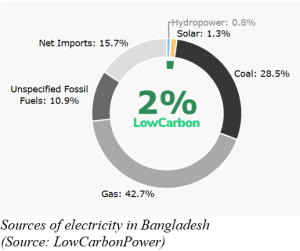
- Electricity: Bangladesh’s annual electricity generation is now well above 90 terawatt-hours, and the power system remains dominated by fossil fuels. Natural gas provides the largest share, while furnace oil, diesel, and coal account for much of the remainder, and imported electricity adds a small but strategically important contribution to supply.
- Renewables: Renewable energy contributes only a small share of national electricity supply—about 1 percent. Hydropower remains limited to a single major facility, and solar energy has shown the greatest promise, particularly in rural areas through initiatives like solar home systems.
Taken together, these figures show that Bangladesh’s energy use is heavily dependent on imported fuels and external supply arrangements.
Bangladesh’s energy procurement contracts
Bangladesh’s energy vulnerability is not defined by import dependence alone. It is also built into the contractual framework through which the country buys fuel and electricity from abroad. Many of these arrangements are long-term and relatively inflexible. They help ensure supply, but they also leave Bangladesh with limited room to adapt when world prices fall, domestic demand softens, or geopolitical disruptions unsettle normal trade routes.
LNG contracts. Bangladesh turned to LNG because its own gas fields could no longer meet rising demand. To make sure supplies kept coming, the country signed long-term deals with major suppliers, including a 15-year arrangement involving QatarEnergy and Excelerate Energy and another 10-year deal with Oman’s OQ Trading. These agreements reduce the risk of sudden shortages, but they also come with a trade-off. Because the price is still tied largely to oil, Bangladesh can end up paying high bills even when gas markets ease elsewhere. In simple terms, the contracts buy stability, but not much flexibility. That can leave the government carrying heavy costs when energy prices stay high for a long time.
Petroleum imports. Bangladesh buys much of its petroleum from Gulf countries through deals arranged by the state-run Bangladesh Petroleum Corporation. Some crude is processed at the Eastern Refinery located at Chattogram (Chittagong), while other fuel is imported in refined form. This system helps maintain supply, but it also carries risks. Because much of the oil arrives by sea from the Gulf, Bangladesh is vulnerable to shipping disruptions and regional tensions.
Cross-border electricity. Bangladesh is increasingly looking beyond its borders to keep the lights on. Buying electricity from India helps reduce the country’s heavy dependence on imported oil, coal, and LNG that must arrive by sea. Some of that power already comes through long-term deals, including supplies connected to the Adani plant in Jharkhand. Bangladesh is also trying to bring in hydropower from Nepal through transmission lines that pass across India. This strategy gives the country more sources of power and eases some pressure on fuel imports at home. At the same time, it also comes with a new kind of risk. The more Bangladesh relies on imported electricity, the more its energy security depends on cross-border power lines, stable regional agreements, and the politics of neighboring countries.
U.S. Agreement. The U.S.-Bangladesh trade deal matters not just because of its size, but because it appears to tie energy buying to a much wider bargain. Public reports say Bangladesh agreed to purchase about US$15 billion in American energy products over 15 years in exchange for better access to the U.S. market for Bangladeshi exports. The deal does not spell out exactly which energy products will be bought, but the broader message is clear: energy decisions may now be shaped by trade and diplomacy as much as by price or supply. That could deepen Bangladesh’s long-term reliance on foreign suppliers rather than reduce it.
Regional refining. One possible option for Bangladesh is to import crude oil and have it refined nearby in India before bringing the finished fuel home. On paper, that could save money and reduce pressure on Bangladesh’s own limited refining and storage capacity. It would also allow the country to benefit from the larger, more established refineries of eastern India. However, this would not end Bangladesh’s dependence on others. It would simply shift that dependence into a new form. Instead of relying only on foreign oil suppliers, Bangladesh would also have to rely on Indian refineries, cross-border transport links, and stable political and commercial ties with India. In other words, regional refining may improve efficiency, but it could also create a new layer of vulnerability if not handled carefully.
Why and how must Bangladesh renegotiate its international contracts?
Bangladesh needs to reopen parts of its international energy deals because the current system has become too expensive, too rigid, and too risky. Heavy reliance on imported fossil fuels has pushed up energy bills, strained foreign exchange reserves, and left the country exposed whenever global prices surge. Some long-term contracts appear to lock Bangladesh into unfavorable terms, while older power agreements can force the state to keep paying even when plants sit idle. As domestic gas supplies fall, the country has become even more dependent on volatile LNG markets, where conflict or disruption abroad can quickly drive-up costs at home.
The case for renegotiation is therefore not only about cheaper fuel. It is about giving Bangladesh more room to respond to changing markets, cutting unnecessary costs, and protecting long-term economic stability. That means reviewing questionable contracts more closely, pressing for pricing formulas that are less vulnerable to sudden swings, moving away from costly payments for unused power capacity, and widening the country’s options through regional electricity links and more competitive domestic energy exploration. None of this would end Bangladesh’s dependence on imported energy, but it would make the system more flexible, less wasteful, and better able to absorb future shocks.
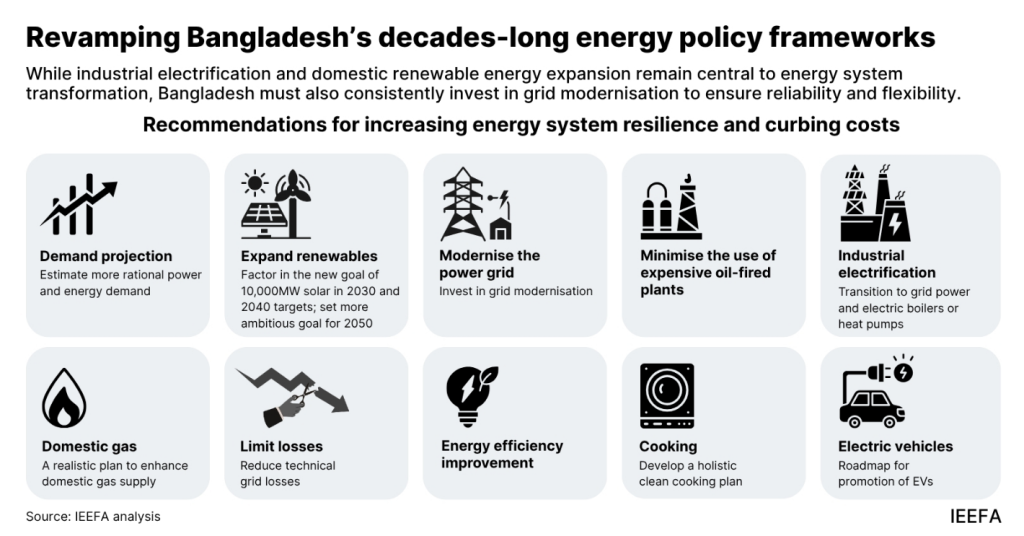
Renewable energy in Bangladesh
Hydro power. A realistic assessment of Bangladesh’s renewable energy prospects suggests that the country should proceed with caution and focus on options that fit its geography, settlement pattern, and infrastructure constraints. Large-scale hydropower is unlikely to expand much beyond the existing Kaptai hydro-dam facility because Bangladesh is predominantly a flat deltaic country with limited elevation drop and few sites suitable for major dams. Small run-of-river or micro-hydro schemes may still be possible in selected upland streams in the Chittagong Hill Tracts, but these would contribute only marginally to national supply rather than transform the overall power balance. In short, hydropower can remain part of the renewable discussion, but it is not a scalable national solution.
Wind power. Wind power also must be treated carefully. Bangladesh has some wind power potential along the southeast coast and nearby offshore areas, including parts of Chittagong, Cox’s Bazar, and Kutubdia. Recent policy documents therefore place considerable emphasis on its development. Yet the opportunity appears geographically narrow and technically uneven rather than nationwide.
Biomass energy. Biomass and waste-to-energy require an equally careful approach. Bangladesh produces agricultural residues, municipal waste, and animal waste that can support small-scale biogas, composting, or localized power generation. However, the open burning of biomass and waste already contributes to air pollution and public-health damage. The real opportunity lies in shifting away from inefficient burning toward controlled, modern systems that capture energy with lower emissions
Solar energy. For Bangladesh, solar power is the most practical renewable option—especially when it is spread across rooftops rather than concentrated in vast solar parks (as mentioned in the 2025 Renewable Energy Policy report). Solar panels on homes, apartment buildings, schools, hospitals, factories, and commercial properties fit far better with the country’s crowded landscape and limited open land. Rooftop solar panel system will not solve Bangladesh’s energy crisis on its own, but it is one of the few renewable options that is both technically realistic and politically achievable in the near term. If the country wants a serious renewable energy strategy, it should focus on what best suits its geography: limited hydropower, selective coastal wind, modest modern biomass, and above all a major expansion of rooftop solar panels.
Conclusion
Bangladesh’s energy crisis is no longer just a story about shortages, price spikes, or delayed shipments. It has become a test of how much control the country can retain over its own future while depending so heavily on fuel, electricity, financing, and transport systems that lie beyond its borders. As domestic gas reserves decline and import contracts grow more expensive and rigid, energy insecurity is turning into something larger than an economic problem. It is becoming a strategic challenge, with direct consequences for sovereignty, external hegemony, development, and national resilience.
That does not mean Bangladesh can isolate itself or treat every outside partnership as a threat. Geography and development needs make continued engagement with India, the United States, China, the Gulf states, and other partners unavoidable. The real question is how to manage those relationships without allowing dependence to harden into strategic subordination. That is why resilience matters. It means building an energy system with more room to absorb shocks, more flexibility in contracts, and more diversity in both suppliers and technologies. It also means expanding the renewable energy options that fit Bangladesh’s realities—above all rooftop solar panels, but also selective wind, limited hydropower, and modern biomass energy where practical.
In the end, the goal is not total energy self-sufficiency, which is unrealistic for Bangladesh, but a stronger capacity to withstand external pressure without losing policy autonomy. That will require more than better fuel management. It will demand smarter diplomacy, more careful contract design, and a clearer commitment to putting Bangladesh’s long-term interests first. In that sense, resilience is not just a technical fix. It is a national strategy for navigating an increasingly uncertain world without surrendering control over the country’s own choices.

Saleh Muhammad Harunur Rashid Khan
Harunur Rasid, Ph.D., Emeritus Professor, Department of Geography and Earth Science, University of Wisconsin-La Crosse, WI 54601, USA. My original name Saleh Muhammad Harunur Rashid Khan was distorted as Harunur Rasid by a non-Muslim clerk at the time of my application for High School graduation. For a variety of reasons, I was unable to change it legally.