

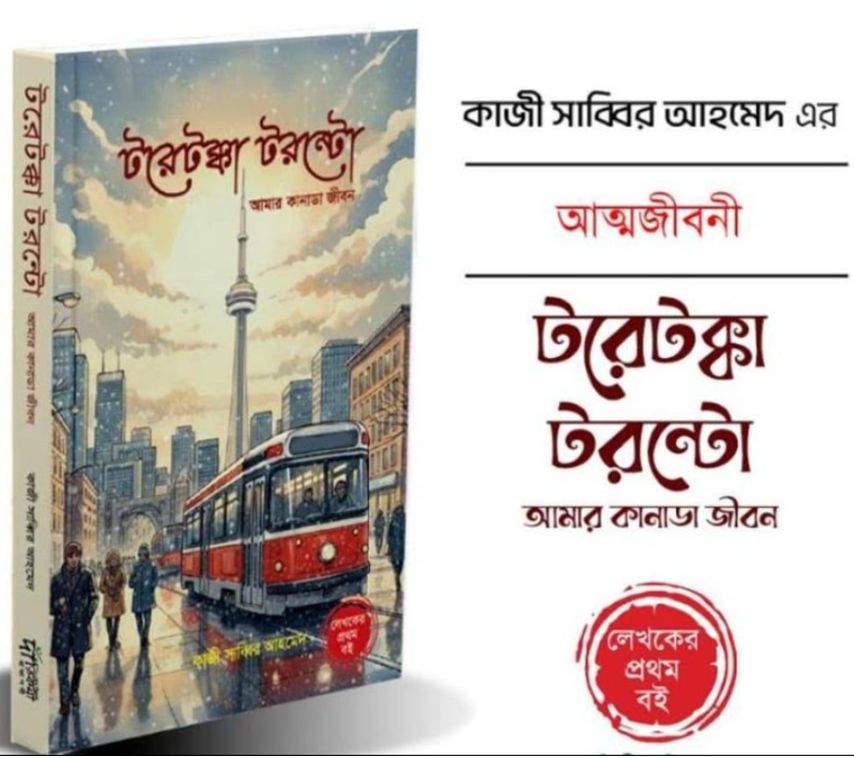
Toretokka Toronto: Amar Canada Jibon takes the reader on an intimate journey through the lives of immigrants in this cold yet promising land—capturing their struggles and successes, hopes and disappointments, and their determined march toward fulfilment. The book traces the author’s journey from Bangladesh to Singapore and then to Canada in search of a new life, weaving together his personal experiences with the many dimensions of immigrant life. The narrative begins with an explanation of why the author chose to leave behind the opportunity of permanent residence in the developed country of Singapore and instead travel to distant Canada, setting the tone for a deeply personal account.
The book presents both the positive and darker sides of Canada. Alongside discussions of Canada’s healthcare system, education, employment opportunities, social security, and natural beauty, it also examines unsettling chapters such as the Begumpara scandal, racism, Islamophobia, and state-imposed injustices against Indigenous peoples. While Canada offers immigrants opportunities to establish themselves, it also confronts them with harsh realities. To overcome these challenges, certain qualities are essential—such as the courage to take risks and the ability and preparedness to adapt quickly in adverse situations. Drawing on his own experiences, the author elaborates on these indispensable traits. The book also explores how one can build a career aligned with personal qualifications in Canada while simultaneously raising a well-educated second generation.
Most immigrant families come to Canada in the hope of securing a better and safer future for their children. This book highlights both the strengths and limitations of Canada’s education system. On one hand, it offers free, mandatory education up to Grade Twelve, along with social supports such as breakfast programs in primary schools and after-school programs. On the other hand, structures like “streaming” and “gifted programs” categorize children at an early stage, often deepening socioeconomic inequalities.
The book also places strong emphasis on language and identity. The author makes a reasoned appeal to keep children connected to their mother tongue, history, religious values, and culture. At the same time, he cautions against immigrant children developing a sense of inferiority toward their parents or their own culture due to accent, profession, or social status. By combining lived experiences of raising children in immigrant families, structural analysis of the education system, and the struggle to preserve ethnic identity, the book transcends a personal memoir and becomes a collective document of the immigrant experience.
Due to the pressures of livelihood, first-generation immigrant parents often fail to maintain sufficient emotional connection with their children. This distance can gradually deepen, leading to depression, harmful habits, and identity crises among children. The book cites several tragic examples of suicide and family violence involving Bangladeshi youth in Canada and the United States, illustrating how emotional distance and excessive academic pressure can lead to devastating consequences.
As a remedy, the author emphasizes the importance of building a functional family, drawing on the family philosophy of the ancient Chinese thinker Confucius and Islamic values to explain the need for a balance between responsibility, authority, mutual respect, and love. Respect for each family member’s opinions, transparent decision-making, open discussion, and spending joyful time together are identified as the foundations of a healthy family.
Parents are advised against imposing their unfulfilled dreams on their children’s education and career choices. Ignoring children’s interests and abilities and focusing solely on outcomes and “safe” careers can leave them directionless, sometimes with extreme consequences. Instead of coercion, the author stresses the need for professional counselling.
The book highlights the importance of sports, regular physical activity, and open communication for mental and physical well-being. It also underscores the necessity for Muslim children in Western societies to receive religious education, develop critical thinking, and understand contemporary world politics, so they do not drift toward extremism or self-destructive paths.
While discussing career development, the author explains that Canada is a welfare state with various social safety nets designed to ensure citizens’ basic needs. However, to establish oneself as a proud, tax-paying Canadian, every immigrant must build a career of their own—this career forms the foundation of immigrant life. There is no easy path for a newcomer to build a desired career, but there are government-approved agencies that provide free job-search training, interview skills, Canadian résumé preparation, and networking guidance.
Two fundamental lessons for new immigrants are emphasized: no job is considered small in Canada, and “searching for a job is a full-time job.” Building a successful career in Canada is not a matter of luck; rather, it depends on patience, perseverance, a willingness to learn quickly, and staying committed to the right career path.
The book also provides a comprehensive account of how Islam is practiced in Canada, particularly in Toronto. In the early days, the first obstacle faced by Muslim settlers was the lack of mosques. The history of how Canada’s first mosque—and subsequently Toronto’s first mosque—was established is detailed. Building mosques in Canada was never easy; financial constraints, internal conflicts within mosque committees, objections from municipal authorities, and social resistance from political and influential groups all stood as barriers.
Yet, overcoming these obstacles one by one, Toronto has now become a city of mosques. As a result, a significant portion of the immigrant Muslim community has been able to adopt a mosque-centred lifestyle and strive to manage their lives according to Islamic financing guidelines. Since Islam prohibits riba (interest), many face serious dilemmas when it comes to purchasing homes through bank loans. Some accept conventional mortgages under necessity, while others avoid them entirely and choose a difficult life in rented housing—often affecting their children’s mental and social development.
The author analyses the methodological differences and limitations between conventional banking and Shariah-based Islamic financing, questioning the credibility of so-called “halal mortgages.” Citing incidents such as the fraud involving Toronto’s UM Finance, he argues that customers of these “halal mortgages” are not protected by Canadian banking laws. Due to the lack of trustworthy and affordable halal mortgage options, many Muslim families are forced to refrain from home ownership, effectively choosing a form of “voluntary ghettoization.”
Curiosity about Canada’s “Begumpara” is widespread among people in Bangladesh. This is because the wives of certain fraudsters and loan defaulters from Bangladesh have settled in Canada and live luxurious lives in mansion-like homes purchased with their husbands’ illicit wealth. They have been joined by fugitive criminals such as PK Halder, often referred to as a “currency monster.”
The book details how these three groups exploited bank loans, capital markets, and state systems to launder thousands of crores of taka abroad and establish safe havens in Canada and elsewhere. It also notes how incidents such as the sale of a goat for 1.5 million taka by Sadeq Agro, along with images of the lavish lifestyles of powerful families in Canada, fuelled public outrage and intensified the ongoing “July Movement.” The political outcome of this movement—the fall of Sheikh Hasina’s fascist government—is also discussed in detail.
The author raises questions about how Bangladeshi money launderers have turned Canada into a “safe haven” by exploiting its flexible immigration and real estate policies, while expressing hope that social resistance and awareness within the Diaspora can help build effective public opinion against this predatory class.
One of the most profound chapters of the book is titled Second Life. After being diagnosed with blocked heart arteries, the author underwent open-heart bypass surgery at Toronto General Hospital and spent fifteen days hospitalized. His account of this experience reveals the intricacies of Canada’s healthcare system and the dedication of doctors and nurses in fulfilling their duties, offering readers a clear understanding of the quality of Canadian healthcare.
Toretokka Toronto: My Life in Canada concludes with an immigrant’s timeless longing to return to their homeland. In reality, however, returning is often not easy, and in many cases, immigrants are unable to go back. Yet their souls remain bound to their birthplace by an invisible thread. The author presents poignant examples of how the inability to return slowly consumes immigrants from within, expressed in deeply moving language.
Kazi Sabbir Ahmed’s language is simple, heartfelt, and grounded in reality. In this autobiography, the warmth of humanity felt amid Canada’s cold climate lingers with readers long after they finish the book. This work stands simultaneously as a document of immigrant life, an instructive narrative for the new generation, and a valuable repository of information for those interested in immigrating to Canada.

Kazi Sabbir Ahmed
Kazi Sabbir Ahmed was born in Dhaka in 1967 and grew up there. He completed his education up to Class Seven in Dhaka and then studied at Rangpur Cadet College. With a scholarship from the Chinese government, he earned a bachelor’s degree in Computer Engineering from Beijing in 1992. He was an eyewitness to the historic Tiananmen Square massacre that took place in Beijing in 1989. In 2006, he immigrated to Toronto, Canada. He is working as a Software Engineering Manager at a leading Canadian bank. In 2025, his first book, Toretokka Toronto – Amar Canada Jibon, was published. He is currently working on his second book titled Beijing-er Sei DinGuli (Memoirs of Beijing).

