A Failed repatriation framework
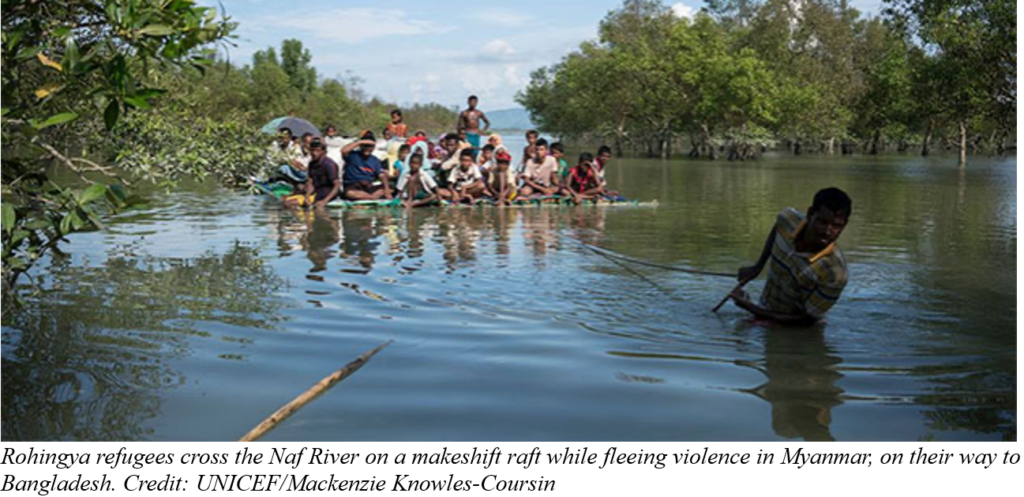
Nine years after the mass expulsion of Rohingya from Myanmar’s Rakhine State, repatriation remains the language of policy but not yet a credible pathway home. Bangladesh now hosts more than one million Rohingya refugees in Cox’s Bazar and Bhasan Char, while Myanmar has failed to create the conditions necessary for their safe return. What began as an emergency response has hardened into a protracted displacement crisis marked by statelessness, insecurity, aid dependency, and diplomatic fatigue. Repatriation is repeatedly presented as the preferred durable solution, yet every major attempt has failed because the core political issue remains unresolved: the Rohingya cannot safely return to a state that denies them citizenship, protection, and equal belonging.
The weakness of the repatriation process was evident from the beginning. In 2017, only months after the largest influx, Bangladesh and Myanmar signed a bilateral Memorandum of Arrangement. It committed both sides to a time-bound return process, but it was non-binding, weakly enforced, and silent on the guarantees, most essential to return: citizenship, freedom of movement, property restitution, and independent monitoring inside Rakhine. Bangladesh, under demographic, environmental, and political pressure, needed a pathway to reduce the burden of hosting refugees. Myanmar, by contrast, had incentives to delay, control, and symbolically manage the process without addressing the legal and security conditions that caused the exodus in the first place.
This asymmetry has shaped every subsequent negotiation: Bangladesh seeks relief from an unsustainable burden, while Myanmar offers procedural engagement without political rights and other entitlements. Further, Myanmar government disputes claims that more than one million people were displaced, asserting instead that roughly 540,000 crossed into Bangladesh during the 2017 crackdown while more than 200,000 remained in northern Rakhine. It claimed that the military had verified only 308,797 refugees in Cox’s Bazar as former residents of Rakhine State, branding the rest as “terrorists” or “Bengali” infiltrators.
In the past, three major repatriation efforts since 2017 have followed the same script. Attempts in 2018 and 2019 collapsed because refugees refused to return without credible guarantees of safety, citizenship, and dignity. A China-facilitated initiative in 2023 proposed a pilot return of several thousand refugees and arranged visits by Rohingya representatives to Rakhine for verification and confidence building. It too stalled.
Cyclone damage, renewed fighting, and widening armed conflict made even limited returns impractical. More importantly, refugees remained unconvinced. Their reluctance was not a rejection of return; it was a rational response to risk. Returning to fenced villages, transit camps, or tightly controlled areas without rights would merely convert exile in Bangladesh into containment in Myanmar. As per a recent press statement, Myanmar appears willing to receive verified former residents when the security situation in Rakhine becomes “more stable.”
Myanmar’s refusal and Rakhine’s fragmented power map
These failures reveal the central flaw in the repatriation agenda: it has prioritized the movement of refugees over the restoration of their rights. Successful repatriation cannot be measured by border crossings alone. For the Rohingya people, Myanmar’s 1982 citizenship framework, restrictions on movement, communal segregation, and discriminatory administration remain decisive barriers.
The 2021 military coup further weakened prospects for accountability and reform. Since then, Myanmar has fragmented into multiple conflict zones, and Rakhine has become a battlefield involving the Myanmar military, the Arakan Army, Rohingya armed groups, and other actors. The junta’s politics are rooted not in reintegration but in denial, demographic engineering, and security control. It has little incentive to readmit forcibly displaced Rohingya as rights-bearing citizens because doing so would challenge the nationalist Bamar narratives through which successive Myanmar regimes have excluded them. Bangladesh is therefore no longer dealing only with a reluctant state authority; it must also navigate a shifting territorial reality in which non-state actors’ control or contest areas central to any return.
The Arakan Army’s rise complicates the question further. Any future return to northern Rakhine will have to account for the authority that actually controls territory, checkpoints, land access, and local administration. Yet engagement with the Arakan Army cannot mean ignoring allegations of abuse, coercion, forced recruitment, movement restrictions, or denial of Rohingya identity. A repatriation framework that deals only with Naypyitaw may be irrelevant on the ground; one that deals only with de facto authorities may normalize a new structure of exclusion. This is the hardest diplomatic dilemma for Bangladesh and the international community: to recognize the facts of power in Rakhine without legitimizing another system that leaves the Rohingya people stateless, voiceless, and vulnerable.
Cox’s Bazar: Disaster, dependency, and humanitarian exhaustion
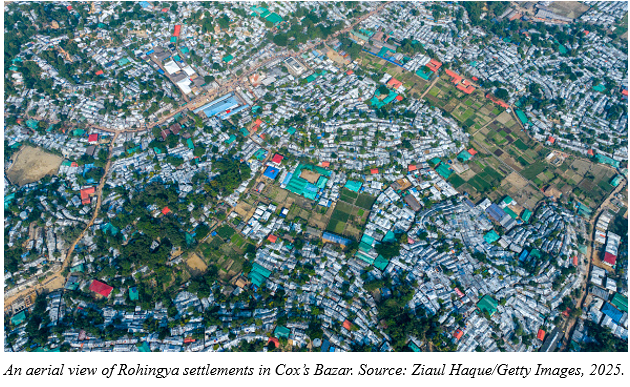
Life in Cox’s Bazar has become a cycle of displacement within displacement. The camps are not stable settlements; they are fragile slopes, narrow pathways, plastic-and-bamboo shelters, congested drainage channels, and crowded communal facilities exposed to repeated shocks. Monsoon rain turns footpaths into mud, saturates deforested hillsides, collapses retaining walls, contaminates water points, and cuts families off from health posts, learning centres, food distribution sites, and protection services.
Floods do more than damage shelters; they erase the few possessions refugees have rebuilt after earlier losses. Landslides are especially dangerous because many shelters cling to unstable slopes where families sleep under the constant risk that the hill above them may give way at night. Fires add another layer of insecurity. In camps where shelters are built close together and cooking fuel, tarpaulin, bamboo, and electrical wiring sit side by side, a small flame can race through blocks in minutes, destroying homes, documents, food stocks, learning spaces, clinics, and memories. For a population already stripped of citizenship and property in Myanmar, each flood, fire, or mudslide reproduces the original trauma of loss.
The disaster risks are not natural hazards alone; they are political outcomes. The camp landscape was created in haste, under pressure, and without the land, infrastructure, or legal permanence needed for dignified life. Refugees cannot freely move, work, build durable homes, or plan futures, while humanitarian agencies are asked to maintain minimum survival standards in a shrinking aid environment. Funding cuts weaken slope stabilization, drainage maintenance, access roads, health preparedness, child protection, and community-based disaster response. The result is a cruel paradox: the more the international community accepts the camps as temporary, the longer people remain trapped in unsafe temporariness. Cox’s Bazar has become a humanitarian holding zone where climate risk, statelessness, poverty, and diplomatic stagnation clearly converge.
Bangladesh’s burden and strategic dilemma
Bangladesh’s position has become increasingly difficult. Its initial humanitarian generosity has become a long-term national burden. The camps place pressure on land, forests, water, public services, and local labour markets. Security concerns have grown as trafficking, armed activity, and criminal networks exploit a population with limited mobility, education, and livelihood opportunities. Declining humanitarian funding has deepened frustration: reduced food rations, health services, and education increase despair and encourage dangerous onward movement by sea to Indonesia, Malaysia, and Thailand, where conditions are also precarious and hostile.
Political transition in Dhaka has added another layer of uncertainty. The current authorities have inherited a massive internal and external crisis without the fiscal space, administrative coherence, or regional leverage needed to offer a clear direction. The new government must reassure host communities, contain security risks, negotiate with Myanmar’s fractured authorities, coordinate with donors, and protect refugees from disaster and deprivation at the same time. Yet Bangladesh’s legitimate burden cannot justify premature repatriation. Any return must be voluntary, safe, rights-based, and dignified.
This is where the crisis intersects with Bangladesh’s own political fragility. The newly elected government is trying to deal with the crisis, but it cannot easily manufacture leverage over a collapsing neighbour or persuade exhausted donors to fund an open-ended emergency. Nor can it offer full local integration without facing domestic backlash from host communities who already perceive unequal attention, rising prices, environmental damage, and insecurity. Without a credible national strategy, the Rohingya question risks becoming an arena of blame: Dhaka blames Myanmar, Myanmar blames insecurity, donors cite limited resources, regional powers invoke instability, and refugees remain trapped between these explanations.
Bangladesh’s role must therefore be understood in two ways: as the frontline host state and a diplomatic actor without strong allies supporting repatriation without rights. As host, it has provided territory, emergency protection, administrative coordination, policing, health services, vaccination campaigns, disaster response, and space for one of the largest humanitarian operations in the world. It must also balance refugee protection with the anxieties of host communities in Ukhiya and Teknaf, where local residents face pressure on wages, forests, roads, water, prices, and public services. The burden is not only financial; it is political and social. The longer the crisis continues, the harder it becomes for any government in Dhaka to preserve public sympathy while resisting coercive or unsafe repatriation.
At the same time, Bangladesh has limited policy space. Full local integration is politically sensitive and could create domestic backlash, yet indefinite encampment deepens dependency, insecurity, and despair. The government’s restrictions on movement and formal employment reflect real concerns about sovereignty, security, and local labour markets, but they also leave refugees without lawful ways to support themselves. This dependency makes aid cuts especially dangerous. When food, health, education, and protection services shrink, the consequences extend beyond the camps: trafficking networks expand, child labour and early marriage risks rise, criminal groups gain influence, and irregular boat journeys increase. Bangladesh is then expected to manage the very security risks that prolonged exclusion and underfunding help produce.
Diplomatically, Dhaka has pursued every available channel—bilateral talks with Myanmar, Chinese facilitation, engagement with the United Nations, appeals to Western donors, and regional outreach through ASEAN and neighbouring powers. Yet Bangladesh’s leverage remains weak because the crisis originated in Myanmar and the conditions for return must be created inside Rakhine. Dhaka cannot confer Myanmar citizenship, rebuild destroyed villages, guarantee freedom of movement, or ensure protection from the junta, the Arakan Army, or other armed groups. Its diplomacy therefore oscillates between urgency and dependence: it must push for repatriation to satisfy domestic and strategic pressures, but it must rely on external actors who have repeatedly shown limited willingness to impose costs on Myanmar or create enforceable guarantees.
The crisis also tests Bangladesh’s border management and national security capacity. Renewed fighting in Rakhine creates periodic cross-border tension, continuing arrivals, fears of arms movement, and pressure on border guards and local administration. Dhaka must avoid being drawn into Myanmar’s internal conflict while still protecting its territory and managing practical contact with whichever authority controls the opposite side of the border. Engagement with the Arakan Army may become unavoidable for humanitarian access, the release of fishermen, border incidents, or future return arrangements, but such engagement is diplomatically delicate. Too much contact risks angering Naypyitaw; too little may leave Bangladesh without influence over the actors now shaping conditions in northern Rakhine.
Environmental management is another area where Bangladesh carries costs that are often underestimated internationally. The rapid expansion of camps transformed forested hills into dense settlements, increasing pressure on groundwater, fuel, waste systems, drainage, roads, and disaster-risk infrastructure. Host communities see erosion, congestion, and competition for services, while refugees remain exposed to floods, fire, cyclones, and landslides. Bangladesh is expected to prevent humanitarian catastrophe in one of the world’s most climate-vulnerable coastal zones, but it cannot do so sustainably without predictable financing, stronger development support for host communities, and international recognition that environmental repair is part of burden-sharing, not a local administrative matter.
Geopolitical gridlock and the road ahead
A critical analysis must also recognize the limits of humanitarianism. Aid keeps people alive, but it cannot resolve statelessness or political exclusion. The international response has often separated relief, justice, and diplomacy into disconnected tracks: humanitarian agencies sustain survival in Bangladesh; lawyers pursue accountability; diplomats negotiate repatriation frameworks; and development actors support host communities. Each track is necessary, but together they have not formed a coherent strategy. The Rohingya have too often been treated as beneficiaries rather than political stakeholders. A durable solution requires their participation in defining return conditions, monitoring mechanisms, citizenship pathways, education policy, and community security arrangements.
The failure is also institutional and geopolitical. The United Nations has documented abuses, appealed for funds, convened conferences, supported humanitarian operations, and called for voluntary and dignified repatriation, but it has not been able to convert moral language into enforceable political action. The UN Security Council remains constrained by the strategic calculations of powerful members, especially those unwilling to support measures that could seriously pressure Myanmar’s military authorities. As a result, resolutions, statements, and humanitarian plans have kept the issue visible without changing the balance of power that sustains displacement.
Great powers have treated the Rohingya crisis less as a test of international responsibility than as a secondary file within broader contests over China’s influence, India’s border and security interests, Russia’s ties with Myanmar’s military, Western sanctions policy, ASEAN’s non-interference culture, and access to the Bay of Bengal. The result is a diplomacy of minimum consensus: enough aid to prevent total collapse, enough statements to signal concern, but not enough collective pressure to compel citizenship reform, accountability, or safe return. For the Rohingya, international attention rises during anniversaries, disasters, donor conferences, or new violence, then fades again into procedural language and funding appeals.
The road ahead must be realistic rather than rhetorical. Repatriation should remain the long-term objective, but only when it is voluntary, safe, dignified, and sustainable. This requires verifiable changes inside Rakhine: citizenship or a credible pathway to citizenship, freedom of movement, access to services, restoration of or compensation for property, and protection from military, police, and armed-group abuse. Any future framework must include independent international monitoring with meaningful access to return areas. Diplomacy must also adapt to Myanmar’s altered conflict map by engaging relevant actors without legitimizing abuses or abandoning principles. Bangladesh will need pragmatic but principled engagement with the junta, the Arakan Army, regional powers, and international organizations, while insisting that no actor’s search for legitimacy should come at the cost of Rohingya rights.
Meanwhile, the camps in Bangladesh cannot remain waiting rooms for an indefinitely delayed return. Refugees need education, skills training, legal protection, and limited livelihood opportunities to prevent social deterioration and prepare for eventual reconstruction in Rakhine. These measures should not be framed as local integration against Bangladesh’s wishes, but as human-capital preservation and crisis management. International burden-sharing must also become concrete: donors should sustain aid, expand resettlement for vulnerable cases, support host communities, and coordinate pressure on Myanmar. Accountability mechanisms should continue because impunity is one reason repatriation remains unsafe.
Ultimately, the Rohingya repatriation crisis is not a logistical failure but a political one. Buses, refugee lists, reception centres, and pilot projects cannot substitute for rights, security, and recognition. Bangladesh seeks relief, Myanmar seeks control, regional powers seek stability, and donors seek a manageable humanitarian file. The Rohingya, however, seek what repatriation is supposed to guarantee: return to their homeland as citizens with dignity. Until diplomacy is anchored in that principle, repatriation efforts will continue to produce announcements without arrivals, agreements without trust, and roadmaps without roads.
The way forward requires pressure, patience, and a decisive shift from counting potential returnees to creating the conditions inside Myanmar that make return safe, voluntary, and just. To achieve this, Dhaka must intensify its bilateral, regional, and international efforts to prevent Naypyidaw from turning repatriation into a political performance, and to ensure that return becomes a restoration of justice rather than an act of desperation.

Mohammad Zaman
Dr. Mohammad Zaman is an internationally known development/ resettlement specialist. He has worked in many major projects for the World Bank in Bangladesh and in other countries in Asia and Africa. Dr. Zaman’s most recent edited book (co-editor Mustafa Alam) is titled Living on the Edge: Char Dwellers in Bangladesh, Springer, 2021. E-mail: mqzaman.bc@gmail.com