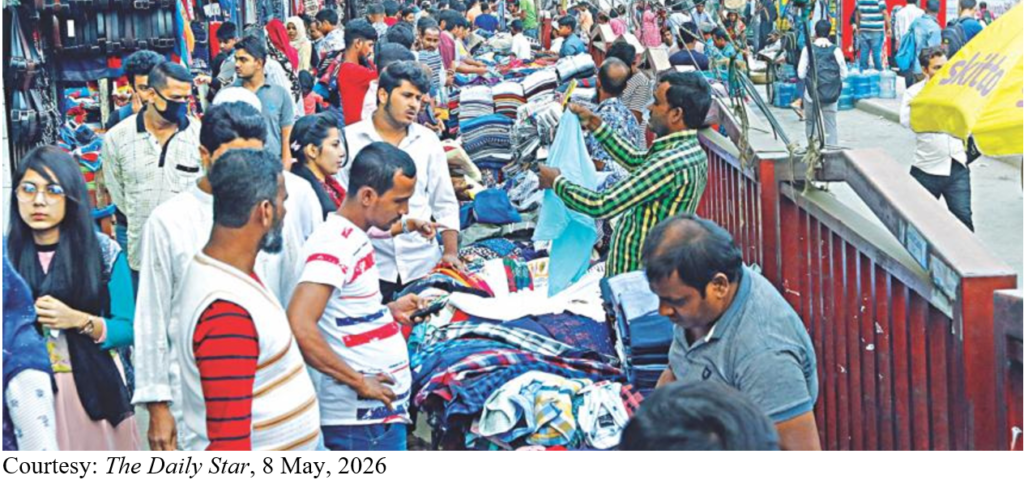
The government has recently drawn up a guideline to regulate street vendors in the capital ostensibly aimed at reclaiming footpaths and roadsides. The “Dhaka City Hawker Management Policy‑2026”, by the City Corporation‑1 Branch of the Local Government Division was gazetted on 6 May, 2026. The management policy is supposed to ease pedestrian and traffic movement while also bringing discipline to the trade for the welfare of hawkers.
Under the new hawker management policy, hawkers will need to register formally with the city corporation by paying a one-off fee of Tk 5,000, an annual renewal fee of Tk 2,500 and a monthly charge of Tk 3,000 for space use and waste management. Once registered, a hawker will receive a barcode or QR-coded digital ID card fixing their business location and hours and registration will be tied to the designated location so that hawkers cannot shift elsewhere to do business. Applicants must be Bangladeshi citizens aged 18 or above and the city expects the system to be running within two weeks.
On 17 August 2026, Dhaka South City Corporation (DSCC) brought together hawker leaders, police officials and journalists to Nagar Bhaban for exchanging views on a new way of managing street hawking in the capital. Chaired by DSCC Administrator Md. Abdus Salam, the meeting laid out the first details of the Hawker Management Policy for Dhaka City 2026, a policy that supposedly will shape how thousands of hawkers earn their living in the months ahead.
Cycles of evictions and reoccupying
The first ever “hawker management policy” followed a massive drive in the first week of April by Dhaka Metropolitan Police (DMP) to clear encroached footpaths and roads. At least 44 people were arrested, and around Tk 10 lakh was realized in fines during the drive from April 1 to April 5.
However, shortly after the eviction drive, hawkers retook footpaths and the capital’s streets are once again caught in a complicated standoff between urban order and livelihoods. Three weeks after the eviction drive, Adnan Zillur Morshed wrote on 27 April, “Amid an eviction drive that started earlier this month and subsequent re-occupation attempts by aggrieved hawkers, we have seen calls for a proletarian revolution: shara Banglar hawker ek hao, lorai koro … bhat de, kaj de, noile hawker boshte de (“Hawkers of the country, unite—fight on… give us food, give us work, or at least let us sit on the footpath and sell”). Marx would have agreed with them”.
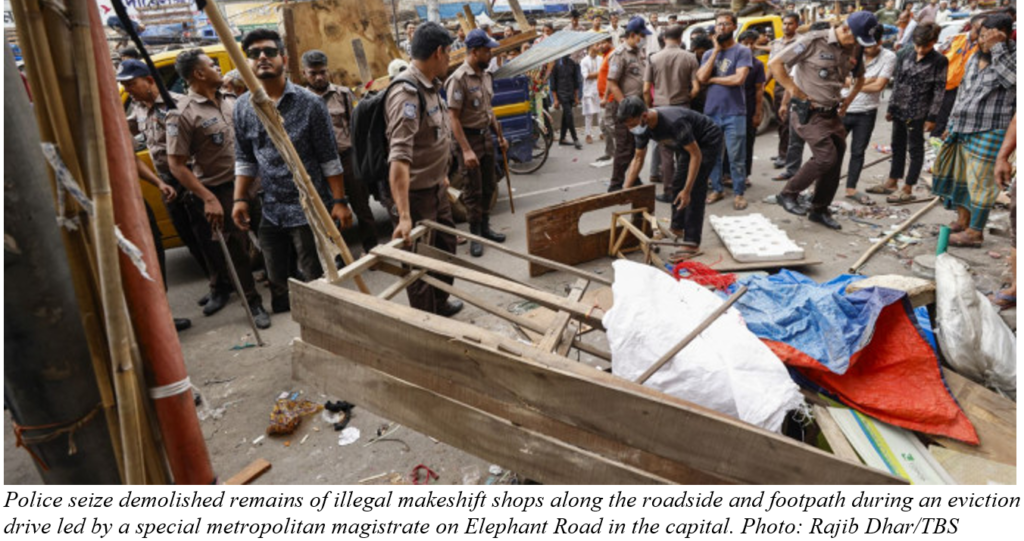
Neil Ray, in his 20 April opinion piece, exposed cynicism involved in the hawker eviction drives as every “new governments had embarked on similar exercises in the past without ever achieving the stated objective”. He emphasized, “Before launching such a drive there is a need for recognising the plight of the hawkers. Why do they come back every time they are evicted? It is because the small businesses in most cases are the only source of income, the mainstay of their livelihoods. No authorities have ever wanted to know how many of them are solely dependent on footpath vending”.
In an opinion piece, published on 2 September, Prattayee Chakma highlighted, “Repeated hawker evictions hit low-income people in Dhaka”.
Hawker statistics
There is no formal list of hawkers, but the Bangladesh Hawkers’ Federation estimates the number at over two lakh in the Dhaka city. The Labour Force Survey 2024 of the Bangladesh Bureau of Statistics put the country’s total labour force at 6.91 crore. An overwhelming 5.80 crore (84%) are engaged in informal employment that mainly constitutes hawker’s job, along with many other occupations.
Tanmoy Datta (School of Business, Chittagong Independent University) provided a brief sketch of Bangladeshi city hawkers’ socio-economic condition. According to him, street hawkers are predominantly male (87.5-94%), young (many under 30), and from low-education backgrounds, with 23-38% illiterate and large family sizes averaging 4-6 members. Their monthly incomes are low, often below Tk.10,000, with minimal savings (16.9% have none) and initial investments under Tk.30,000 (mostly by borrowing from relatives).
Street hawkers sell items like clothing (36%), food (21%), and plastics (20%), relying on self-employment or family labour. In big cities like Dhaka, Chittagong, Narayangonj rural migrants dominate (55%) who are driven by poverty, lack of formal jobs and unstable livelihoods.
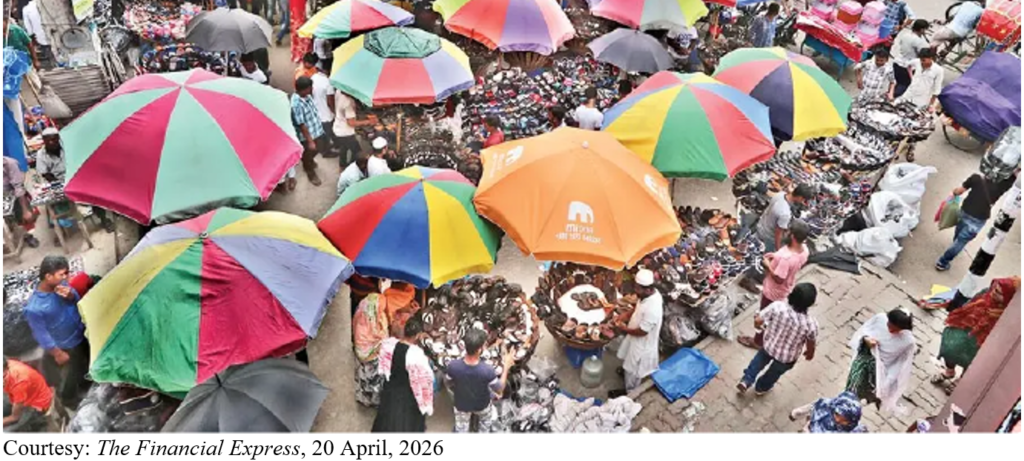
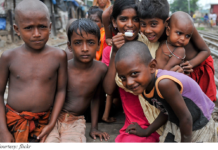
Hawkers eke out a living by selling everyday goods on footpaths and other informal spaces. For many, this is not a matter of choice or convenience but a survival strategy in an economy that has failed to generate enough productive employment to absorb its growing labour force.
Simply evicting hawkers may restore order to footpaths, but it does not resolve the underlying economic problem. Behind every hawker is often a family dependent on that modest income for food, education, rent and other necessities. Removing the livelihood without providing a viable alternative merely shifts the burden from the streets to already vulnerable households.
The fundamental question, therefore, is not simply how to remove hawkers from the footpaths, but why so many people have been forced to depend on precarious informal livelihoods in the first place.
Economic Insecurity: Pandora’s Box and a Root of Social and Political Instability
At the heart of many of Bangladesh’s persistent problems lies a fundamental economic reality: a weak economy breeds multifaceted problems; a strong and inclusive economy creates the means to solve them.
Widening inequality, unemployment, inadequate livelihoods, rising living costs and social unrest do not arise in isolation. They are intensified when the economy fails to generate sufficient growth for productive employment, decent incomes and economic security for its growing population. When millions struggle simply to survive, economic insecurity can spill over into social frustration, dependency, patronage and, ultimately, social and political instability.
The larger crisis of employment
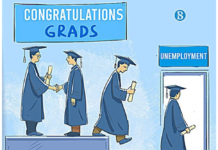
The problem extends far beyond hawkers and the informal economy. Bangladesh also faces the difficult reality of educated young people: school, college and university graduates struggling to find meaningful employment. When education does not translate into economic opportunity, frustration and a sense of exclusion can deepen, particularly within a large and youthful population.
The combination of informal survival employment, unemployment and underemployment represents a much larger economic challenge. Economic insecurity can weaken social cohesion, encourage dependency and patronage, and create fertile ground for frustration and instability.
Growth, governance and the resource constraint
These problems cannot be separated from the broader condition of the economy. Political instability, corruption, weak institutions and inefficient resource allocation can discourage investment, constrain entrepreneurship and reduce the economy’s capacity to create productive employment.
When national resources are already scarce, their inefficient use carries an enormous opportunity cost. Every resource lost through corruption, patronage or waste is a resource unavailable for productive investment in infrastructure, education, healthcare, skills development and job creation.
Economic growth alone, therefore, is not enough. Growth must be inclusive, productive and capable of translating into livelihoods and economic security for ordinary citizens.
From eviction to economic absorption
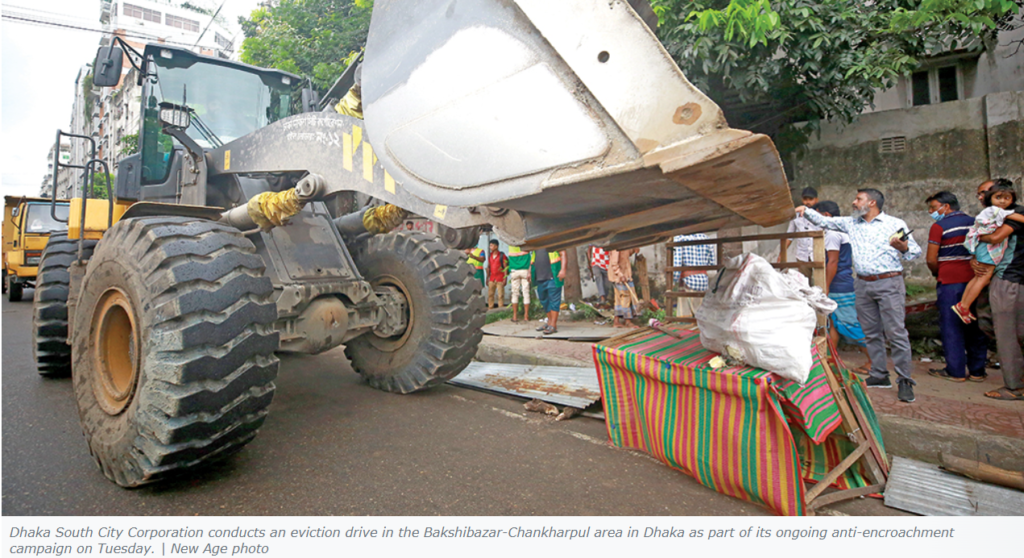
The long-term answer is not simply better management of footpaths. It is economic absorption: creating sufficient productive employment, supporting small and sustainable enterprises, and expanding opportunities so that people are not compelled to depend on precarious informal work merely to survive.
Urban order matters, but so does economic justice. A humane and sustainable approach can combine orderly cities with designated spaces, affordable licensing, access to finance and skills, while addressing the deeper issue: building an economy capable of providing better and more secure opportunities.
The question we should ask is not merely, “Why are so many people selling things on the streets?” It is “Why has the economy been unable to provide them with better alternatives?”
That is the deeper economic and social question.
A strong economy is the foundation of a stable society
A strong and inclusive economy does more than increase GDP. It expands people’s choices, creates livelihoods, reduces economic dependency and gives citizens a greater stake in social stability. Sustainable employment, decent incomes, affordable essential services and economic opportunity provide the foundation for dignity and security.
Conversely, when economic insecurity becomes widespread, social problems multiply and political tensions can intensify. A weak economy limits the resources available to address problems; a stronger economy expands the capacity of both citizens and the state to address them.
In simple terms: a weak economy breeds problems; a strong economy provides the means to solve them. The economy is therefore the key to addressing many of Bangladesh’s deepest social and political challenges.
A national challenge requiring collective action
This is ultimately a national challenge, not a partisan one. Political leaders across the spectrum, together with civil society leaders, professionals, intellectuals, economists and other stakeholders, need to join hands in confronting these deeply rooted economic and social challenges.
Economic vulnerability does not respect political boundaries. When livelihoods become insecure, unemployment rises and inequality widens, the resulting frustration and social unrest can affect society as a whole. No segment of society should assume that it will remain insulated from the consequences of prolonged economic insecurity.
It is therefore in our collective national interest to confront these problems honestly and constructively, not merely by managing their visible symptoms, but by addressing their underlying causes.
The objective should be clear: an inclusive economy that creates opportunity, expands productive employment, protects livelihoods and enables citizens to live with dignity and economic security.
Ghulam Rabbani
A Freedom Fighter from Sector 9, is an international banker with experience across continents and a graduate of the University of Canterbury, New Zealand. His career reflects a blend of dedication to national service and expertise in global finance.