
Dhaka is one of the world’s fastest-growing megacities. As the political, economic, and administrative centre of Bangladesh, it attracts hundreds of thousands of migrants every year. It is struggling with traffic congestion, inadequate infrastructure, environmental degradation, flooding, waste management challenges, and growing demands for public services. For ordinary residents, the quality of urban governance is not measured by policy documents but by whether roads are usable, waste is collected on time, mosquito infestations are controlled, drains function during heavy rain, and public spaces remain accessible.
Urban governance in Dhaka is complicated because responsibility for service delivery is fragmented among numerous agencies, including city corporations, utility providers, transport authorities, and national ministries. Within this complex environment, the division of the former Dhaka City Corporation (DCC) into Dhaka North City Corporation (DNCC) and Dhaka South City Corporation (DSCC) in 2011 represented one of the most significant institutional reforms in Bangladesh’s urban governance history. The official expectation was that smaller administrative units would improve efficiency, accountability, and service delivery.
This article examines whether that expectation has been realized. It compares DNCC and DSCC from the perspective of residents and taxpayers, evaluates their financial and institutional capacities, and conducts an in-depth analysis of solid waste management and garbage collection, one of the most visible and consequential municipal functions affecting daily urban life.
The central argument is that while the division created opportunities for more focused management, structural constraints, fragmented governance, uneven revenue capacity, and rapid urban growth continue to limit performance in both corporations. However, important differences have emerged, with DNCC generally benefiting from greater fiscal capacity and newer urban infrastructure, while DSCC faces the additional burden of managing a denser, older, and more complex urban environment.
From one corporation to two
Municipal governance in Dhaka dates back to the establishment of the Dacca Municipality in 1864. Over time, the institution evolved into Dhaka Municipal Corporation and eventually Dhaka City Corporation (DCC), which became responsible for a growing metropolitan population.
By the late 2000s, Dhaka had become one of the world’s largest megacities. The single city corporation struggled to manage increasing demands for sanitation, road maintenance, drainage, public health, and urban services. Concerns regarding administrative inefficiency, limited responsiveness, and management complexity contributed to calls for institutional reform.
In November 2011, Parliament approved legislation dissolving DCC and creating two separate entities:
- Dhaka North City Corporation (DNCC)
- Dhaka South City Corporation (DSCC)
The government argued that bifurcation would bring government closer to citizens, improve administrative efficiency, and enhance service delivery. Each corporation would have its own mayor, council, budget, and administrative apparatus.
The reform was expected to make city governance more efficient and citizen-focused. By bringing decision-making closer to local communities, both city corporations were anticipated to respond more quickly to public needs, improve access to essential services, strengthen transparency and accountability, and manage the growing challenges of urban development more effectively. Yet the results have been mixed. Early assessments suggested that many residents observed little immediate improvement in service quality despite the institutional restructuring.
Snapshot of the two city corporations
| Indicator | DNCC | DSCC |
| Origin | Created from DCC split in 2011 | Created from DCC split in 2011 |
| Urban Character | Newer and expanding urban areas | Historic core of Dhaka |
| Wards | 54 | 75 |
| Population | Large and rapidly growing | Slightly smaller but denser |
| Population Density | Lower relative density | Significantly higher density |
| Land Use Pattern | Planned residential and commercial zones | Mixed-use historic neighbourhoods |
| Fiscal Capacity | Stronger revenue base | Comparatively weaker revenue base |
| Administrative Burden | Urban expansion management | Aging infrastructure and congestion |
| Major Responsibilities | Roads, drainage, waste, public health, licensing | Same |
A key difference lies in economic geography. High-value commercial districts, major business centres, and many high-income residential areas are located in DNCC. Consequently, DNCC enjoys a stronger revenue-generating base. Former DSCC officials have argued that roughly 60 percent of the revenue potential of the former DCC was allocated to DNCC, while DSCC inherited greater expenditure burdens associated with older infrastructure and denser settlements.
Functions and financial capacity
Despite serving different parts of Dhaka, both city corporations carry out largely the same core responsibilities. Their duties include managing solid waste, constructing and maintaining roads, improving drainage systems to reduce waterlogging, providing street lighting, controlling mosquitoes and other disease vectors, issuing trade licenses, registering births and deaths, operating public markets, maintaining parks and recreational facilities, and delivering various community services.
To finance these activities, the two corporations rely on a combination of locally generated revenues and external funding. Their main own-source income comes from holding and property taxes, trade license fees, property transfer fees, user charges, market rents, and vehicle and rickshaw licensing fees. However, like many urban local governments in developing countries, both DNCC and DSCC remain heavily dependent on central government transfers, development grants, and donor-supported projects to fund major infrastructure and service improvements. Recent budgets reflect the substantial scale of their operations. For FY2025-26, DNCC approved a budget of approximately Tk 6,069 crore, while DSCC’s budget ranged from around Tk 3,841 crore to more than Tk 6,700 crore, depending on whether externally financed development projects were included. These figures underscore the significant financial resources required to govern and serve one of the world’s largest and most densely populated urban regions.
Fiscal autonomy
Although city corporations generate substantial local revenue, their fiscal autonomy remains limited. Large infrastructure projects often depend on national government approval and donor financing. Many key urban functions, including water supply, transportation planning, electricity distribution, and land-use regulation, remain under separate agencies.
For residents, this fragmented governance creates confusion regarding responsibility. Citizens often blame city corporations for failures that are partially controlled by other agencies. Similar institutional fragmentation has long been identified as a major weakness in Dhaka’s urban governance system.
Impact on service delivery
Financial strength plays a critical role in determining how effectively a city corporation can deliver services and invest in urban improvements. With a relatively stronger revenue base, DNCC has greater flexibility to fund road development, modern waste management equipment, mosquito control initiatives, and the enhancement of public spaces. In contrast, DSCC faces the added burden of maintaining older and often deteriorating infrastructure while serving some of the most densely populated parts of the city. The area’s narrow roads, historic neighbourhoods, and intense development pressures require significant resources simply to maintain existing services, leaving less room for new investments and large-scale upgrades.
Comparative analysis of solid waste management
Why waste management matters
For many residents, waste collection is the most noticeable service provided by a city corporation. People may not always see the work involved in urban planning or infrastructure management, but they quickly notice when garbage is left uncollected. Effective waste management has a direct impact on public health, environmental conditions, neighbourhood cleanliness, and overall quality of life. When waste is not properly managed, it can clog drains, worsen waterlogging, create breeding grounds for mosquitoes, increase pollution, and raise the risk of disease outbreaks. For these reasons, waste management offers a useful way to compare the performance of Dhaka North City Corporation (DNCC) and Dhaka South City Corporation (DSCC).
Both city corporations are responsible for the full chain of municipal waste services, including primary collection from households, transportation of waste, street cleaning, operation of waste transfer facilities, and public awareness campaigns. Delivering these services requires coordination among municipal workers, community-based collectors, private contractors, and local neighbourhood organizations. At the same time, final waste disposal depends on larger metropolitan systems and cooperation among multiple public institutions.
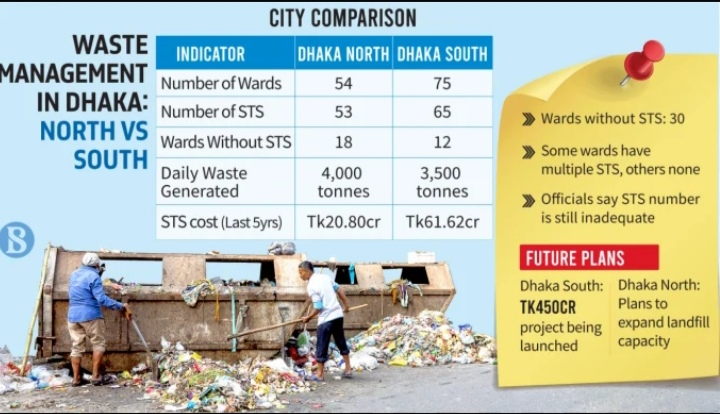
In terms of operational conditions, DNCC enjoys several advantages. Much of its jurisdiction consists of relatively newer and more planned urban areas, with wider roads and better accessibility for collection vehicles. Combined with a stronger financial position, these conditions make waste collection and transportation more efficient. Reflecting the importance of the sector, DNCC allocated more than Tk 436 crore for waste management activities in its FY2025-26 budget, demonstrating a substantial commitment to improving urban cleanliness and environmental health.
Residents of many neighbourhoods in northern Dhaka generally benefit from more predictable waste collection services. Wider roads and better-planned urban layouts allow collection vehicles to operate more efficiently, resulting in more regular pickup schedules and quicker responses when waste accumulates. These advantages help DNCC maintain cleaner streets and provide a more consistent level of service across many of its newer residential areas.
DSCC, however, operates under far more challenging conditions. Much of its jurisdiction includes the historic and densely populated parts of the city, where extremely narrow roads, mixed residential and commercial land use, informal waste disposal practices, and limited access for collection vehicles complicate daily operations. Although the corporation has increased spending on waste management and allocated more than Tk 57 crore for urban waste management programs in FY2025-26, the physical realities of the area make collection both more difficult and more expensive. Residents of Old Dhaka frequently express concerns about overflowing communal bins, congested collection points, delays in waste transportation, and increased waste accumulation during religious festivals and peak business seasons.
From a citizen’s perspective, the quality of waste management is judged less by budget figures and more by what people experience in their neighbourhoods. Residents tend to evaluate performance based on how often waste is collected, the cleanliness of streets, the presence of unpleasant odours, the condition of waste containers, the frequency of drain blockages, and how quickly authorities respond to complaints. In many DNCC areas, newer road networks and improved accessibility help ensure smoother service delivery. By contrast, many challenges faced by DSCC residents stem from the physical structure of the city itself. Even an efficient management system can struggle when collection vehicles cannot easily reach densely built neighbourhoods.
An important concern in both city corporations is the unequal distribution of service quality. Higher-income neighbourhoods often benefit from more frequent cleaning, better infrastructure, and stronger community oversight. Meanwhile, lower-income settlements and informal communities are more likely to face irregular waste collection, limited access to municipal services, and greater exposure to environmental health risks. This disparity is particularly pronounced in densely populated urban areas where informal settlements exist alongside commercial districts. For vulnerable residents, poor waste management is not merely an inconvenience; it directly affects health, safety, and overall quality of life.
Despite these challenges, both corporations have made notable progress. DNCC has strengthened its revenue generation, increased budget allocations for waste services, expanded the use of mechanized operations, and improved collection coverage in many of its newer wards. DSCC has continued to provide essential services under difficult physical conditions, increased investments in waste management, and taken steps to integrate waste management efforts with drainage and waterlogging reduction initiatives.
Nevertheless, significant challenges remain. Both city corporations continue to struggle with limited waste segregation at source, inadequate recycling systems, heavy dependence on landfill disposal, weak citizen participation, and coordination gaps among responsible agencies. Rapid population growth often outpaces improvements in service delivery, placing additional pressure on already stretched municipal systems. Moreover, waste management in Dhaka remains focused primarily on collecting and disposing of waste rather than recovering value from it. Opportunities for recycling, composting, and adopting circular economy approaches remain largely untapped, limiting the long-term sustainability of the city’s waste management system.
Performance scorecard
| Criterion | DNCC | DSCC |
| Efficiency | Higher | Moderate |
| Responsiveness | Generally stronger | Improving but constrained |
| Accountability | Moderate | Moderate |
| Transparency | Moderate | Moderate |
| Financial Sustainability | Stronger | Weaker |
| Inclusiveness | Mixed | Mixed |
| Service Quality | Generally better | Variable |
DNCC and DSCC show different strengths shaped by their urban contexts. DNCC generally performs better in areas where scale and resources matter most. It has stronger revenue generation capacity, more consistent investment in infrastructure, smoother waste collection logistics, and greater operational flexibility in adapting services across newer urban layouts. These advantages allow DNCC to respond more efficiently to growing service demands in many parts of North Dhaka.
DSCC, on the other hand, demonstrates strengths that come from managing some of the most complex urban conditions in the city. It has long experience dealing with extremely dense settlements, historic neighbourhoods, and mixed land-use patterns where residential, commercial, and informal activities coexist. In many cases, DSCC also plays a more active role in linking urban renewal efforts with everyday municipal service delivery, especially in older parts of the city where infrastructure upgrading and service provision must happen simultaneously.
At the same time, both corporations face a set of shared structural challenges. These include fragmented institutional responsibilities across agencies, heavy dependence on external funding sources, continuous pressure from rapid urbanization, growing environmental stress, and persistent gaps in meaningful citizen engagement. These issues limit overall efficiency and often slow down service improvements despite ongoing reforms.
Addressing these challenges requires a phased reform approach. In the short term, within one to two years, both city corporations can focus on practical improvements such as expanding digital complaint systems, publishing ward-level service performance data, improving the transparency of waste collection schedules, strengthening citizen feedback channels, and making municipal procurement processes more open and accountable.
In the medium term, over three to five years, deeper structural changes become necessary. These include introducing citywide waste segregation at source, expanding recycling and composting infrastructure, modernizing revenue administration systems, improving coordination among different agencies, and shifting toward performance-based budgeting to link spending more directly with service outcomes.
Over the long term, within five to ten years, more transformative reforms are required to ensure sustainable urban governance. These include establishing a metropolitan-level coordination authority, increasing fiscal autonomy for city corporations, integrating land-use planning with service delivery systems, adopting smart-city monitoring tools, and gradually building a circular urban waste economy with stronger participation from the private sector.
The division of Dhaka City Corporation into DNCC and DSCC was intended to improve urban governance by creating smaller and more manageable administrative units. More than a decade later, the evidence suggests that the split has produced some benefits but has not fundamentally resolved Dhaka’s urban governance challenges.
DNCC generally performs better in terms of fiscal capacity, infrastructure investment, and operational efficiency. Much of this advantage stems from its stronger economic base and relatively newer urban fabric. DSCC, meanwhile, faces the difficult task of serving the historic core of the city, where population density, aging infrastructure, and physical constraints increase the complexity of service delivery. In solid waste management, both corporations have made progress, yet neither has fully overcome the challenges created by rapid urbanization and fragmented governance. Citizens continue to judge performance through everyday experiences such as clean streets, functioning drains, timely garbage collection, and responsive local services. The key lesson is that institutional restructuring alone cannot guarantee better governance. Sustainable improvements require stronger finances, clearer accountability, enhanced coordination among agencies, citizen participation, and long-term investment in urban infrastructure. The future of Dhaka’s urban management depends less on whether there are one or two city corporations and more on whether those institutions are empowered, coordinated, and accountable enough to meet the needs of a rapidly growing megacity.

Ayesha Siddiqua Rumi
Currently pursuing Master’s degree at University of Dhaka. MSS 2nd Semester Department : Public Administration