

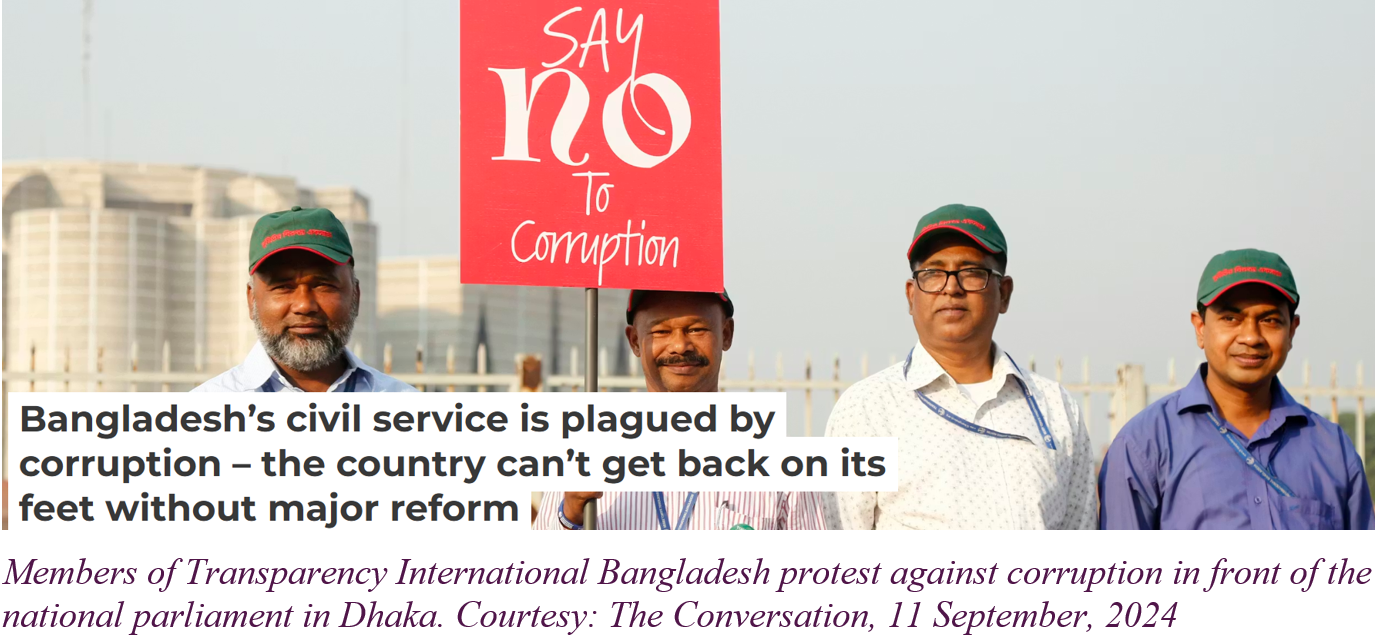
There is a particular kind of speech that gets delivered to capitals all over the world, with remarkable consistency across cultures and centuries. The speech typically includes statements such as: the previous administration was corrupt; the system is broken; we will restore trust; and we will have zero tolerance. The crowd applauds. The cameras flash. And then, with depressing regularity, no change is evident.
Recently deposed through popular uprising, Bangladesh’s Awami League (AL) Government declared “zero tolerance” against corruption in February 2019, shortly after returning to power. It is a phrase so familiar that it has almost lost meaning, not because the leaders saying it are necessarily lying at that moment, but because the forces that produce corruption are so much older, deeper, and more structurally embedded than any single government’s resolve. Understanding why corruption persists, despite genuine laws and real institutions, tells us something important about the difference between building a framework and building a culture.
The architecture of good intentions
Most people assume that corrupt countries simply lack the right rules. Provide them with better laws, stronger commissions, and independent courts, and the problem will disappear. This logic drives much of the international anti-corruption industry, and it is not entirely wrong. Rules do matter enormously. But Bangladesh is a revealing case study precisely because it does not lack rules. It has a remarkable stack of them.
There is the Prevention of Corruption Act dating to 1947. The Anti-Corruption Commission was created in 2004 with a broad mandate to investigate, prosecute, and educate. There has been a Right to Information Act since 2009. A Whistleblower Protection Law from 2011, making Bangladesh the first South Asian country to enact such legislation. A Money Laundering Prevention Act from 2012. A National Integrity Strategy. Government Servant Conduct Rules. A Public Procurement Act modeled on international standards. The list goes on and on.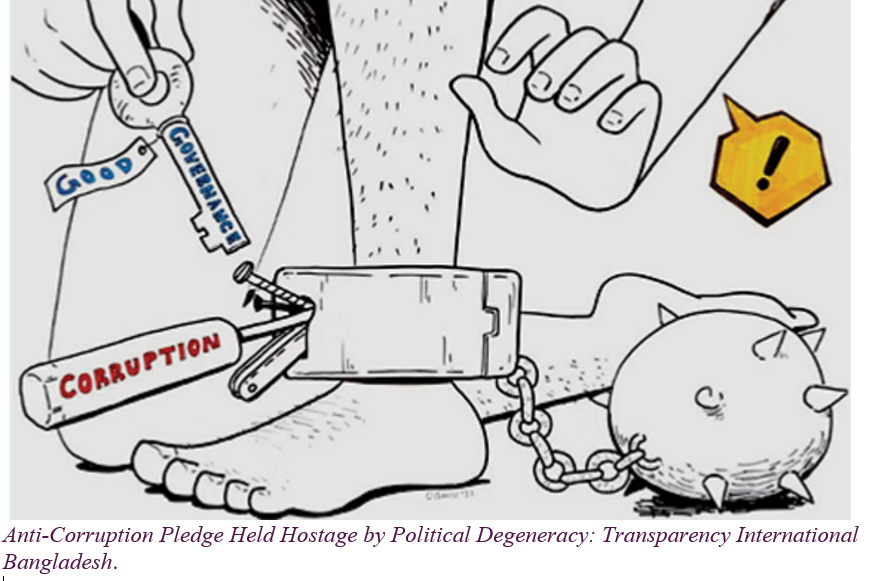
And yet, by Transparency International’s 2025 Corruption Perceptions Index, Bangladesh ranked 150th out of 182 countries, with a score that had dropped from the year before. Laws exist; corruption persists. Why?
The answer lies in a distinction that is easy to overlook: the difference between having institutions and trusting them. Laws on paper are inert until they are enforced, and enforcement requires people — people with incentives, careers, political loyalties, and fears. When those people operate inside a system where corruption carries low risk and high reward, the laws become theatrical props rather than real constraints.
When the referee joins the game
The most corrosive form of corruption is not the petty bribery that ordinary citizens experience daily—the speed money paid to process a document, the small payment to the rural police officer to avoid harassment. These are painful and humiliating, and they erode civic dignity in ways that are impossible to fully quantify. But petty corruption, at least, is visible and legible. Everyone knows what is happening.
 Grand corruption is something different. It operates at the heights of power, where the people responsible for enforcing integrity are the same people benefiting from its absence. In Bangladesh, researchers have documented a pattern where the ruling party uses the Anti-Corruption Commission (ACC) not as an independent watchdog but as a political instrument—pursuing opposition figures aggressively while shielding its own loyalists from prosecution. The ACC has been described as a “toothless tiger”, structurally limited by the very people it is meant to hold accountable. Legislators with real estate interests sitting on parliamentary committees that oversee public works. Ministers extracting financial benefits from industries they
regulate. Judges whose appointments and verdicts reflect the preferences of the executive rather than the demands of law.
Such behaviour is sometimes called “state capture”—a phrase that sounds abstract but describes something very concrete: the moment when a government stops being a mechanism for serving the public and becomes, instead, a mechanism for enriching and protecting those who control it. And state capture is self-reinforcing in a particularly nasty way. Once it takes hold, the very tools designed to fight corruption — the commissions, the courts, the audit bodies — get repurposed to serve the capture rather than resist it.
It is worth sitting with how disorienting this is. We design institutions on the assumption that they will be operated in good faith by people who share the institution’s stated purpose. Anti-corruption commissions are designed by people who want to fight corruption. But if those commissions are then staffed by political appointees who want to protect the ruling party, the institution becomes a trap: it provides the appearance of accountability while preventing the reality of it.
The citizen in the middle
Meanwhile, there is the citizen. In a country where corruption is pervasive and normalized, the ordinary person faces a choice that is not really a choice at all. If bribing a public official is the only reliable way to get a birth certificate processed, or avoid an unjust arrest, or have a legitimate land claim recognized, then refusing to participate in corruption means being effectively excluded from basic services. The moral clarity of “just don’t bribe anyone” collapses quickly when the alternative is genuine hardship for you and your family.
This creates a dynamic that researchers sometimes call “the corruption equilibrium”: everyone would prefer a world without corruption, but no individual can exit corruption unilaterally without paying a heavy personal cost. The system is sticky precisely because it coordinates everyone’s worst expectations of everyone else.
Breaking that equilibrium is extraordinarily challenging, and it requires something beyond laws: it requires enough people to believe, at the same time, that the rules will actually be enforced and that others are also changing their behaviour. This is why transparency matters so much. Not just as an abstract good, but as a coordination mechanism. When citizens can see what public officials are doing, and when that visibility has real consequences, it becomes rational to expect enforcement and irrational to assume impunity.
Technology has made this somewhat easier. E-procurement systems, for example, have demonstrably reduced collusion and corruption in government contracting in various countries, including Bangladesh itself, precisely because they make transactions visible and auditable in ways that personal relationships cannot easily corrupt. The digitization of land records, public service portals, and financial disclosures all carry similar potential, not as silver bullets, but as friction against the easiest forms of corrupt dealing.
The politics of anti-corruption
Here is the deepest paradox. Fighting corruption is enormously popular as a political platform. Every election campaign features it. Every new government arrives with a mandate to clean things up. And then the very act of governing tends to compromise that mandate, because governing requires coalition-building, and coalition-building requires distributing rewards, and distributing rewards is perilously close to patronage, and patronage is perilously close to corruption.
 This does not mean reform is impossible. But it suggests that reform cannot depend on the goodwill of those currently in power. The most durable anti-corruption gains tend to come from structural changes that constrain future governments regardless of their intentions: genuinely independent judiciaries with protected tenure, civil service systems based on merit rather than political loyalty, campaign finance regulations that reduce the financial dependence of politicians on wealthy interests, and vibrant civil societies that can investigate and publicize wrongdoing even when the government would prefer silence.
The media matters here more than is sometimes acknowledged. Corruption thrives in darkness. Genuine investigative journalism, although messy, expensive, legally vulnerable, and often unglamorous, is one of the most effective anti-corruption tools societies have ever developed. Societies that systematically undermine press freedom consistently score worse on corruption indices. This is not coincidence.
What integrity actually requires
Governmental integrity is not, at bottom, a technical problem. It is a political and cultural one. Technically speaking, we know roughly what works: independent institutions, transparent processes, meritocratic bureaucracies, protected whistle-blowers, active civil society, and a free press. That knowledge exists. The challenge is building and sustaining the political conditions under which that knowledge can be applied.
That requires citizens who demand accountability not just at election time but continuously. It requires opposition parties willing to hold governments accountable without simply waiting their turn to exploit the same systems. It requires international institutions that apply consistent pressure rather than looking the other way when strategic issues are side-lined. And it requires a long-term perspective that is genuinely difficult to maintain in political systems built around short electoral cycles. Five-year cycles in Bangladesh are not short, though.
None of this makes for a satisfying conclusion, because there is no single fix, no policy lever that can be pulled, no commission that can be established to make the problem go away. What there is, instead, is the slow accumulation of institutional trust, built moment by moment, whenever an official declines a bribe, whenever a court rules against the powerful, whenever a journalist publishes a story that inconvenient people would prefer to suppress, or whenever a citizen refuses to resign themselves to the idea that nothing can change.
Corruption persists in part because it convinces people that it is permanent. Undermining that conviction by demonstrating, in concrete and visible ways, that integrity is possible and that it is enforced may be the most important work that reformers, in any country, can do. Not the dramatic zero-tolerance speeches. The quieter, harder, longer work of making the rules real.

Habib Zafarullah
Dr. Habib Zafarullah has taught at the Universities of Dhaka, New England and Sydney. He has published extensively in democratic governance, public policy, and international development. His recent books include Governance and Sustainable Development in South Asia; Open Government and Freedom of Information; Handbook of Development Policy; and Colonial Bureaucracies. He has also published numerous articles and book chapters. E-mail: habibzed@gmail.com

