
A silent public health crisis
Bangladesh is currently facing a severe mental health crisis. The National Mental Health Survey of Bangladesh (NMHS) 2018-2019, a collaboration between the National Institute of Mental Health (NIMH) and the World Health Organization (WHO), found that16.8% of adults meet the criteria for a psychiatric disorder, with women more likely to show symptoms. Among university students, 2024 data reveal that 28.7% experience moderate to serious depression, while 25.4% report severe anxiety and 12.1% have considered self-harm.
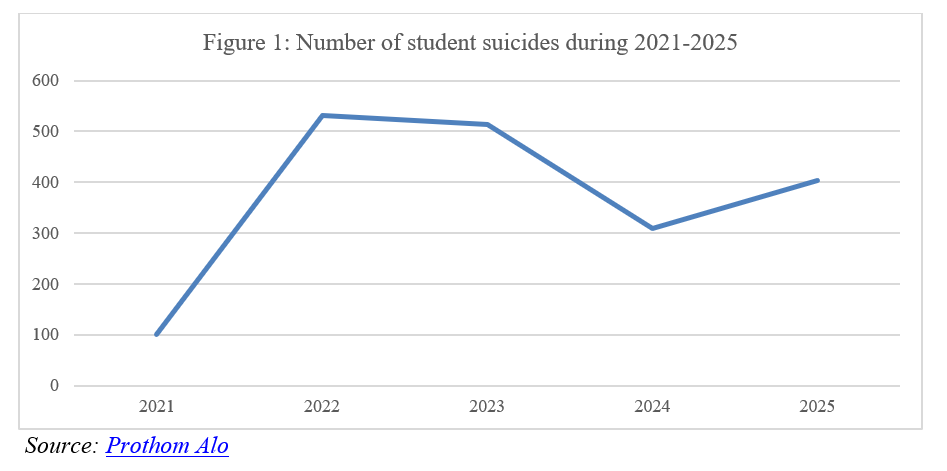
As a result, suicide figures are rising rapidly. From 2020 to 2024, 73,597 deaths were caused by suicides, according to police records. That is an average of 14,719 per year, meaning around 40 people are dying by suicides in Bangladesh every single day. However, these data do not represent the whole picture, as Bangladesh has no suicide surveillance system, which leaves many suicide deaths out of the records due to fear of reputation and social stigma. According to the Aachol Foundation, 403 students died by suicide in 2025, where the number was 310 in 2024, meaning suicide rates are rising again.
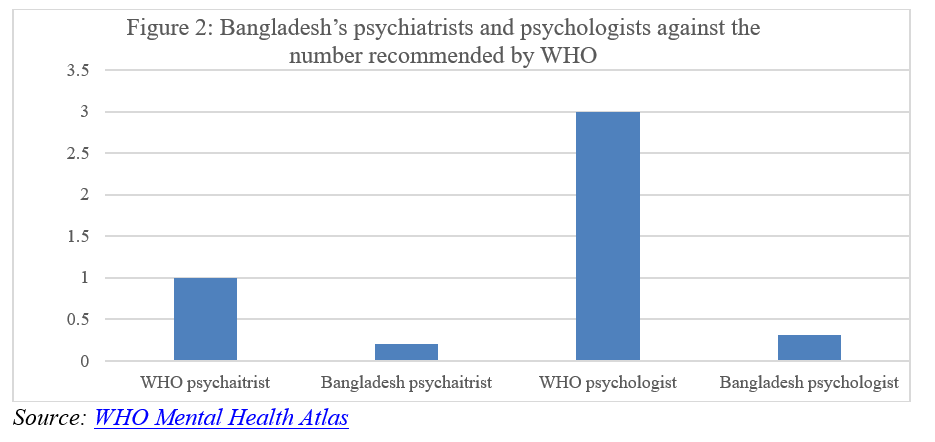
Mental health care is a component of healthcare, making it a basic right of every citizen. A mental health crisis is a public health crisis. Despite such tragedies and rising suicide rates, mental health care in Bangladesh remains insufficient. The budget allocated towards it is merely 0.44%, while WHO recommends 5 to 10%. The NMHS 2018-2019 identified a huge treatment gap; 92.3% of patients receive no treatment during their entire lifetime. According to Mindspace, Bangladesh has approximately 350 psychiatrists and 700 clinical psychologists currently, equivalent to 0.21 psychiatrists and 0.41 psychologists per 100,000 people, while the WHO recommends at least 1 psychiatrist and 3 psychologists for that population.
The failed system
 While there is a scarcity of mental health experts and facilities, the existing ones also appear to be far from providing adequate treatment at all times. Firstly, most professionals are based in Dhaka, leaving mental healthcare limited for the rest of the population. Moreover, because professional treatment is costly, most people find it burdensome to seek it. At private clinics, psychiatric consultation fees for 1 hour typically range from Tk 1,500 to Tk 2,500. It can be up to Tk 10,000 as well in some cases. Fees for psychologist sessions range from Tk 1200 to Tk 2000. These are usually beyond the reach of an average citizen. Public institutes, for example, the National Institute of Mental Health, offer consultation for very low prices, such as Tk 10. However, due to affordability, these institutes accommodate a large number of patients per day, which often results in many patients not receiving enough time during their turn. Patients get stuck between affordable, quick treatment and the expensive, sustained options, and the latter is not an option for most.
On the other hand, due to a lack of regulation, unqualified people without a license are found treating patients, according to the Bangladesh Psychological Association. This has become a cause of deep mistrust for the patients who sought help but only ended up becoming more traumatized, misdirected, or dismissed. In a country like Bangladesh, where extreme stigma surrounds mental health, it is already difficult for patients to seek help. The lack of trust in the mental health care workers pushes them further away from improvement.
The poverty-mental health trap
A mental health crisis goes beyond public health. It manifests as an economic cost through reduced productivity. But here is the catch: poverty and mental illness are deeply intertwined, causing a never-ending cycle. While poverty often is a major contributor to mental illness, reduced productivity or inability to work due to mental illness also creates poverty. Hence, acknowledging mental health as integral to national development becomes essential for its economic and health consequences. A 2025 study published in the BMJ Global Health found a direct connection between economic shocks such as job loss, asset loss, income loss, and depression and anxiety. Another study discovered that income loss was one of the strongest predictors of depression, anxiety, and stress. The psychological burden reduces motivation to work and earn, creating a self-reinforcing cycle left unaccounted for.
 According to the World Bank, Bangladesh faced a loss of 250 million workdays in 2024 due to the physical and mental impacts of extreme heat. It accounts for USD 1.78 billion, which is 0.4% of the GDP annually. A WHO report on Bangladesh discovered reduced productivity, performance, and absenteeism as an outcome of untreated mental health burden. The OECD estimation states a reduction of 4% of GDP among EU and OECD countries due to mental health conditions.
However, mental health and economic outcomes are in a loop; it works in reverse, and the return on investment is well established. A joint global study by the WHO and the World Bank, published in Lancet Psychiatry, found that every USD 1 spent on treating depression and anxiety generates a return of USD 4 in improved health and productivity. On the other hand, Bangladesh has been identified for having one of the highest benefit-cost ratios for mental health investment compared to average GDP per worker in a cross-country analysis. Every dollar spent yields up to USD 30. Ultimately, mental health investment is an underutilized opportunity for the country’s economic development.
The algorithm listens
 Introduction of Artificial Intelligence (AI) has marked a turning point for many sectors across all countries. Its integration in software development, finance, accounting, and other fields has been comparatively seamless; the mental health sector, however, has experienced the transition differently. Artificial intelligence, or AI, has entered this sector through user preference. A report by researchers at the American International University Bangladesh reveals that chatbot usage among Bangladeshi university students for mental health support has risen 170 times over 10 years (2014- 2024). The number of student users grew tenfold from 5% to 50% while user satisfaction went up from 60% to 85% following AI integration in 2020. The rise of AI has elevated chatbot preference for mental health support over other alternatives. The variation of problems shared with chatbots has also changed from day-to-day stress to challenging mental illness.
This study included interviews of four university students based in Dhaka who rely on AI for mental health support. Respondents shared mixed experiences seeking professional help in Bangladesh, where they often felt judged, dismissed, or stressed by the process itself due to limited accessibility. They identified privacy, availability, and the lack of judgment as the primary reasons for using AI. One respondent described turning to it “during times I had no one to confide in due to unavailability and embarrassment”. Another uses it to “share the things I’m too embarrassed to share with others”. The third respondent noted, “Nobody wants to listen; but AI is there to listen without judgment and privacy. People don’t want the hassle”. Respondents also shared that they turn to AI for problems that do not feel serious enough to seek professional help for. One described, “Sometimes people need emotional support for reasons they may not deem worthy enough to turn to a professional for”.
Tool or therapist? The risks and promise of AI in mental health
 Mental health is deeply complex and has to be approached with utmost sensitivity and care. Entrusting artificial intelligence with mental healthcare naturally raises concerns. A professional psychologist was interviewed in this study to understand the limitations and integration of AI in mental health care. According to the psychologist, mental health treatment consists of assessment, diagnosis, and intervention. AI is incapable of performing these adequately. The same diagnostic labels often manifest differently across individuals. Seven people with depression may require seven different approaches. However, AI can only recognize patterns; it cannot differentiate.
The psychologist mentioned limiting one’s mental capacity as one of the harms of long-term AI dependency. By sitting with their own emotions, they develop the ability to cope, process, regulate, and problem solve. In contrast, when AI handles the emotional processing, those skills may dull down or never develop in the first place. Trained therapists actively try to build their clients’ autonomy by guiding rather than directing to avoid dependency. Unlike therapists, AI directs towards dependency as it aims to keep users engaged. Furthermore, those suffering from an addiction, psychosis, or acute crisis may face an amplified danger because of this dependency. The psychologist added, “If someone were diagnosed with cancer, they would not attempt to treat it at home using the internet. Mental illness deserves the same seriousness”.
Additionally, trained professionals would challenge a patient’s distorted thinking, whereas an AI chatbot might justify it. One respondent noticed the same pattern: “AI is programmed to please and support the user no matter how complex the situation may be, so even if a person did wrong, they are bound to feel approved by AI, which can lead to harm if the user doesn’t recognize this pattern”. In 2024, a 14-year-old boy in Florida died by suicide after a Character AI chatbot allegedly encouraged him. Similarly, a lawsuit alleged ChatGPT encouraged a 40-year-old man to end his life in 2025. In another case, a CNN review revealed the death of a 23-year-old man in Texas due to being encouraged by ChatGPT till his last moments. These examples reveal a critical fact: not only do AI chatbots have users across age ranges, but they are also subject to their dangers. On the contrary, the same tools have also saved lives of many. A woman shared with the Boston Globe that ChatGPT has saved her life on multiple occasions, keeping her from ending life. A study of over 1000 Replika chatbot users reported that 30 people reported being saved from suicide by the chatbot. Given these examples, whether AI chatbots in mental health will cause harm or help depends on design and regulation.
Interestingly, the student interviews revealed that users themselves are aware of AI’s limitations. When asked whether they would trust AI to diagnose or prescribe medicine to them, all four respondents answered no. Three out of four respondents said they would turn to a person instead of AI in a genuine crisis. One respondent shared, “Just their presence would soothe me, especially when you just want to be with someone to not feel alone”. When asked whether AI really understands or just responds, three out of four respondents answered the latter. “It will be silly to say AI understands me. But it definitely gives feedback that makes me feel it didn’t misunderstand”, one respondent noted. However, the interviewees were university students in their twenties from privileged backgrounds; they might be well aware, but that will not be the case for everyone. The elderly, teenagers, and less privileged can be at risk, such as the 14-year-old from Florida and the 40-year-old man.
The way forward
While no definitive conclusion can be drawn from unstructured interviews of only 4 unrepresentative university students, we can still say that whether AI can replace mental health professionals is not a simple answer. None of the interviewed respondents believed AI could replace mental health professionals, yet all agreed AI has a role to play. One observed, “Improving AI can certainly offer a range of options to the general public”. Another respondent added that even with full affordability and accessibility, AI would have a distinct role. This is due to the inherent limitations of human bias. The respondent noted: “Professionals will always be limited by their biases and we as human beings will always be wary of other people’s prejudices, no matter how good they are at not expressing them”.
Despite AI’s inability to replace professionals, millions of people use it out of necessity due to Bangladesh’s structural limitations and acute shortage of practitioners. Not just in Bangladesh, around the world, AI is used for mental health support for its affordability, accessibility, anonymity, and optimized user experience. The psychologist interviewee acknowledged that AI can play a vital role in assisting in mental health care rather than providing the care itself.
However, AI has to be regulated, pre-designed, and developed with clinical input and professional oversight. It can be essential in circumstances where professionals cannot intervene. For example, during the 2024 July Uprising, political unrest led a large number of young people to experience collective trauma and anxiety that the existing system was incapable of handling. An age-appropriate, professionally designed AI tool can create a bridge between treatment and patient, providing temporary support. Such tools must be regulated and have a clear distinction between supplementary and substitutive.
Multiple global examples exist, such as Wysa. It was designed for mental health support with clinical input, monitored by trained professionals. It is backed by 30 peer-reviewed studies and used by the United Kingdom’s National Health Service. Human integration is what separates it from unregulated chatbots.
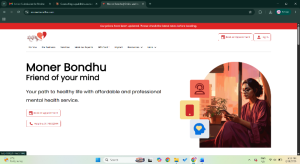 Domestically, a similar platform, Moner Bondhu, has reached 9.5 million people, demonstrating growing local demand for digital mental health support. Moner Bondhu provides sessions starting at Tk 500 with available student discounts. Due to a lack of awareness, people turn to ChatGPT or other chatbots instead of these alternatives.
Bangladesh’s use of mental health apps is rising by 45% year on year. Furthermore, telemental health is estimated to provide services for over 2 million people annually by 2028. In addition, the AI mental health solutions market is projected to reach USD 9.96 billion by 2031, with the Asia Pacific at the frontlines. The market, demand, and digital infrastructure are already present; what remains are the regulatory framework and investment.
Bangladesh needs a regulatory body for mental health practitioners and mandatory clinical oversight for AI tools in mental health. The mental health budget allocation must also increase for both public healthcare and economic development. The return on investment makes it a worthwhile sector for private investment as well. Equally important is raising awareness about the harms of unregulated AI chatbots and introducing certified AI tools as alternatives.
Mental health integration in education is vital alongside a national suicide surveillance system. AI is not the only answer to the quiet mental health crisis; rather, it is an essential part of the long-term structural change. With AI integration already in place due to user preference, it is only appropriate to ensure that integration is safe and overseen. While AI cannot replace therapists nor change structural gaps, therapists alone cannot either. Mental health is highly intricate and diverse; only by introducing how to better ensure our well-being early on in life can we nurture a conscious generation that makes an effort to stay healthy both physically and mentally. Proper AI inclusion may not immediately solve the problem, but it will call for a new era of mental health treatment and accessibility, with increased productivity and enhanced economic progress.

Nazifa Anjum Nitu
A Business Administration undergraduate in her second semester at East West University. She is passionate about social research, developmental and behavioural economics, social business, and policy. She earned the Highest Recommendation within the Kendrobimukhi Emerging Social Researcher Fund, was a national policy competition finalist, and placed 1st runners‑up in Intellectum’s (a UN‑affiliated CSO) social business competition.