
Introduction
My wife, Habiba, and I recently spent two unforgettable weeks in Egypt from 24 January to 8 February, 2026, traveling with Insight Vacations. From the moment we arrived, the tour felt magical, allowing us to experience Egypt’s rich history and stunning beauty in comfort and style. Each day was filled with many awes and discoveries, as we explored archaeological marvels that showcased the country’s incredible prehistory and the remarkable achievements of past civilizations, many of which still stand unrivalled today. The trip consistently captivated us by the magnificence of Egypt’s ancient monuments, the breath-taking scenery of the Sahara Desert, the majestic Nile River, and the vibrant communities lining its banks.
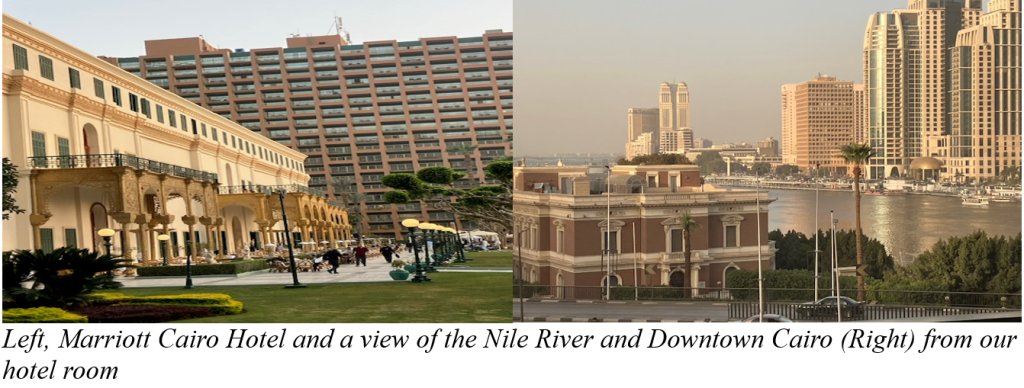
Before our journey, Habiba took the time to thoroughly research both the main tour package and the optional excursions available to travellers looking to extend their adventure before or after the scheduled itinerary. The main tour was set to begin in Cairo on the 28th January. Wanting to make the most of our visit, we arrived on 25 January to enjoy some of these additional experiences. Upon our arrival, an Insight Vacations representative greeted us warmly and smoothly assisted us through the visa-on-arrival process, making everything much more convenient and efficient. Once we finished with the airport procedures, we were swiftly transported to the Marriott Cairo Hotel in downtown, which served as our group’s designated hotel.
Staying at the grand and historic Marriott Cairo was a delight in itself. Situated on an island in the Nile River, the hotel was originally built in 1869 to accommodate European dignitaries for the inauguration of the Suez Canal and was later transformed into a luxury hotel. Marriott acquired the property in the 1970s, adding two 20-story towers at each end of the original palace. Today, the hotel boasts 1,087 guest rooms/suites and 14 restaurants, catering to approximately 3,000 guests each day.
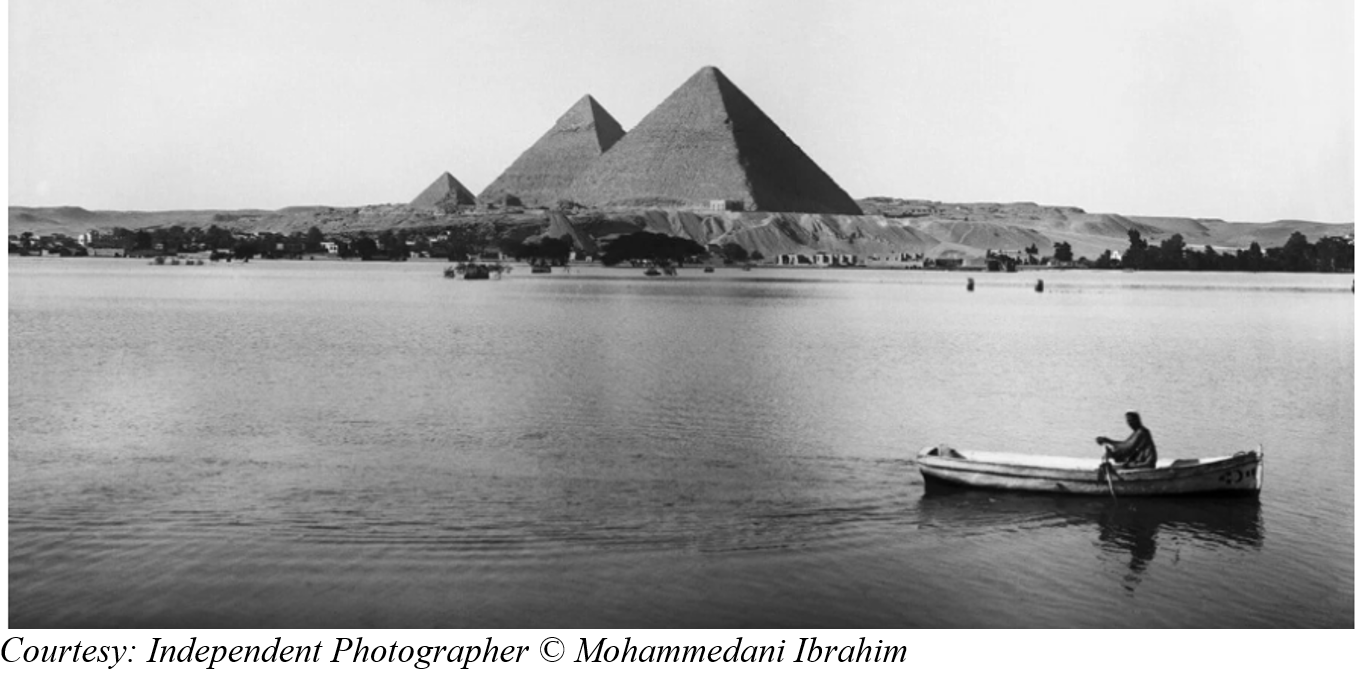
 Our stay at the hotel, both before and after the Nile cruise, provided a convenient and enjoyable opportunity to visit several of Lower Egypt’s most famous landmarks, such as the Pyramids of Giza and Memphis, the first capital of ancient Egypt, founded by King Menes around 3100 BC. So, the country called Egypt represents centuries of empires, dynasties, invasions and identities. This short account, complete with stories and photos from prehistoric sites, is designed to captivate and inform our Global Bangladesh readers. We hope our journey will encourage others to discover Egypt’s treasures and appreciate its lasting legacy.
Trip to Alexandria and Cairo city tour
Our Optional Tour began on 27 January with a day trip to Alexandria, offering us an early opportunity to immerse ourselves in Egypt’s legendary coastal city before the main tour commenced. The journey from Cairo to Alexandria took us through scenic desert landscapes and gave us a glimpse of the Nile Delta’s fertile expanses, where modern life and ancient traditions coexist. Upon arrival, we were greeted by the cool Mediterranean breeze and the striking blend of Greco-Roman and Egyptian influences that define Alexandria. Founded in 331 BC by Alexander the Great, Alexandria was one of the largest and most important cities in antiquity. It was Egypt’s capital city during the reign of Alexander the Great. The city had a strategic link between the Mediterranean and the Nile, becoming a premier centre of Egypt’s Hellenic culture. The renowned Lighthouse (Pharos) is a huge attraction to tourists.
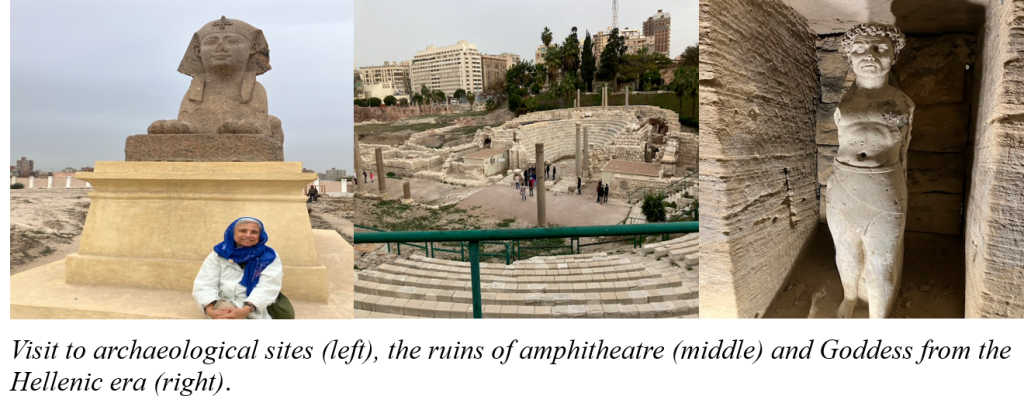
Our expert tour guide, Mohammad Rekaby, who holds advanced degrees in history, archaeology, and Egyptology, enriched our experience by sharing captivating insights about the city’s storied past. He walked us through the complex tapestry of Egypt’s ancient history—not just in Alexandria, but throughout the entire two-week adventure—helping us appreciate the significance of every monument, every ruin, and every cultural artifact we encountered. Thanks to his guidance, the historical sites came alive, and we gained a much needed understanding of Egypt’s fascinating legacy, from the time of the Pharaohs through the Hellenistic and Roman eras featuring remains of Roman amphitheatre.
The following day was devoted to discovering the heart of Cairo, a bustling metropolis that serves as the political, cultural, and economic centre of Egypt. With a population of roughly 22 million, Cairo is the largest city in the country. Egypt as a whole is home to about 120 million people, the vast majority of whom reside in cities and towns along the narrow, fertile strip of the Nile Valley and Delta—an area that represents only about 23% of the nation’s total landmass. The remaining 77% of Egypt is dominated by the arid Sahara Desert, which remains largely uninhabited and starkly contrasts with the lively, densely populated riverbanks.
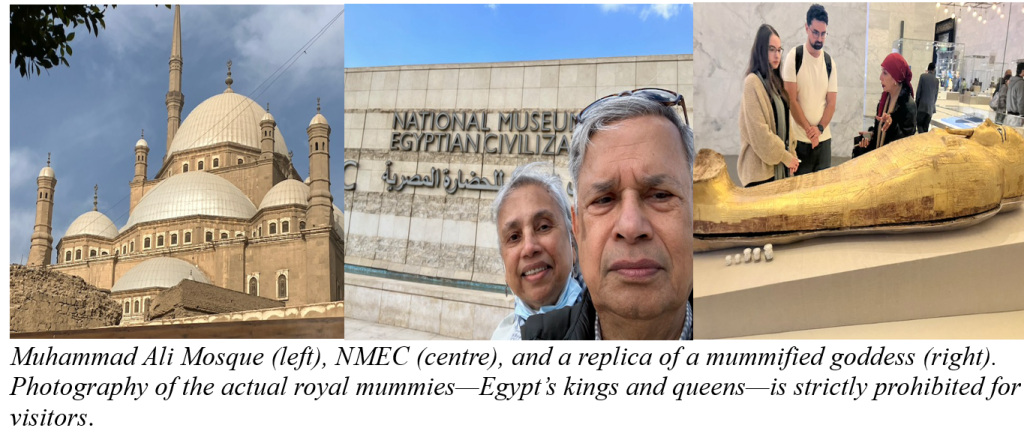
Our first stop was the renowned Muhammad Ali Mosque, an architectural masterpiece built in the Ottoman style by Egypt’s ruler Muhammad Ali Pasha. Perched atop the Saladin Citadel, the mosque offered sweeping views over Old Cairo, allowing us to appreciate both the city’s historical depth and its sprawling urban landscape. However, many awes were yet waiting for us at the National Museum of Egyptian Civilization (NMEC), which houses the largest collections – about 170,000 items – of Egyptian antiquities, that chronicle the nation’s journey from prehistoric times through the pharaonic dynasties and beyond. The centerpiece was the Royal Mummies Hall, where 22 mummified rulers—each preserved for centuries—rest in quiet dignity. Standing before these ancient monarchs, we felt a profound connection to Egypt’s enduring legacy.
Wonders of Egypt
Our official tour commenced in Cairo on the morning of 29 January. Gathering together with the full group—around 25 enthusiastic travellers—we boarded a bus in the early hours to catch our 7:30 AM flight from Cairo to Luxor. The excitement was evident as most of us met for the first time, sharing introductions and stories as we made our way to the airport, ready to begin our journey together into Upper Egypt. It was a group of 25 travellers from Australia, Canada, Ireland, and the United States.
Upon arrival in Luxor, the gateway to the treasures of Upper Egypt, we were immediately struck by the city’s vibrant energy and historical significance. Luxor, often described as the world’s greatest open-air museum, would serve as the starting point for our exploration of ancient temples, royal tombs, and the timeless landscape along the Nile. This leg of the trip promised unforgettable encounters with some of Egypt’s most remarkable archaeological wonders, setting the stage for an adventure through the heart of ancient civilization. The tour bus at the airport took us directly to Karnak Temples. Our tour guide asked us to be ready for some awesome experience in Karnak, Luxor and the Valley of the Kings (see the Map with archaeological sites in Upper and Lower Egypt, Source: World History Encyclopaedia). The sites indeed offer glimpses into the grandeur of the ancient Egyptian civilization, with stories of pharaohs and gods from millennia past.
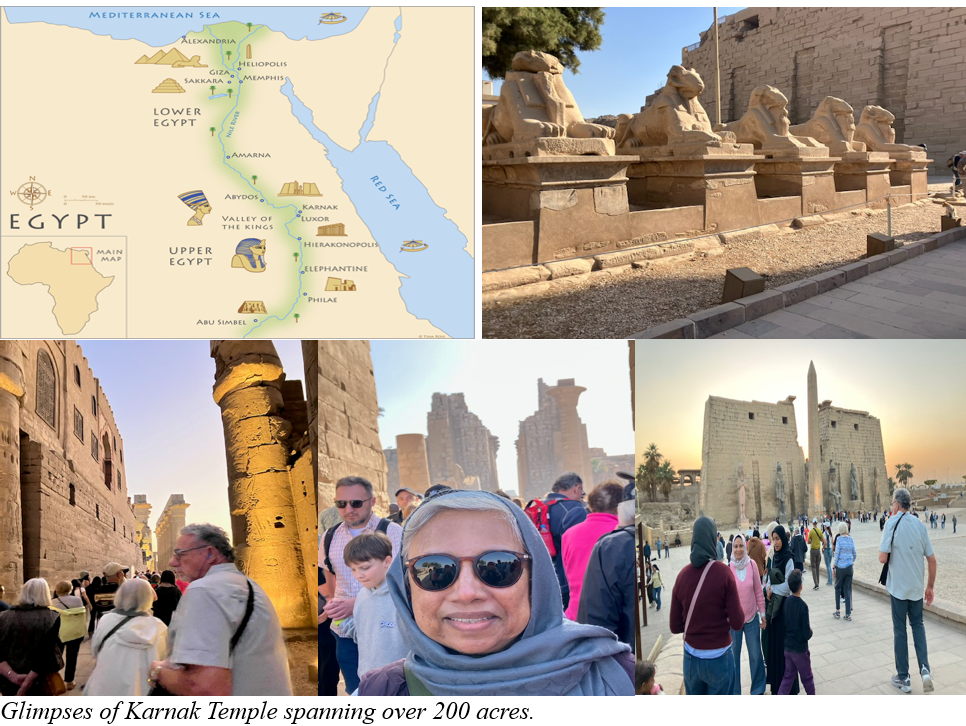
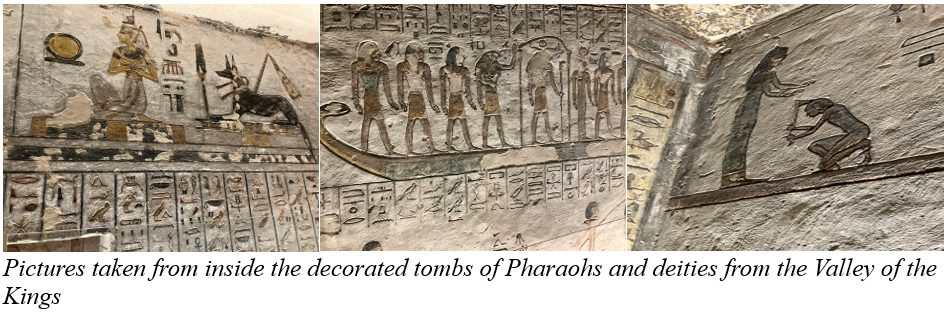
The Karnak Temple complex, in particular, is one of the largest and most impressive religious sites ever constructed. Spanning more than 200 acres, Karnak was built and expanded over a period of nearly 2,000 years by successive pharaohs. Walking among these towering columns and monumental gateways, we could sense the scale and ambition of the ancient builders. Many consider that Karnak not just a historic monument but a living testament to Egypt’s enduring spiritual and artistic legacy. We also visited other iconic prehistoric sites – for example, the Valley of the Kings, with its elaborately decorated tombs and intricate hieroglyphics and well-preserved statues told stories of pharaohs and deities worshiped thousands of years ago.
On the Cruise: Luxor-Aswan-Luxor
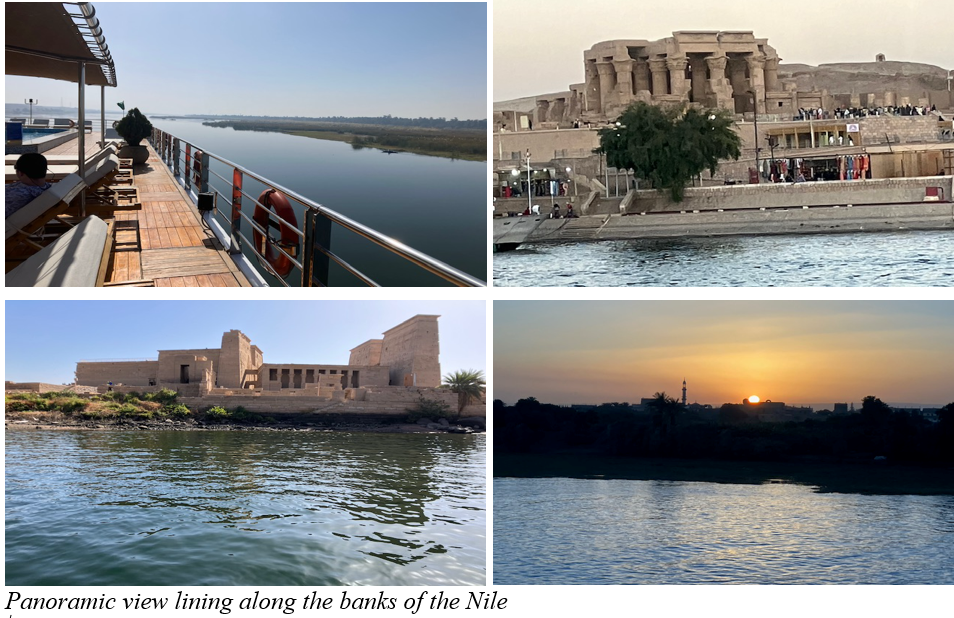
We boarded our cruise ship in Luxor for an 8-night round trip to Aswan, embarking on an unforgettable voyage along the legendary Nile River. The cruise offered a unique perspective on Egypt’s history and landscape, as we sailed past lush riverbanks dotted with palm groves, traditional villages, and ancient monuments. Each day brought new discoveries. As we continued southward, the cruise stopped at Edfu, home to one of Egypt’s best-preserved temples.
Onboard, the atmosphere was lively and relaxed; we enjoyed delicious Egyptian cuisine, evening entertainment – including Egyptian belly dance. We had cooking lesson on board and cooked moussaka, an Egyptian favourite dish. The Insight Vacations group had designated tables for breakfast, lunch and dinner. There were another five different groups like us on board the cruise ship. A particularly memorable moment occurred when the executive chef surprised me with a birthday cake, accompanied by lively music and dancing, making the celebration truly special. The different groups broke into enthusiastic applause to celebrate the birthday.
The cruise also included engaging movies and lectures on the region’s archaeology and cultural heritage, enriching our understanding of Egypt’s history. Throughout our journey, the Nile remained a serene companion, its gentle waters mirroring stunning sunsets and offering glimpses into the daily rhythms of life along its banks.
Aswan and Beyond
Our time in Aswan was truly unforgettable. The Nile shimmered with an astonishingly deep blue shade, and watching the traditional feluccas and local boats gracefully sail up and down the river brought a sense of joy and tranquillity. During our stay, we toured the Aswan High Dam—a remarkable feat of engineering completed in 1970 under President Gamal Abdel Nasser with support from the former Soviet Union.
The dam has played a vital role in advancing Egypt’s agriculture, industry, and tourism, though it also resulted in the displacement and resettlement of about 100,000 Nubians and significant changes to the local ecosystems. The cruise provided opportunities to learn first-hand about the Nubian people: we visited their resettled villages along the Nile and gained insights into their enduring culture and history, so closely intertwined with this region. Their unique heritage, now being thoughtfully preserved, offered us valuable perspectives on the cultural mosaic of southern Egypt.
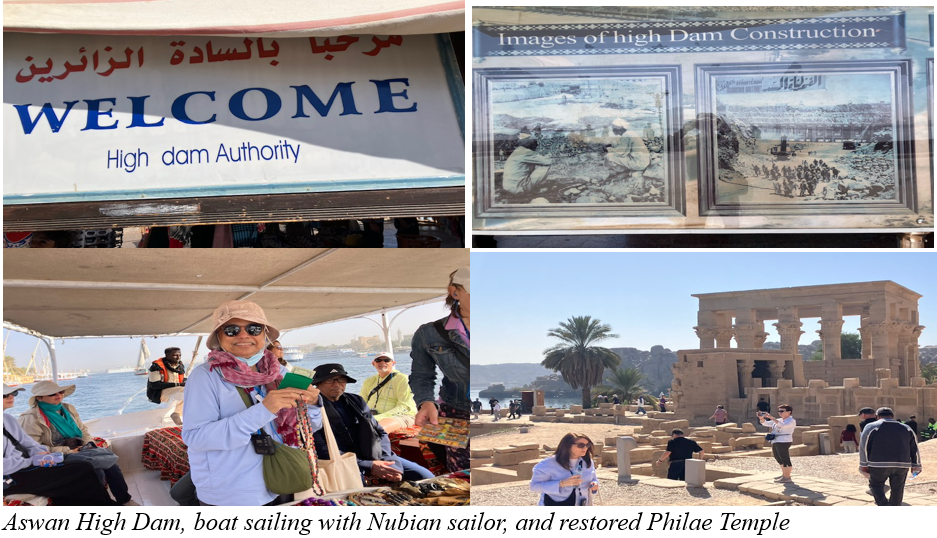
Another unforgettable experience was our tour of the majestic Philae Temple. Originally threatened by the rising waters of the Nile following the construction of the Aswan High Dam, this ancient sanctuary was carefully dismantled and reconstructed on Agilkia Island in a remarkable international preservation effort led by Italian archaeologists. Today, Philae Temple stands as a symbol of global collaboration to safeguard Egypt’s priceless heritage for future generations.
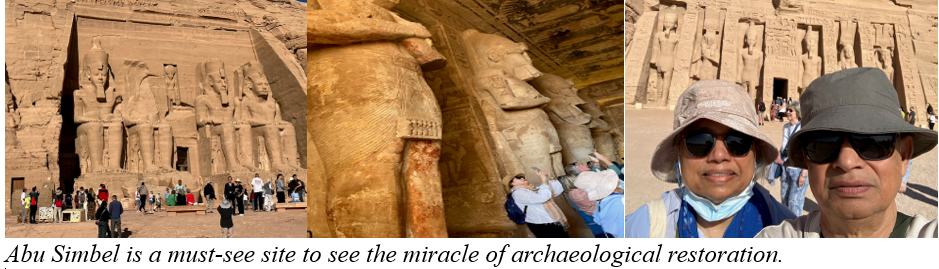
An important highlight of the trip was a short flight from Aswan to Abu Simbel, where the monumental temples of Ramses II and Nefertari were moved stone by stone to their current location, showcasing both the grandeur of ancient Egypt and the ingenuity of modern preservation efforts. The relocation was a massive international effort and remains one of the most ambitious archaeological preservation projects in history.
Our cruise on the Nile from Luxor to Aswan was not just a journey between two cities, but an immersive experience into the heart of Egypt’s civilization, offering breathtaking scenery, rich historical sites, and lasting memories of the world’s most iconic river. We flew back from Luxor to Cairo for the final leg of our tour.
Giza, Memphis and the GEM
Insight Vacations had planned this finale as the ultimate awe of the entire tour experience. Our trips to Giza—including the legendary Pyramids of the Pharaohs—were truly phenomenal. The Pyramids, especially the Great Pyramid of Khufu, stand as enduring testaments to ancient Egyptian engineering and ambition. Rising from the desert sands, these massive structures, built over 4,000 years ago, are not only royal tombs but also symbols of Egypt’s rich history and mystery.
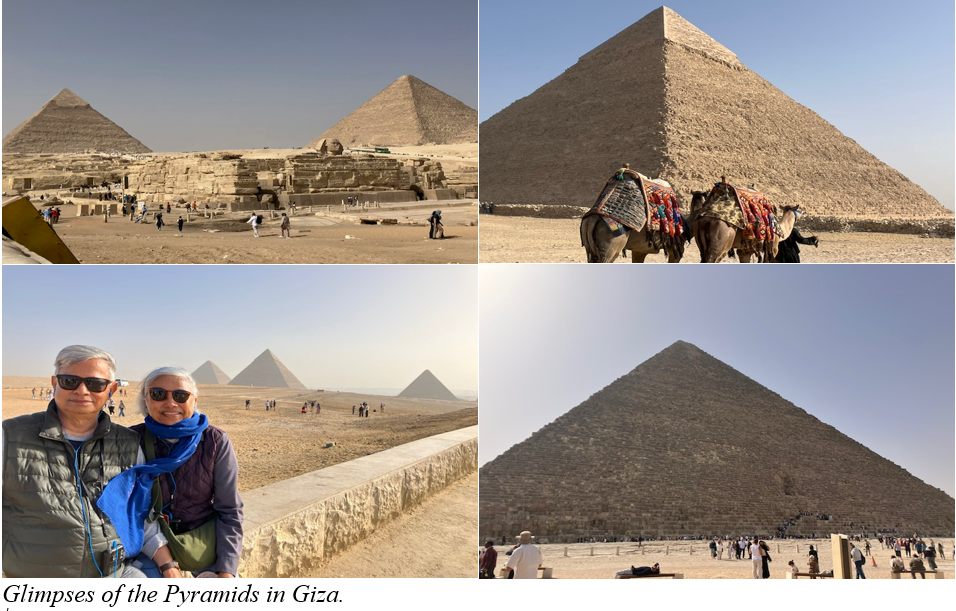 We also visited Memphis, the first capital city of ancient Egypt, renowned for its colossal statues and the Alabaster Sphinx, offering a glimpse into the country’s earliest days of civilization. The highlight of our visit was the newly opened Grand Egyptian Museum (GEM), a state-of-the-art cultural landmark near the pyramids. The GEM showcases thousands of Egypt’s priceless artifacts, including the complete collection of Tutankhamun’s treasures, brought together for the first time in a modern, breath-taking setting. Walking through the museum’s expansive galleries, we experienced a captivating journey through Egypt’s extraordinary legacy.
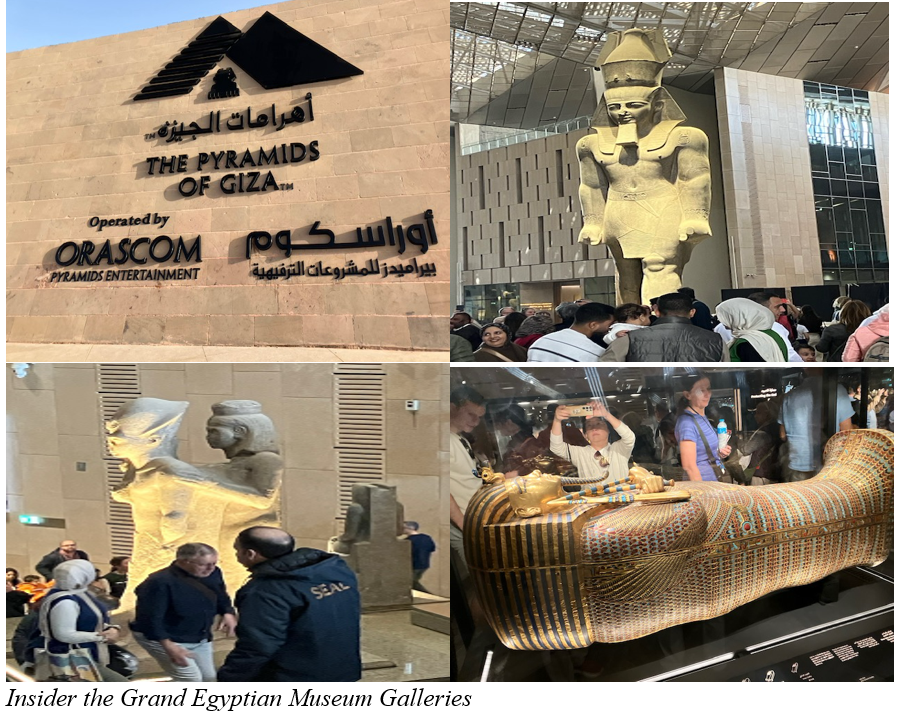 In sum, our journey through Egypt was filled with unforgettable moments, from sailing on the Nile and exploring Nubian villages to witnessing remarkable feats of ancient and modern engineering at the Aswan High Dam, Philae Temple, and Abu Simbel. The cruise offered immersive encounters with Egypt’s history and culture, culminating in awe-inspiring visits to the legendary Pyramids of Giza and Memphis. A highlight was the visit to the Grand Egyptian Museum, where priceless artifacts and the treasures of Tutankhamun are displayed in a breath-taking modern setting. Overall, the trip provided a profound appreciation for Egypt’s enduring legacy and vibrant heritage.

Mohammad Zaman
Dr. Mohammad Zaman is an internationally known development/ resettlement specialist. He has worked in many major projects for the World Bank in Bangladesh and in other countries in Asia and Africa. Dr. Zaman’s most recent edited book (co-editor Mustafa Alam) is titled Living on the Edge: Char Dwellers in Bangladesh, Springer, 2021. E-mail: mqzaman.bc@gmail.com