Antora is already in the kitchen when the city is still asleep in the early hours of the morning. She continues lying down silently for some more time in the small room which she shares with her husband and children. There is little room for anything else, except for a bed, some clothes folded into a heap and the sounds of her family sleeping.
Her husband drives a CNG. He has a tough schedule. His work hours are super long. They change every single day. So, Antora has to take care of everything at home by herself. They have two kids. Her daughter is eight years old, and her son is four years old. There is no daycare in the factory. These people cannot afford to pay anyone to look after their children. So, they have to ask the people who live in their compound for help.
In the morning her daughter goes to a school. One of their neighbours is really nice. She keeps an eye on the little boy. When Antora’s daughter comes back from her school in the afternoon, she has to be like a mom. She gives her brother food and takes care of him until Antora and her husband come home really late, at night. This is what happens six days a week.
Antora only gets one day off which is Friday. The woman in the house does not get to sleep in or rest. She spends the day washing the family’s clothes and cleaning their rooms and doing all the housework, for the family for the next week.
There is no time to waste for Antora. She is awake by 5:30 am. For the first hour in Antora’s daily routine, she has no time for herself. Her morning starts by cooking and preparing food for everyone else, such as making roti, boiling water for tea, or perhaps frying an egg if she has one available. It is a simple and quick breakfast that is mainly consumed by her husband and kids. Whatever is left goes to Antora or nothing at all. There is always something else more important to do.
Antora was born in Lal Mohon, Bhola — a coastal region in southern Bangladesh. Like many other women in rural Bangladesh, she left for Dhaka during her youth, lured by the opportunities to earn some money through garment manufacturing companies. She got married, has children, and is presently working as a garment manufacturing worker for two years in a factory in Mohammadpur’s Udyan. There are about three million garment manufacturing workers like her working in the ready-made garments industry of Bangladesh, which generates around 80% of Bangladesh’s overall export revenue and makes it the world’s second-largest garment manufacturer after China.
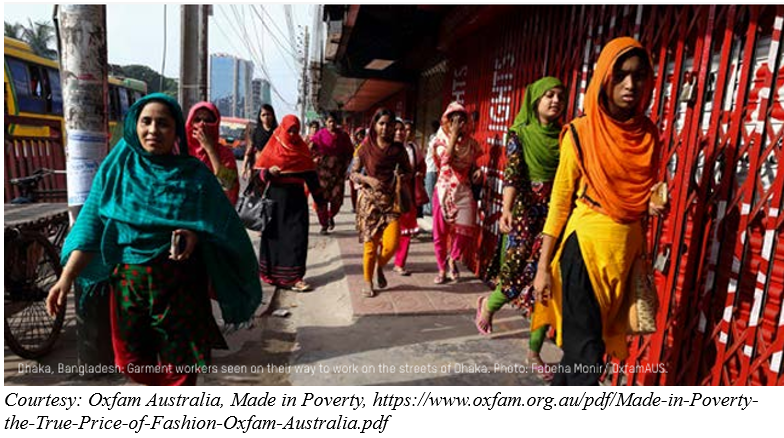
Antora’s factory can be reached by foot from where she lives, and this is one of the only conveniences she gets during the day. She leaves before 8 am when the street vendors have begun to establish themselves for business, and she moves through the narrow streets around her as the city begins to hum into life. Her fellow workers, on the other hand, have to walk much greater distances to get to work — according to some research, more than half the distance between one and five kilometres to reach their workplace.
Antora’s factory is situated just around a fuelling station along the primary road in Udyan. The company is medium-sized, the kind that makes up the backbone of the garment industry in Bangladesh. Officially, she is considered an operator, but she functions more as a helper – which is typical of such disparities in official categorizations of employment. She begins work before eight o’clock. Work is supposed to end by five in the afternoon.
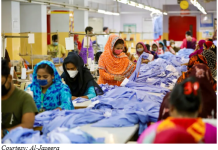
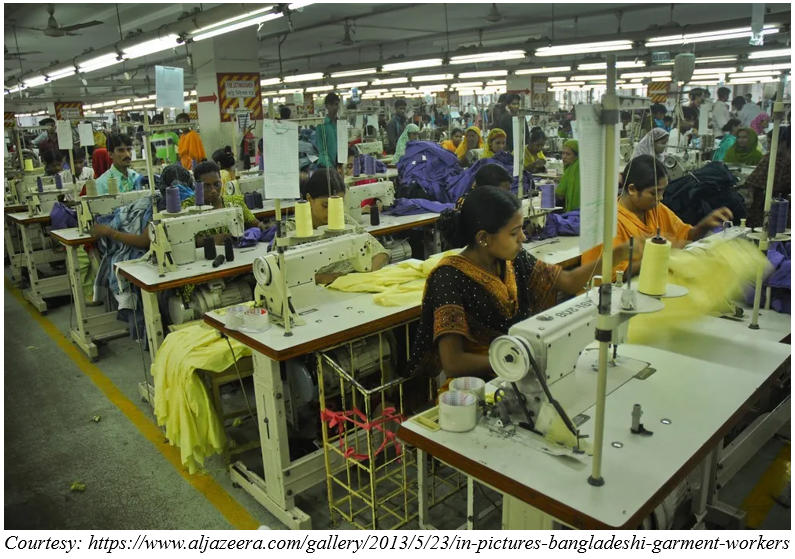
The noise of production inside the factory never ends; machines constantly hum, supervisors walk around between the assembly lines, and the constant pressure of meeting production goals affects everyone. Working as a helper on the assembly line requires her to help the workers as she passes materials to them and removes their work.
When production works normally, the mood in the factory is more bearable. However, when production levels drop because there is something wrong with the process of production or the product itself, the behaviour of the senior management changes rapidly. “If production level decreases, then they start treating us poorly”, says Antora in a flat tone of voice, without any signs of resentment.
A mid-day meal is available. Considering the long working schedule of nine to ten hours at the factory, this lunch hour is one of the very few scheduled breaks from an otherwise exhausting day for the workers. Meals are usually simple consisting of a helping of rice with some vegetables or fish or eggs. This will suffice for a while, but there is no denying of the fact that income limitations prevent the workers from having a balanced diet for themselves and their families as various studies have repeatedly revealed.
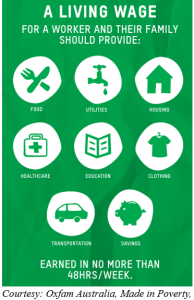 Working extra hours is common practice among factory workers in the garment industry of Bangladesh. In the case of Antora, her overtime shifts can last till eight at night. During the busy seasons, especially during the period just before Eid, they can be requested to stay even longer. On such days, the factory gives some basic snacks to help them go on: like an egg and a banana.
The overtime allowance in theory makes this extended work hours’ worth it. But in reality, the arithmetic does not quite favour the workers. In her workplace, employees are paid the exact same rate for overtime as they are for normal working hours. Ideally, overtime should come with a higher pay rate and proper meals at night. The kind of arrangement that may seem like an advantage, but really is just one way of compressing wages in this sector. A study by the Bangladesh Institute of Labour Studies showed that workers who receive overtime pay earn roughly BDT 12,794 a month — which is even below the minimum required for survival.
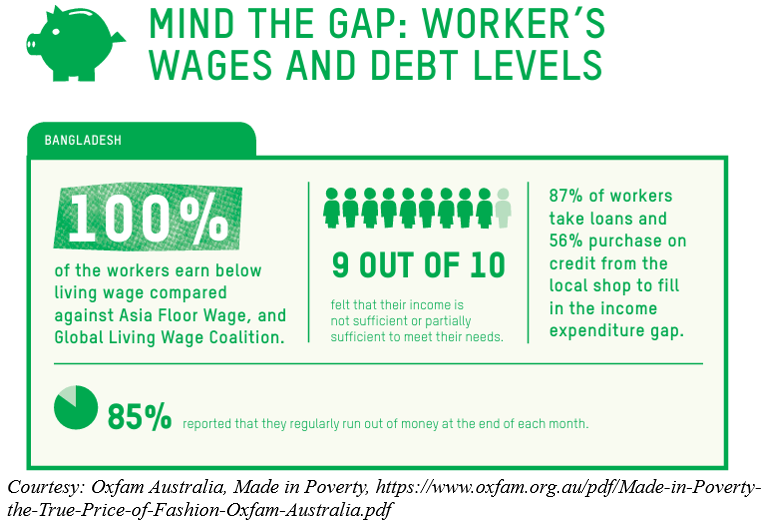
Even when the statutory minimum wage is paid, that still leaves garment workers earning only 38% of what would be considered a living wage. The disparity is very clear for Antora. Even though she earns a salary of 12,000 taka, she only receives 7,000 taka as her salary.
This issue has never been clarified with her. Some months, even that amount is not given on time. Sometimes she only receives her salary either on the 20th or the 25th of the month. There is a deduction of 300 taka when workers are late for three days—even if it is just by 10 minutes—which is exactly equivalent to their entire daily wage. Antora is well aware of the inequality, but chooses not to complain because, “if we complain, they can sack us,” she says, adding that there will always be someone to fill the position.
Immediately upon leaving the factory, it is already dusk. The night has come and gone without her. The way she is making back into her locality along the roads seems like an entirely different journey. The street peddlers who were selling stuff on the streets already had gone back to their huts or shantytowns, and the children playing outside in the street must be already sleeping. That is, she had yet another day in the city end without stepping outside once on that day. She reaches her apartment just before ten, changes herself, and then stands in line outside the bathroom.
That is when she begins her meal, whatever is available: old rice heated up, a basic meal made using whatever had been bought during the course of the week, or simply bread with whatever she may have to scrounge in the dark corners of the room where her children are already fast asleep.
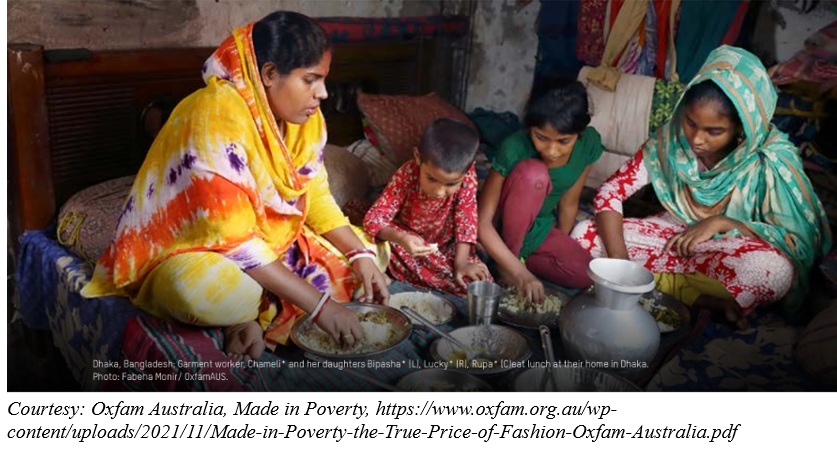
Her entire living space is just one room. It accommodates four members: Antora, her husband, and their two children. It is not uncommon either. On average more than three people live in one ten-by-twelve-foot room and share all the amenities like cooking, washing, water, etc., according to a report prepared for The Global Living Wage Coalition. Another study has found that the garment workers usually rent a single room in a group housing regardless of their family size. In a group housing, a minimum of 5 and maximum 35 family live, sharing the kitchen, toilet and bathroom. Most of these group housings are built with corrugated tin sheets, lacking proper drainage and solid waste management systems. The workers living in these houses often face frequent load shedding.
The monthly rent of Antora’s room is 4,000 taka while her monthly income is 7,000 taka. One study has found that nearly 62% of the respondents are living in housing beyond their affordable limits in terms of their income.
Antora is somewhat “lucky”; she works in a factory that has a doctor. This cannot be said of other factories. If she feels unwell, she can visit the factory doctor. She gets either a paracetamol or a Napa pill and sent back to work. More severe cases she manages herself, paying from her pocket.
Antora never took any maternity leave during her pregnancy. According to the latest labour laws, female workers are eligible for a maternity leave for 120 days (some companies may violate these laws). Resignation from work due to pregnancy is the only option for a woman. When she returns after the delivery, she is treated as a newcomer. Such a situation is not specific to this particular factory. The research conducted in 2022 showed that many women either lose pay during their maternity leave period or get laid off as a result of pregnancy.
It is not until long after dinner is prepared and she finally lies down when it is past midnight. The only noise in the room would be the breathing of her children. She would get out of bed in just a few hours.
This has been happening for two years already — getting up before the sun rises, preparing breakfast for her family members before eating anything, going to the factory where she does not even have her real name because her pay and what she does at work are not the same. She does not talk about the problem angrily. The kind of tiredness she feels goes beyond any anger, especially since speaking up would not make a difference and would mean having nothing left at all.
The garment sector earned exports worth US$42.4 billion in 2021-2022 financial year, breaking all records and increasing by an impressive 35% over the previous year. New orders continue coming in. Factories continue to expand their operations. Brands are increasingly relocating production to the country, seduced by the low cost of production and quick turnaround. In one of those factories is a shirt, a pair of pants, a jacket – made by hands such as Antora’s, in a factory such as hers, at a cost that leaves her with a meagre 3,000 taka to feed and clothe her family of four at the end of the month. While the industry booms, the salaries of Antora do not increase.
She programmes her body to wake up at dawn, and she sleeps on. But outside, in the bustling world of relentless activities, which does not need to sleep, the world depends entirely upon her and her sisters to power this boom.

Israt Jahan Eshita
A BBA student at East West University with a strong background in business studies, leadership, and social engagement. She has experience in event management, finance handling, and organizational roles through academic clubs, scouting, and youth platforms. She is proactive, detail-oriented, and eager to contribute in professional and impact-driven environments.