
Introduction
South Asians are the largest ‘visible minority’ group, who are non-white and non-Indigenous in Canada. But the Bangladeshi Bengali community constitutes only a fraction of South Asians, mainly overrepresented by the Punjabi people. According to Statistics Canada’s Census data, a total of 5,680 self-reported Bengali speaking people lived in British Columbia in 2021, though anecdotal sources claim the number to be close to seven thousand.
Despite being relatively new and small, the Bangladeshi community can boast of having more than half a dozen of organized groups and clubs in Metro Vancouver, the third largest city in Canada. These organizations coordinate socio-cultural, religious and other events, programmes and activities for fellow Bangladeshi Canadians.
No matter where they migrate or settle, most Bangladeshi Bengalis try to build a home away from home by nurturing their rich national heritage, cultural legacies, and religious customs. The Bangladeshi Canadians in Greater Vancouver are no exception; hence there is a Greater Vancouver Bangladesh Cultural Association (GVBCA), the largest organization of the Bengali diaspora in the metropolitan city.
There has been little official documentation of the history and activities of the Bangladeshi community and their organizations in Vancouver. The first ever attempt to document the migration and social history of Bengalis to Canada occurred in a conference in September 2017. The two-day conference titled Canada 150 Migration of Bengalis was organized at Simon Fraser University, Harbour Centre and the Centre for India and South Asia Research in the University of British Columbia. SFU library issued a digital copy of the proceedings where an article was published about the GVBCA. This is a shorter and updated version of that original piece. Terms such as Bangladeshi Canadians, Bangladeshi immigrants, Bangladeshi Bengalis and Bangladeshi diaspora have been used interchangeably; GVBCA has often been referred to as the Association. As a former secretary of GVBCA, I have shared my insider’s perspectives along with my observations as a community member, activist, leader, organizer, and performer for over-10 years.
Origin and nature of the GVBCA
Formed in 2002 as a registered non-profit society, GVBCA emerged as a merger of two smaller associations to address the growing demand for organizing sociocultural events and festivals for the increasing size of the community in a more unifying fashion. The main objective was to celebrate the heritage and national days of Bangladesh on a larger scale in a more structured manner. The general purpose of this organization is to promote the national heritage, culture and linguistic history of Bangladesh in the multicultural society of Canada. The Constitution also narrates other objectives such as, to promote friendship, co-operation, and social welfare among community members as well as other ethnic groups in Canada.
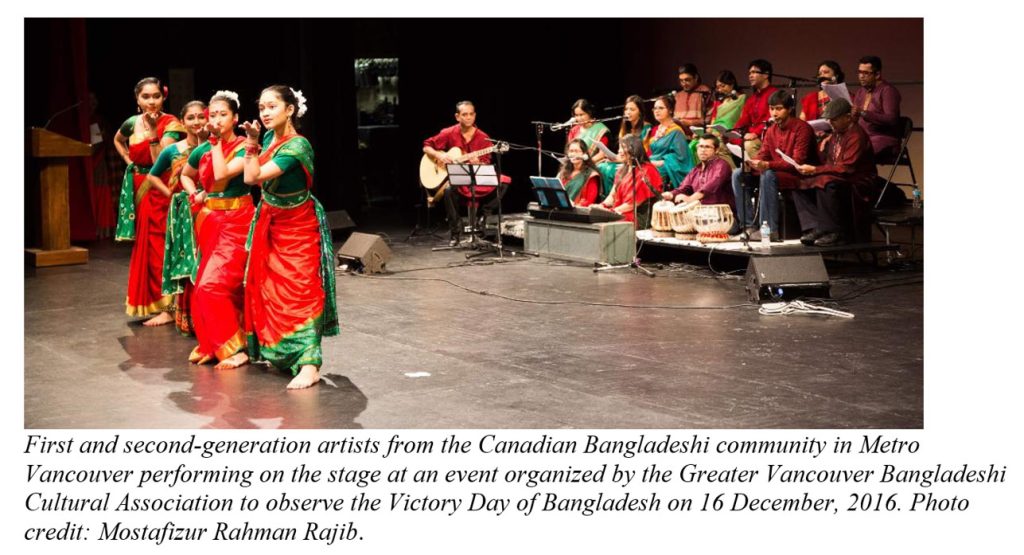
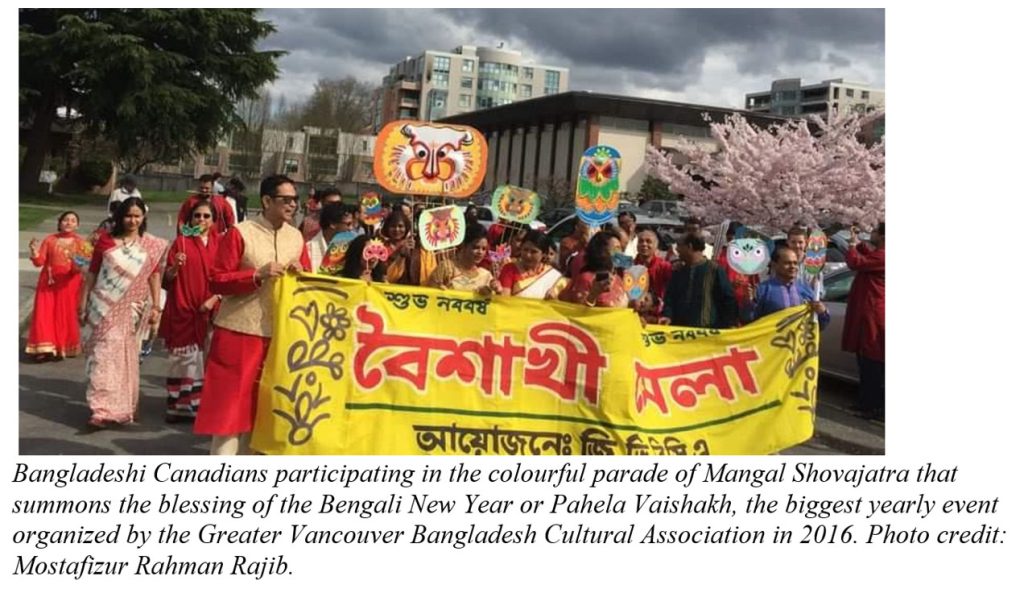
GVBCA observes all the important national days, including Independence Day and Victory Day of Bangladesh. It also celebrates Bengali cultural heritage through organizing secular events such as the Bengali New Year and Pitha Utsav (festival of Bangladeshi pan/cakes, desserts and pastries), and other social events, such as an annual picnic and Eid Reunion following Eid-Ul-Fitr, the biggest celebration of the Muslim community. Vaishakhi Mela, a fair to celebrate the Bengali New Year, is the biggest and most popular event of the Association.
Significance and contributions
The Association works towards preserving, promoting and presenting Bangladeshi arts and culture in the multicultural ecosystem of Metro Vancouver. In so doing, it provides a platform for local artists and performers to express and hone their talents, skills, creativity and passion. It fosters Bangladeshi literature, music, arts and culture among local Bangladeshi Canadians, particularly the youth and the second-generation. The Association publishes souvenir magazines and leaflets featuring both professional and amateur writers from Vancouver and beyond, covering local, national (Bangladeshi and Canadian), and international topics. It has thus facilitated expression and exchange of ideas and opinions, creativity and originality among members of the diaspora.
Fostering leadership and organizing skills and promoting volunteering opportunities are important contributions of the Association. It creates openings for community members, especially youth, to volunteer for organizing and managing its events. It offers opportunities for members to develop and enhance leadership, communication, community development, and organizational skills. It recognizes significant national, international and local accomplishments and contributions of distinguished community members by offering them a special award every year.
Although the GVBCA does not provide any direct settlement services to Bangladeshi immigrants, it plays a vicarious role in the wellbeing, settlement, and integration of many by providing an opportunity to socialize and build friendships, support networks and a sense of community with fellow members. Through various celebrations, festivals and events, it creates an atmosphere and opportunity for the diasporic community to feel at home and to make Vancouver their new home.
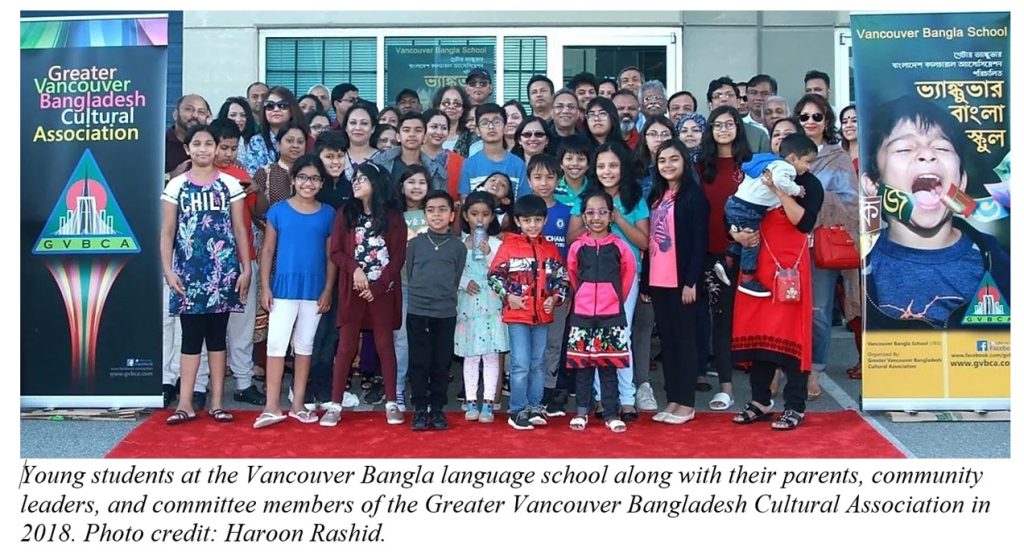
The Association has facilitated some other intermittent services to the community. The first Bengali language school (Vancouver Bangla School) was established under the umbrella of GVBCA in 2018. Bangladeshi Canadian children received Bangla language classes offered on a weekly basis for free or small donation. Several volunteer teachers used to run the classes. After the Covid pandemic shut down, the in-person classes were transferred online with the leadership, technical and online resource support provided by a graduate student at UBC faculty of Education. The virtual school has reportedly attracted more children from beyond the city or even province.
Another important service includes temporary consular services offered by the Consulate General of Bangladesh for Bangladeshi Vancouverites. They visit from Toronto and set up a temporary office or camp once in a few years, coordinated and supported by the Association. The email listserv and Facebook page of the Association serve as important media for making public announcements about programmes and events, and for sharing important news among community members, especially newcomers.
In short, GVBCA plays a central role in community development, inclusion and unification of community members of diverse ages, regions, religions, educational, professional, and socioeconomic backgrounds. While there are many other cultural, social, sprots, religious and professional groups and organizations convened by the Bangladeshi community members, they usually come together under the banner of the Association to reach out and connect with each other. By celebrating the national days and heritage of Bangladesh under GVBCA in a unifying and befitting manner, the diaspora celebrates a common identity as Bangladeshi Canadians.
Roadblocks and the path ahead
There are many challenges of organizing and maintaining organized activities among the first-generation ethnic minority immigrants as they struggle to settle and integrate financially and socially in Canada. A lack of accessible childcare system in Canada creates additional barrier for families with young children. Unlike the Punjabi and Chinese multigenerational families, most Bangladeshis do not enjoy support from extended family members.
Run by volunteers, the Association programmes and events are supported by charity and/or sponsorships from a few business owners and well-established community members while the majority are engaged in service-oriented and professional jobs. The EC members donate a significant amount of time, energy and resources to manage the operation and organization of programmes and events. For example, during my tenure as the General Secretary, there were 13 EC meetings in a year demanding at least 40 hours. Additional 40 to 50 hours were spent by each member to plan, organize, coordinate, attend and perform at different events.
Limited funding and resources make it extremely difficult to organize events with free access to everyone. Presenting a good quality show/production with local amateur artists is quite challenging too. Limited funds do not allow adequate involvement of professional artists and trainers. Although there are many talented artists and performers in the community, a lack of funds, time and common space for rehearsals present a lot of hurdles to maintaining a high standard of the programmes and performances.
Organizing too many programmes a year with two little time and resources does not do justice to the quality of the programmes either. While volunteerism is the central value of community organizing, GVBCA needs an improved system to recruit, engage, manage and reward the volunteers, especially youth. A more systematic approach to coordination, training, and accreditation of volunteer services and hours based on skills and interests would motivate and reward volunteerism more effectively. A volunteer coordinator position can be created under the EC for better efficiency and professionalism.
The youth and second-generation folks undergo some unique struggles to fit into two different cultures and to cope with the tensions between opposing values and norms. They most often do not show the same level of passion to preserve and practice the “home” culture and traditions since they also prioritize fitting into the mainstream culture.
Thus, it is challenging as much as it is important to involve them in leadership and make them feel included and heard in the activities of GVBCA. Similarly, with the growing population and diversity in the community, organizing inclusive programmes and events for the whole community will become increasingly challenging, especially when the community tends to be polarized according to political ideologies and agendas.
The Association can also do better in integrating Bangladeshi arts, culture, music and literature into the mainstream by connecting and collaborating with other ethnic or multicultural groups and organizations, and by organizing or participating in more intercultural activities, festivals and events. Our youth and second-generation children can be supported to take leads in such intercultural activities which will eventually enrich Canadian multiculturalism. It can engage in mainstream cultural activities through organizing, sponsoring or supporting radio and TV shows on local multicultural channels.
There are limited culturally appropriate settlement services available for Bangladeshi immigrants in Metro Vancouver. There is an expectation for the biggest organization in the community to be involved in providing information and services to fulfil more material needs of immigrants, especially newcomers. GVBCA can lead some projects to provide social and settlement services and programmes alongside its cultural activities. The Association needs to prioritize, optimize and balance all these expectations and activities within limited resources. The community leaders and organizers must apply for government grants, raise funds and improve resources.
The Bangladeshi community, like many other communities, is often viewed through a hegemonic lens. As a Muslim-majority group, religious preferences along with male dominance are often reflected in many Association activities, even though it is expected to be secular, non-communal and non-partisan. More attention and care need to be invested in ensuring better representation of gender, religion, age, abilities and other demographic diversity in leadership and governance.
Given the limited funding and resources available, however, GVBCA has been very successful in consistently organizing all the important national days and events of Bangladesh for more than 20 years. It has provided a common platform for Bangladeshi immigrants in the Lower Mainland to come together to share and celebrate cultural heritage and build a sense of community and “home.” It has nourished the roots of Bangladeshi diaspora and supported them to carve out a new identity as Bangladeshi Bengali Canadians.
Nonetheless, for sustainability, inclusivity and successful integration into multicultural Canadian society, the Association need to listen to the diverse voices of its members and tap into community funding opportunities. It must promote non-partisan, secular and inclusive values that Canada as a country and nation attempts to uphold.
As we are living in an era of poly-crisis, global climate change being one of the central issues, Canadian leaders and policy makers are trying to integrate Indigenous knowledge and worldviews with scientific practices to address those crises. The community sector is also trying to collaborate with Indigenous groups and leaders to learn about decolonizing approaches and integrate those into policies, operations and practices for community building.
The GVBCA can build bridges between the Indigenous and Bangladeshi communities and work together to undermine systemic racism, economic and social inequities and join hands in promoting social justice in Canada.

Sanzida Habib
Sanzida Habib, PhD; is an independent scholar, community educator and activist based in Vancouver, Canada.

