
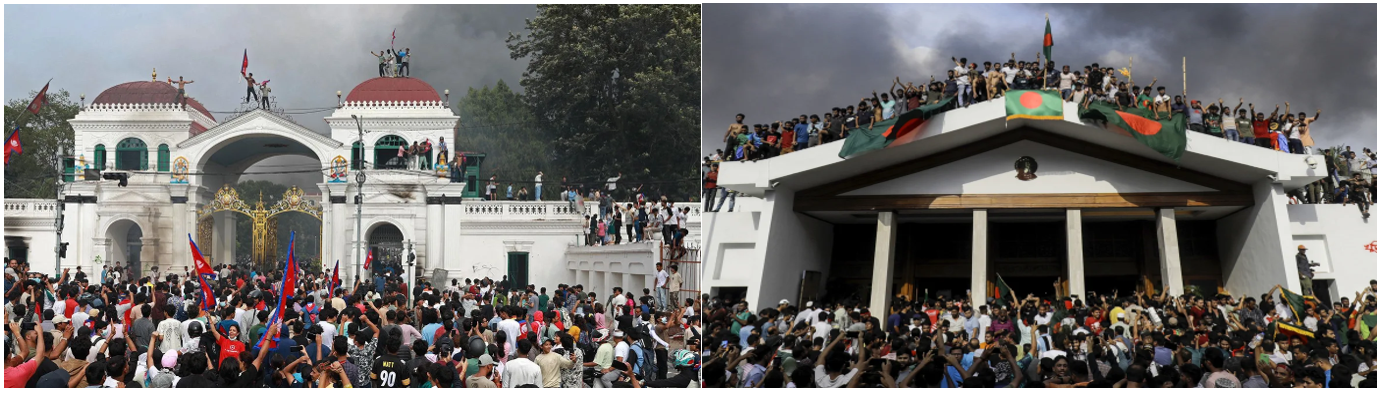
The political upheavals in South Asia over the past couple of years have revealed a striking generational shift. In Nepal, Gen Z activists and organizers achieved a peaceful electoral victory that reshaped the country’s political landscape.
In Bangladesh, the same generation—fresh from toppling the autocratic Hasina regime on August 5, 2024—entered the 2026 election with high expectations. The Awami League (AL) that ruled the country since 2008 by consolidating power through fraudulent means and repressions of political opponents, was banned from taking part in the polls. Pre‑election surveys suggested that the National Citizen Party (NCP), a youth‑driven movement, would perform strongly, especially in the 11‑party alliance with Jamaat‑e‑Islami (JI). The JI-led 11-party alliance was projected to secure at least half the seats, as young voters (18–37 years old) who make up 44 per cent of the electorate were likely to determine the outcome, along with undecided voters. Meanwhile, nearly 48 per cent of AL voters were shifting to the Bangladesh Nationalist Party (BNP), long tainted by corruption and dynastic politics.
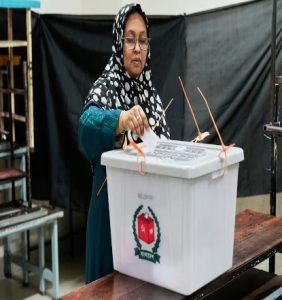 However, the results defied expectations. The 11‑party JI–NCP alliance won a total of 77 seats: JI secured 68, NCP managed only 6, and the remaining seats went to smaller coalition partners. The BNP, in contrast, won a landslide 212 seats, giving it a two-thirds majority. Voter turnout was low, with only 59.44 per cent of eligible voters casting ballots. Many observers described the outcome as “election engineering,” while others suggested that AL supporters shifted their votes to the BNP, often viewed as the old regime’s B-team.
Yet even with these structural distortions, the central question remains: why did Nepal’s Gen Z succeed where Bangladesh’s Gen Z stumbled? And what lessons can Bangladeshi youth draw from Nepal’s example?
This essay explores three dimensions of the contrast: organizational strategy, political culture, and institutional environment.
- Organizational strategy: Nepal’s cohesion vs. Bangladesh’s fragmentation
One of the clearest differences lies in how youth movements organized themselves.
Nepal: Unified, disciplined, and strategically patient
Nepal’s Gen Z activists spent years building networks across universities, civil society groups, and local communities. Their rise was not sudden; it was the culmination of:
- Grassroots organizing that reached rural and urban voters alike
- Clear messaging centred on anti-corruption, transparency, and generational renewal
- Internal discipline, avoiding public infighting or factionalism
- Strategic alliances that did not dilute their identity or autonomy
Crucially, Nepal’s youth movement understood that electoral success requires more than moral legitimacy. It requires infrastructure—polling agents, legal teams, media outreach, and voter‑mobilization machinery. They built these patiently.
Bangladesh: A movement without a machine
Bangladesh’s Gen Z, despite their revolutionary energy, lacked the organizational depth needed for a national election. Their success in toppling the Hasina regime created a sense of momentum, but not necessarily a durable political structure.
Several weaknesses became apparent:
- NCP was new, untested, and organizationally thin
- Alliance with JI overshadowed NCP’s identity, making it appear junior and dependent
- Youth activists were more comfortable with protest politics than electoral logistics
- Polling agents and vote protection mechanisms were insufficient, leaving them vulnerable to manipulation
Even if election engineering occurred, the absence of a robust electoral machine made it easier for opponents to exploit weaknesses.
- Political culture: Nepal’s openness vs. Bangladesh’s entrenched partisanship
Nepal: A society ready for generational change
Nepal’s political culture has long been fluid. The monarchy’s fall, the Maoist insurgency, and repeated constitutional transformations created a public accustomed to political experimentation. Voters were willing to give young leaders a chance because:
- Traditional parties had exhausted public patience
- Youth leaders articulated a hopeful, forward looking narrative
- The electorate saw generational change as a national necessity
In short, Nepalese society was primed for a peaceful youth takeover.
Bangladesh: A society polarized by decades of two‑party dominance
Bangladesh’s political culture is far more rigid. For over three decades, politics has been dominated by two dynastic parties—Awami League and BNP—whose rivalry shaped every institution, from bureaucracy to media to local administration.
Even after the fall of the Hasina regime, this entrenched polarization persisted:
- Many voters defaulted to familiar party labels
- Older generations distrusted new parties
- Youth movements struggled to break through the BNP–AL binary
- Religious, regional, and class divisions complicated coalition building
In such an environment, Gen Z enthusiasm alone could not overcome decades of political conditioning.
- Institutional environment: Nepal’s fairer playing field vs. Bangladesh’s structural constraints
Nepal: Institutions allowed competition
Nepal’s electoral institutions — while imperfect — were relatively neutral. The Election Commission, judiciary, and media maintained enough independence to prevent large‑scale manipulation. Youth candidates could compete on a reasonably level field.
Bangladesh: Institutions still shaped by old regimes
Even after the fall of the Hasina regime, Bangladesh’s institutions did not transform overnight. Key challenges remained: the Election Commission’s credibility issues, local administration still influenced by old networks, media ecosystems shaped by decades of political patronage and mostly owned by oligarchs, a highly polarized and fragile civil sphere, and security forces not fully neutralized.
Compounding these constraints was the fact that the bureaucracy — both administrative and military — remained largely untouched by the revolution. The old guard, many of whom had benefited from the system since at least 2008, continued to occupy key posts. Their presence created a stalemate environment that weakened the interim government and eroded public confidence. The Yunus‑led interim administration, headed by an 85‑year‑old figure with little appetite for sweeping reform, struggled to assert authority or deliver a credible election. With limited time to prepare, the 11‑party JI‑led alliance entered the polls with severe disadvantages. As many analysts observed, transformational change succeeds only when driven by committed agents of the revolution—not by hesitant caretakers or figures perceived as disconnected from the movement’s goals.
In such a landscape, a new party like NCP faced structural disadvantages that Nepal’s youth did not.
What can Bangladeshi Gen Z learn from Nepal
The contrast between the two countries offers several lessons.
- Build long‑term organizational capacity
Revolutions create openings, but elections require machinery. Bangladeshi youth must invest in:
- Local committees
- Polling agents
- Legal teams
- Data analytics
- Voter education campaigns
Without these, enthusiasm cannot translate into seats.
- Maintain a distinct political identity
NCP’s alliance with JI may have diluted its appeal among secular youth and urban middle classes. Nepal’s youth movements succeeded because they remained unambiguously youth‑led.
- Engage older generations, not just peers
Nepal’s Gen Z built cross‑generational coalitions. Bangladeshi youth must similarly persuade:
- Rural elders
- Women voters
- Religious communities
- Working class constituencies
A youth movement cannot win if it speaks only to itself.
- Prepare for institutional resistance
Bangladesh’s youth must anticipate structural obstacles and develop strategies to counter them—through legal advocacy, election monitoring, and international observation.
- Shift from protest to governance mindset
Toppling a regime is one skill; governing is another. Nepal’s youth demonstrated readiness to govern. Bangladeshi youth must articulate:
- Policy platforms
- Economic visions
- Governance models
- Anti-corruption frameworks
Voters reward clarity and competence.
 Conclusion
The divergent outcomes in Nepal and Bangladesh are not simply stories of success and failure. They reflect different political cultures, institutional landscapes, and levels of organizational maturity. Nepal’s Gen Z triumphed because they combined moral legitimacy with strategic discipline. Bangladesh’s Gen Z, despite their courage and revolutionary spirit, entered the electoral arena before building the structures needed to protect their vote and project their message.
Yet the story is far from over. Bangladesh’s youth (aged 15-34 years), constituting roughly 55 per cent of the population, remain the country’s most dynamic force. If they learn from Nepal—by building durable institutions, cultivating broad coalitions, and preparing for the long game with a clear vision, mission, and roadmap—they can still reshape their nation’s future. Ultimately, the next chapter will depend on whether they can transform their movement into a political machine capable of winning not only the streets, but the ballot box.
Bangladesh as a whole also should learn from Nepal. In order to harness the power of the youth, the Interim Government of Nepal lowered the legal voting age from 18 to 16. However, a similar move by the Head of the Bangladesh’s Interim Government Professor Yunus was resisted by the entrenched political class. Speaking as the Chief Guest in December at the Forum for Bangladesh Studies, Professor Yunus said, “To give their (youth) opinion on their own future, I think the voting age for them should be fixed at 17 years”. The youth of Bangladesh must press this issue to realize their political rights.

Habib Siddiqui
Habib Siddiqui, with doctoral research works in California in chemical and nuclear engineering, is an internationally recognized expert on operational excellence. He has successfully deployed the change initiative for four major multi-national corporations, including the BASF where he is currently employed. He has four decades of experience in peaceful activism, especially in defense of the rights of displaced people. He has authored 20 books and more than 1,000 opinion pieces on religion, history, culture and civilization of Muslim people; international politics, political Islam, political leadership, strategic and security issues; terrorism and democracy in the Muslim world. E-mail: saeva@aol.com

