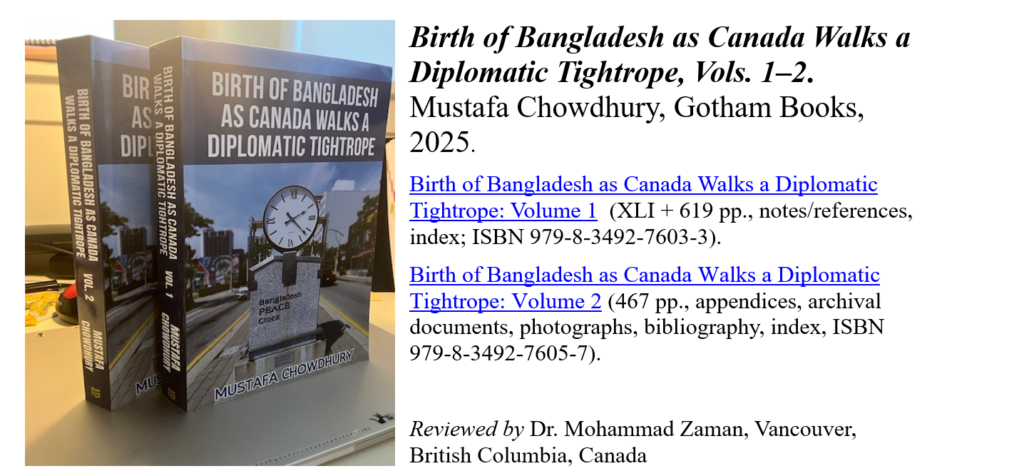
Birth of Bangladesh as Canada Walks a Diplomatic Tightrope, Vols. 1–2 by Mustafa Chowdhury is an ambitious contribution to the historiography of the Bangladesh Liberation War and to scholarship on Canadian foreign policy during the late Cold War era. Drawing on his experience as a former member of Canada’s public service and as an Ottawa-based researcher, Chowdhury brings to this two-volume study a distinctive institutional perspective and access to diplomatic and archival materials not readily available to general readers. Further, rather than approaching the emergence of Bangladesh solely through the conventional regional frame of Pakistan, India, and Bangladesh, the work examines how Canada, as a middle power, interpreted and responded to a crisis involving civil conflict, mass displacement, democratic rupture, humanitarian emergency, Cold War geopolitics, Commonwealth diplomacy, and contested sovereignty. By placing Canada at the centre of the analysis, Chowdhury broadens the field of inquiry and foregrounds the roles of federal officials, parliamentarians, journalists, non-governmental organizations, religious groups, Bengali Canadians, and wider civil society in shaping public and diplomatic responses.
The book and its contents
The book’s title encapsulates its central analytical claim: Canada’s response required a sustained negotiation between moral responsibility and diplomatic restraint. On one side were the humanitarian and democratic imperatives generated by the military crackdown in East Pakistan (now Bangladesh), the electoral mandate of Sheikh Mujibur Rahman and the Awami League, the refugee crisis in India, and the growing intensity of public concern in Canada. On the other were Canada’s adherence to non-intervention, its caution toward secessionist movements, its respect for Pakistan’s territorial integrity, and its preference for multilateral engagement through institutions such as the United Nations and the Commonwealth. Chowdhury therefore presents Canada neither as an indifferent bystander nor as a decisive liberating actor, but as a state attempting to reconcile ethical concern with the conventions, constraints, and ambiguities of diplomatic practice.
Volume 1, comprising six chapters along with a foreword, preface, and acknowledgements, establishes the empirical and conceptual foundation for the book’s argument by tracing Canadian reactions during the early and middle stages of the Bangladesh’s Liberation War and related humanitarian crises. It addresses the political context of Canada-Pakistan relations, the military operation in East Pakistan, Canada’s initial diplomatic posture, Canadian media coverage, civil society mobilization, non-governmental relief initiatives, and parliamentary debate. The volume demonstrates that Canadian officials recognized the gravity of the crisis and were receptive to democratic and humanitarian claims, yet remained reluctant to endorse any position that could be interpreted as a support for the territorial dismemberment of Pakistan. This caution was shaped in part by Canada’s own domestic experience with Quebec separatism, including the activities of the Front de libération du Québec (FLQ) and the 1970 October Crisis. Consequently, Canadian policy emphasized relief, constitutional resolution, and multilateral procedure while avoiding an explicit public commitment to Bangladeshi independence during the conflict’s earlier phases.
Volume 2 comprises four substantive chapters, accompanied by a selected bibliography and fourteen appendices, including a glossary, a chronology of events, archival documents and reports, records of debates in the Canadian Parliament, photographs of political figures and individuals involved in the Bangladesh movement in Canadian cities, and an index. These supplementary materials amount to approximately 175 pages and significantly enhance the documentary value of the volume. Taken together, Volume 2 extends the analysis from crisis response to recognition and reconstruction. It examines Canada’s diplomatic initiatives, policy dilemmas, decision-making chronology, formal recognition of Bangladesh after independence, and allocation of resources for postwar reconstruction. This transition is analytically important because it demonstrates how Canada’s policy options shifted once Bangladeshi statehood became a political reality. Prior to independence, recognition raised complex questions concerning intervention, sovereignty, and precedent; after independence, Canada was able to pursue bilateral engagement, development assistance, and reconstruction support more openly. Canada formally established diplomatic relations with Bangladesh in 1972. The movement from caution to cooperation thus constitutes one of the book’s principal interpretive arcs.
The study is especially persuasive in its treatment of diplomacy as a field structured by competing pressures rather than as a linear succession of official decisions. Chowdhury locates Canadian policy at the intersection of multiple forces: the moral claims advanced on behalf of the Bengali population, the democratic legitimacy conferred by the Awami League’s electoral victory, the humanitarian burden placed on India by the arrival of millions of refugees, the escalating risk of interstate war between India and Pakistan, the strategic orientation of the United States under the Nixon administration, and Canada’s domestic preoccupation with constitutional unity under Prime Minister Pierre Elloit Trudeau. Particularly illuminating is the discussion of Canadian concerns about possible analogies between Bangladesh and Quebec separatism, which demonstrates that foreign policy is frequently shaped not only by external developments but also by domestic political assumptions and anxieties.
A further contribution lies in the book’s expansive conception of political agency. The narrative does not confine itself to cabinet-level decision-making or diplomatic correspondence. It also examines the work of journalists, NGOs, Bengali-speaking Canadians, parliamentarians, religious organizations, and concerned citizens who helped transform the crisis into a matter of Canadian public debate. This broader approach shows that Canada’s response to Bangladesh was not only a product of statecraft; it was also mediated by moral advocacy, humanitarian mobilization, and public pressure. In this respect, the book demonstrates how distant conflicts can become embedded in domestic political discourse and civic action.
Key strengths of the book
The book’s major strength is its originality of perspective. Much scholarship and public memory surrounding the 1971 Bangladesh Crisis have focused on Pakistan’s military regime, Bengali nationalism, Indian intervention, or the policies of major powers such as the United States, China, and the Soviet Union. Chowdhury instead foregrounds Canada, a State that did not determine the outcome of the conflict but nonetheless participated in its diplomatic and humanitarian dimensions. This approach expands the analytical geography of the Bangladesh Liberation War and contributes to a more differentiated understanding of how middle powers respond to crises of sovereignty, democracy, and mass violence.
A second strength is the book’s sustained attention to the distinction between humanitarian engagement and political recognition. Chowdhury demonstrates that Canada’s avoidance of an early declaratory position on independence did not amount to passivity. Canada prioritized relief for Bengali victims and displaced populations, supported national and international relief organizations, encouraged restraint, and worked through multilateral channels. This distinction resists a binary interpretation of Canadian policy as either morally courageous or politically evasive. Instead, the book presents policy-making under constraint, uncertainty, and competing normative commitments.
The incorporation of Canadian public opinion and parliamentary debate into the historical analysis is another major strength. By engaging media coverage, NGO activism, and debates in the House of Commons and Senate, Chowdhury shows how knowledge of the crisis circulated within Canadian society and how public pressure interacted with official policy. These sections challenge the assumption that foreign policy is produced exclusively within executive institutions. Rather, the book suggests that humanitarian crises can generate wider democratic constituencies that influence the priorities, language, and limits of government action.
Finally, the work’s scale and breadth constitute an important strength. Across two volumes, Chowdhury assembles a wide range of institutions, actors, and events into a detailed account of Canada’s evolving position. The study is particularly useful for scholars, students, policymakers, members of the Bangladeshi diaspora, and readers interested in Canada-Bangladesh relations. Its documentation of the movement from hesitation during the conflict to recognition and reconstruction after Bangladesh’s birth makes it a valuable reference for analyzing the interaction of humanitarian concern, democratic values, and diplomatic caution in 1971.
Weaknesses
The book’s principal limitation is its density. Together, the two volumes run to nearly 1,000 pages. The accumulation of detail was perhaps demanding, because Chowdhury addresses government policy, parliamentary questions, media coverage, NGO activity, public advocacy, diplomatic chronology, and postwar reconstruction. For specialist readers, this breadth enhances the evidentiary value of the study and makes it a rich documentary resource. For general readers, however, the narrative may at times feel overburdened, especially where extensive institutional detail slows the interpretive momentum. A more selective synthesis at key points might have helped readers distinguish more easily between essential developments and supporting documentation.
A second limitation concerns the balance between diplomatic analysis and human experience. The Canadian focus is original and productive, yet it inevitably places the lived realities of the Bangladesh Liberation War—violence, displacement, resistance, refugee suffering, and social trauma—at some distance from the centre of the narrative. Contemporary summaries of the conflict emphasize that the war began after the Pakistani military crackdown of March 1971 and ended with Bangladesh’s independence in December 1971, while the refugee crisis involved millions of displaced people who fled to India. Readers seeking a more people-centred or experiential account of the war may therefore find that such dimensions function largely as contextual background to Canadian policy. This limitation does not undermine the book’s purpose, but it does shape the kind of historical understanding the work most effectively provides. There is also an issue with the degree of prior contextual knowledge the book appears to have missed. Readers unfamiliar with the 1970 Pakistani election, the Awami League’s mandate, Yahya Khan’s military regime, India’s regional position, the refugee crisis, Cold War alignments, and Canada’s domestic constitutional debates may need additional orientation.
Another concern is the lack of critical distance. Given the moral force of the subject and its close connection to Bangladesh’s national history, the book at times appears more invested in documenting Canadian concern and assistance than in systematically interrogating the adequacy of that assistance. A more explicit evaluative framework could have further examined whether Canadian caution delayed moral clarity; whether reliance on multilateral channels was sufficient in the face of mass violence; and whether domestic concerns about separatist precedent were analytically justified or politically evasive. These questions are implicit in the material, but they would benefit from more sustained critical development.
Overall assessment
Overall, Birth of Bangladesh as Canada Walks a Diplomatic Tightrope, Vols. 1–2 is a significant contribution to the historiography of Bangladesh’s emergence and to scholarship on Canadian foreign policy. Its principal achievement lies in recovering a middle-power perspective on a major international crisis and demonstrating how humanitarian concern, democratic principle, public advocacy, diplomatic restraint, and domestic political anxiety converged in Canada’s response. Chowdhury’s Canada is neither a decisive architect of Bangladesh’s independence nor a passive observer of events. It is instead a cautious participant whose conduct reveals the limits and possibilities of ethical action within diplomatic constraints.
The book’s strengths ultimately outweigh its limitations. Its originality of focus, breadth of documentation, attention to civil society, and sophisticated account of neutrality make it an important scholarly work. At the same time, its density, specialized orientation, and limited narrative immediacy may reduce its accessibility for non-specialist audiences. The study is best suited to readers seeking a rigorous account of Canada’s response to the 1971 crisis rather than a dramatic narrative of the liberation war itself. As a critical work, it raises a broader question central to humanitarian diplomacy: when a democratic state seeks to preserve neutrality, what obligations does it retain toward democracy, human rights, and national self-determination?
In this respect, Chowdhury’s study extends beyond the immediate history of Bangladesh and Canada in 1971. It illuminates the recurring dilemmas democratic states face when moral urgency collides with diplomatic caution. The book shows that Canada’s eventual relationship with Bangladesh emerged from a complex foundation of hesitation, sympathy, relief work, civic mobilization, and postwar support. For scholars and readers interested in Bangladesh’s liberation, Canadian foreign policy, diaspora activism, and the politics of humanitarian response, the work is both substantive and valuable. Its limitations do not diminish its significance; rather, they underscore the inherent difficulty of writing a comprehensive diplomatic history of an event whose human consequences were profound.

Mohammad Zaman
Dr. Mohammad Zaman is an internationally known development/ resettlement specialist. He has worked in many major projects for the World Bank in Bangladesh and in other countries in Asia and Africa. Dr. Zaman’s most recent edited book (co-editor Mustafa Alam) is titled Living on the Edge: Char Dwellers in Bangladesh, Springer, 2021. E-mail: mqzaman.bc@gmail.com