Introduction
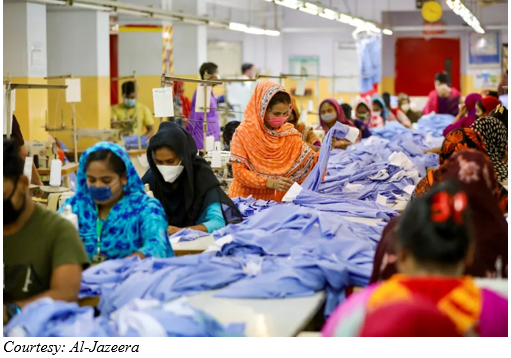
Bangladesh’s development story is both a qualified success and a cautionary tale. From the ravages of post-independence famine, the country emerged as the world’s second-largest apparel exporter, sustaining growth rates many of its neighbours envied. That engine—built on low-cost labour, preferential market access, and a garment industry that absorbed millions of workers—is now beginning to sputter.
Bangladesh is scheduled to graduate from least developed country status in 2026, though a deferral to 2029 is under review. Graduation will narrow preferential market access. Post-graduation tariffs on garments could rise to 9–12% in the European Union alone, with projected annual export losses of up to US$7 billion—a profound risk for an economy in which garments still account for more than 80% of export earnings. Rising wages and competition from Vietnam, Ethiopia, and Cambodia compound the pressure.
This dependence is not simply the result of market forces. Bangladesh’s high import tariffs—often exceeding 25% and compounded by para-tariffs, regulatory barriers, and discretionary exemptions—make it more profitable for firms to sell in the protected domestic market than to compete abroad. This creates a persistent anti-export bias: a hidden tax on exporters who must pay more for imported inputs, machinery, and intermediate goods.
Garments escaped much of this burden through special privileges, particularly duty-free access to imported inputs via bonded warehouse facilities. Other potential export sectors—such as footwear, light engineering, agro-processing—did not receive comparable treatment. The result was a policy regime that unintentionally encouraged export concentration rather than diversification.
Selective industrial policy
The first-order policy response is therefore clear: rationalize tariffs, eliminate discretionary Statutory Regulatory Orders, extend bonded warehouse access to all export-oriented sectors, and allow the exchange rate to be market-determined. But removing a tax on exports merely clears the path; it does not build vehicles. What Bangladesh lacks is diversified production capability. Pharmaceuticals, technical manufacturing, and knowledge-intensive services face coordination failures, learning curves, and knowledge spillovers that price signals alone cannot resolve. These are genuine market failures, and they justify selective industrial policy.
The World Bank’s Chief Economist has finally conceded in March 2026 that three decades of anti-industrial-policy orthodoxy “has the practical value of a floppy disk today”. The IMF has since moved closer to this view; UNCTAD, by contrast, has argued for an active role for industrial policy since its founding. The choice is no longer between liberalization and industrial policy—Bangladesh needs both. A sector qualifies for support when it exhibits latent comparative advantage blocked by coordination failures, knowledge externalities, capital market imperfections, or under-provision of public goods. This is not a license to subsidize every struggling industry; it is a filter for distinguishing productive intervention from rent redistribution.
Potential sectors
Applying this filter, seven sectors emerge as plausible candidates.
- Pharmaceutical exports reach 166 countries, yet Bangladesh imports 85% of its active pharmaceutical ingredients (API) at a cost of US$1.3 billion annually; the stalled API Park at Munshiganj requires urgent infrastructure and regulatory attention before the TRIPS waiver expires in 2033.
- Light engineering has a large enterprise base but fragmented production—shared testing and quality-assurance infrastructure is the natural starting point.
- ICT and digital services reached US$724.6 million in FY2024–25, far short of targets, with promising niches in garment-compliance software, AI training data, and fintech.
- Leather and footwear exports grew 29% to US$620 million, but environmental certification remains a binding constraint no single tannery can meet alone—common effluent treatment infrastructure is the first-rank instrument.
- Shipbuilding has demonstrated capability through export orders of around US$200 million, but requires patient long-term capital.
- Agribusiness and food processing are constrained by chronically under-provided cold-chain infrastructure and collective food-safety coordination.
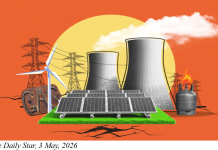
- Green and renewable energy investment is justified by the energy unreliability that constrains diversification across all sectors.
Across these sectors, the diagnosis is consistent: latent comparative advantage is being blocked by market failures. First-rank instruments—quality infrastructure, coordination mechanisms, regulatory reform, and public goods provision—should come first. Directed credit and conditional subsidies should follow only where capital market failures are demonstrable and monitoring capacity exists.
Designing supportive policies
Before any of this is attempted, policymakers should examine the history of the Export Development Fund (EDF). Established in 1989, the EDF grew into a US$7 billion facility whose formal purpose was to diversify exports. By that measure, it failed: Bangladesh’s dependence on garments is as entrenched today as when the fund was created. No meaningful performance conditions were attached, and no sunset clause existed. The fund attracted the organized political attention of the garment lobby and became a permanent entitlement rather than an instrument of structural transformation. The lesson is clear: industrial policy—without discipline, conditionality, and insulation from capture—does not work.
Korea’s industrial policy success rested on credible conditionality—support was explicitly contingent on meeting export targets. Bangladesh’s challenge is to replicate that discipline in a political economy where incentives frequently run in the opposite direction. This requires capture-resistant institutions: a ring-fenced implementation agency with independent governance, performance conditions embedded in primary legislation, hard sunset clauses, and small, transparent pilots before making large bets.
Skills remain an overlooked binding constraint. A training levy of 1–2% of payroll on firms in target sectors—directed into industry-controlled funds—would connect training to employer needs, following Singapore’s model over four decades. Singapore introduced Skill Development Fund (SDF) in 1979 to accelerate its industrial restructuring programme. The SDF funded entirely by the compulsory levy collected from employers. Malaysia also established a similar SDF in December 2000 as a trust fund, later restructured into a corporate body under the Skills Development Fund Act 2004 to provide loans for Technical and Vocational Education and Training (TVET). Such models exist in developed countries as well. A structured diaspora return programme offering salary supplements and tax relief could transfer capabilities that would otherwise take a generation to build domestically.
Conclusion
Bangladesh faces converging pressures: the retreat of globalization, the rise of AI and automation in services, and the impending loss of pharmaceutical advantages quietly sustained by the TRIPS waiver. These carry real timelines, and those timelines are already short.
Seven sectors offer plausible starting points. But the deeper challenge is not identifying candidates—it is building the diversified production capability Bangladesh still lacks and creating the institutional discipline to support it selectively. The knowledge of what needs to be done is not the scarce resource. The discipline to do it honestly is.

M.G. Quibria
M.G. Quibria is an economist and public policy commentator who has written extensively on trade, development, governance, and democratic change in Bangladesh and beyond. His recent book on Bangladesh, Bangladesh’s Road to Long-term Economic Prosperity: Risks and Challenges, was published Macmillan Palgrave (New York). He has recently retired from Morgan State University (MSU), where he served as Professor of Economics. Prior to joining MSU, Dr. Quibria worked at the Asian Development Bank in Manila and at the Asian Development Bank Institute in Tokyo, for more than two decades.