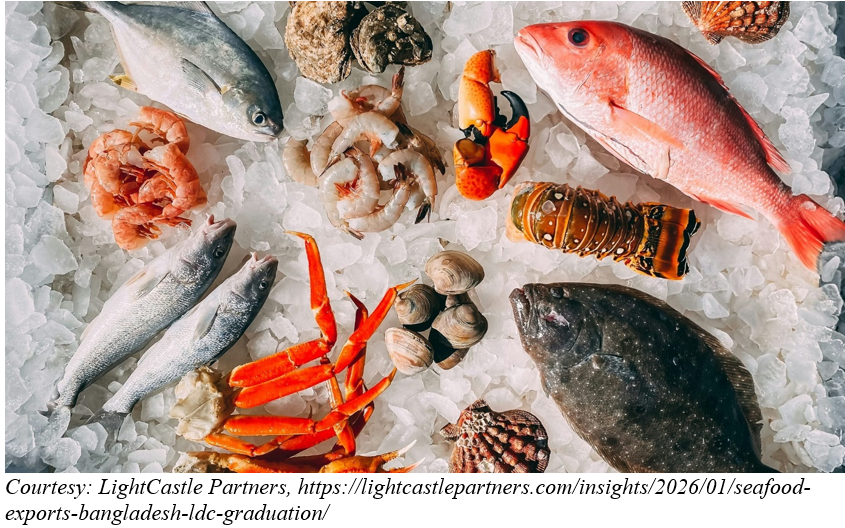
Bangladesh wants to raise shrimp export earnings to US$3 billion by 2030. But Economics teaches us that every choice comes with an “opportunity cost”. When we choose one path, we inevitably give up another. In addition, there is the issue of externality – such as adverse impacts on the environment. This brings us to a critical question for Bangladesh:
Should we prioritize the “White Gold” of shrimp farming and export earnings or protect the “Golden Soil” that sustains our agriculture, food security, and rural livelihoods?
At first glance, the choice seems straightforward. Shrimp exports generate valuable foreign exchange, create employment, and contribute significantly to the economy. Yet the expansion of shrimp farming has also raised concerns about soil salinity, agricultural productivity, environmental sustainability, and the long-term well-being of local communities.
But does this really have to be an either-or decision?
Perhaps the real challenge is not choosing between White Gold and Golden Soil, but finding a way to preserve both. Through strategic policies, sustainable farming practices, proper land-use planning, and effective regulation, can we strike a balance where shrimp farming continues to drive economic growth without sacrificing the fertility of our land?
The question, then, is no longer “Which one should we choose?” but rather it should be
“How can we ensure that the pursuit of White Gold does not come at the cost of our Golden Soil?”
Fisheries export from Bangladesh
“Machhe Bhate Bangali” is more than a popular saying. It reflects the deep connection between fisheries and the economic, social, and cultural fabric of Bangladesh. The fisheries sector plays a vital role in ensuring food security, employment, and economic growth. Around 12% of the country’s population depends on fisheries for their livelihood, while the sector contributes 2.53% to the national GDP and 22.26% to agricultural GDP. It also supplies nearly 60% of Bangladesh’s animal protein intake.
In the 2024–25 fiscal year, Bangladesh produced 5.018 million tonnes of fish and exported approximately 91,000 metric tonnes of fish and fisheries products worth Tk. 6,145 crore. More than 20 million people, including 1.4 million women, are directly or indirectly engaged in fisheries-related activities.
The industry is dominated by shrimp (notably black tiger prawns), with shrimp alone accounting for roughly 80% of Bangladesh’s total seafood export value. The European Union is the largest buyer of Bangladeshi shrimp, thanks to duty-free access under the LDC (Least Developed Country) trade regime.
Table 1: Fish production quantity and export value
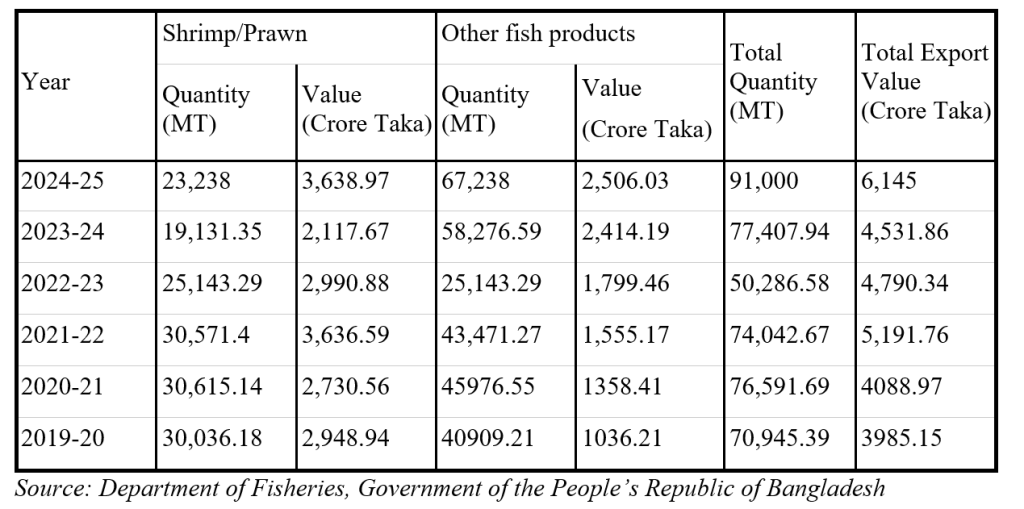 Bangladesh is now exporting fish and fish-made products to over 50 countries across the world. Table 1 shows the growth of the fishery sector. In the fiscal year 2019-20, Bangladesh produced 70,945.39 metric tonnes of fish and earned Tk. 3,985.15 crore from exports. In only 5 years, the
  production increased to 91,000 metric tonnes and export earnings to Tk. 6,145 crore in fiscal year 2024-25.
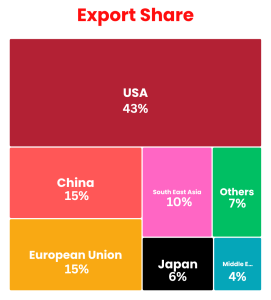
The top 10 export destination countries are the Netherlands, Belgium, Germany, the United Kingdom, China, India, France, America, Japan, and Russia. The remaining share is exported to markets in Southeast Asia and the Middle East.
The country’s major export items include raw block-frozen shrimp, IQF shrimp and white fish, PUD and P&D block-frozen shrimp, consumer packs of raw frozen shrimp, chilled and frozen Hilsa, dried, salted, and dehydrated fish, live fish, eel, crab, and a limited quantity of value-added fish and shrimp products.
Contributions of shrimp sub-sector
Bangladesh is widely recognized as one of the most suitable countries in the world for shrimp farming because of its favourable resources and agroclimatic conditions. With their combined annual contribution of US$360 to US$365 million, marine shrimp and freshwater prawn exports Bangladesh is currently the 8th largest shrimp exporting country in Asia. Bangladesh’s shrimp industry shares 10 % of the global area and 3.7 % of global production.
Exports: Bangladesh’s frozen fish & shrimp export sector bounced back strongly in FY 2024–25, recording a 19.33% rise to US$388.7 million, driven largely by growing demand from India and China. Shrimp exports, totalling 23,238 metric tonnes worth US$296.29 million, led the recovery despite a 21% decline in fish catch and challenges in shrimp farming.
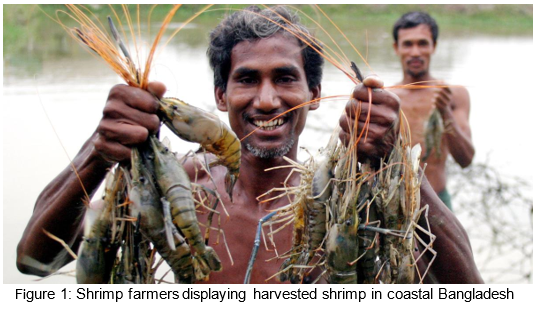
Table 2: Shares of shrimp in total fish exports (volume & value)
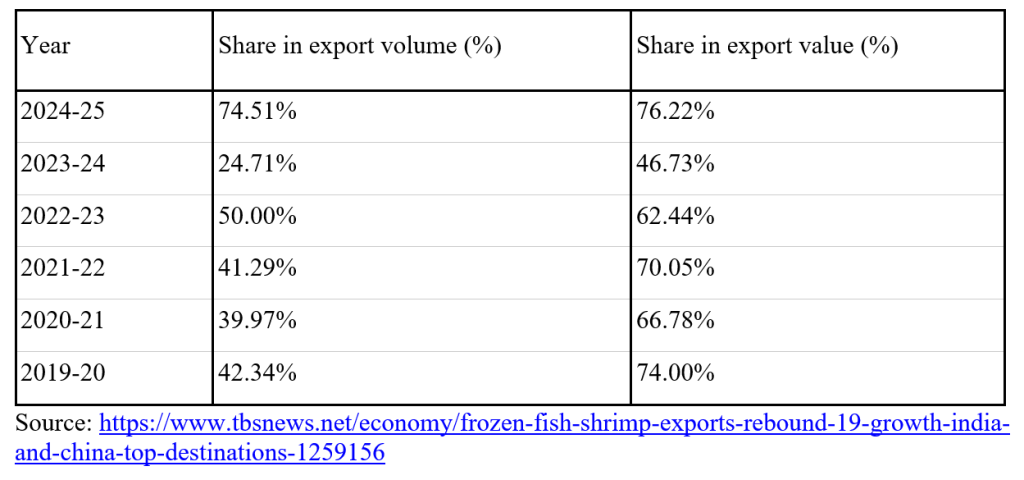 Table 2 shows that the contribution of shrimp and prawn to fish export earnings is disproportionately larger than that in fish export volume. For instance, in 2023–24, shrimp accounted for only 24.71% of total export quantity, yet generated 46.73% of total export earnings. This indicates that shrimp is a high-value export commodity, generating significantly higher export revenue per metric ton than other fish products.
Although the quantity share of shrimp exports has generally declined over time, their contribution to export earnings remains substantial, highlighting the strategic importance of the shrimp sector in Bangladesh’s fisheries export industry and its role in earning foreign exchange. In FY 2024–25, the shrimp sector’s share in fish export volume rose dramatically to 74.51% from 24.71% in FY2023-24. Bangladesh exported 91,000 metric tonnes of frozen fish and shrimp/prawns worth US$388.7 million of which 23,238 metric tonnes was frozen shrimp/prawns worth US$296.29 million in FY2024-25, confirming shrimp’s dominant role in Bangladesh’s export-oriented fisheries sector.
Employment generation: More than 20 million people, including 1.4 million women, are directly or indirectly involved in the fisheries sector. It is estimated that shrimp-based industries in Bangladesh directly employ almost 700,000 people with at least 3 million dependents.
According to a report from the Food and Agriculture Organization of the United Nations (FAO), the shrimp sector in Bangladesh employed approximately 1.5 million people in 2019. These workers are involved in various activities related to shrimp farming, including pond preparation, seed collection, stocking, feeding, water management, disease control, harvesting, and processing. Additionally, there are many indirect jobs associated with the shrimp farming industry, such as transportation, marketing, and support services.
Rural development: The major shrimp cultivation areas in Bangladesh are Khulna, Satkhira, Cox’s Bazar, Chittagong, and Bagerhat. All these districts are located in the southern part of Bangladesh, have long coastlines and are suitable for vannamei shrimp farming. Bangladesh has 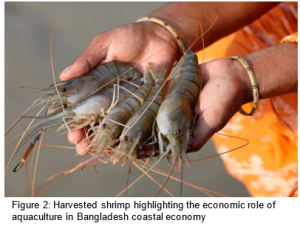 over 55,000 marine shrimp farms that average about 3 ha in size, although single ponds as large as 40 ha still exist.
Shrimp production and exports from Khulna have witnessed a remarkable rebound during the interim government period, reversing years of decline and reviving hopes for the sector once hailed as the country’s “White Gold”.
According to the Export Promotion Bureau (EPB), Khulna earned Tk 11,300 crore from shrimp exports in the last five years from 2021 to 2025, with plans underway to double the figure in the next five years. Exporters in the region fetched Tk 3,483.24 crore from July 2024 to January 2025, up Tk 780.45 crore from the same period a year earlier. During FY 2024-25, Khulna produced 123,151 metric tonnes of shrimp, of which 19,512 metric tonnes were exported, generating Tk2,499 crore. Frozen shrimp exports from Khulna reached 13,019.80 tonnes worth Tk1,990.39 crore, accounting for 42.19% of the country’s total fish exports. From FY 2020-21 to FY 2024-25, the region also exported 153,388 metric tonnes of white fish worth Tk 13,456 crore and 102,340 metric tonnes of shrimp worth Tk 11,301 crore.
Impact of shrimp farming in coastal areas
Environmental and socioeconomic impacts have increasingly become a matter of concern for both government and the public. Objections are often associated with ecological consequences (mangrove destruction, saltwater intrusion, disease outbreak, and pollution), social conflicts, and negative impact on the economy. Ponds are the major source of freshwater in rural Bangladesh. When farms nearby turn saline due to shrimp aquaculture, brackish water seeps into the ground and contaminates the ponds, which become saline as well.
Destruction of the local aquatic ecosystem: Aquaculture production of shrimp becomes the foremost, continuous destroyer of massive areas of tropical wetlands. A variety of shrimp ponds developed alongside the periphery for catching shrimp fry shrinks the reserve location of the mangrove forest.
Human diseases outbreak: The saltwater intake was partly responsible for waterborne diseases’ acceleration, including diarrhoea and dysentery. Additionally, salinity is associated with changes in women’s menstruation and leads to increased miscarriage rates. In addition, drinking water salinity is a significant determining factor of gestational hypertension and infant mortality in coastal Bangladesh.
Salinity intrusion in water and soil layers and impact on agriculture: Shrimp farming invaded soil and water quality in the agrarian land. The unleashed saline water from shrimp ponds consecutively increased the salinity in neighbouring bucolic lands. In southwestern Bangladesh, the mean values of water salinity at the low, medium, and high saline zones were 1.2 – 1.64, 4.25 – 5.14, and 9.75 – 9.17 ppt, respectively. Excessive saline water flow usually enters into the plants by osmosis. Consequently, the agrarian crops were agonized from water starvation and created physiological drought conditions.
A 2019 study by WaterAid Bangladesh looked at 57 ponds in the Shyamnagar sub-district of Satkhira district and found that the water in 16 of them was too salty to drink or be used for cooking; in 25 others, it was still too salty to drink, though it could be used for cooking. And 14 other ponds were out of bounds to residents because they were being used for shrimp aquaculture.
Strategies for shrimp farming
The negative impacts of shrimp farming in coastal Bangladesh can be reduced through planned, regulated, and community-based strategies. Shrimp farming should not be discouraged, as it remains important for export earnings, rural income, and coastal employment. However, the sector must shift from unplanned expansion to a sustainable model that protects farmers, cultivators, freshwater sources, agricultural land, and coastal ecosystems.
- Introduce coastal land-use zoning: A strict coastal land-use zoning policy should be introduced to identify which areas are suitable for shrimp farming and which areas must be protected for rice cultivation, freshwater ponds, homesteads, forests, and community use. Shrimp farming should only be permitted in designated aquaculture zones after assessing salinity levels, soil quality, water availability, and environmental risks. This would reduce land-use conflicts and prevent the careless conversion of productive agricultural land into shrimp ghers.
- Ensure controlled water management: Uncontrolled saline water flow is one of the major causes of soil and freshwater contamination in coastal areas. Sluice gates, canals, embankments, and drainage systems should be properly regulated to prevent saline water from entering nearby agricultural land, ponds, and homesteads. Community-based water management committees should be formed with shrimp farmers, rice farmers, landless workers, local government representatives, and environmental experts to ensure fair and responsible water use.
- Protect freshwater ponds and drinking-water sources: Since ponds are a major source of freshwater in rural Bangladesh, they must be protected from salinity intrusion. Community ponds should be officially marked as protected freshwater zones, and shrimp farms should not be allowed near these ponds without proper barriers and drainage systems. Rainwater harvesting, pond-sand filters, community reservoirs, and safe drinking-water facilities should be expanded in shrimp-producing villages to reduce water insecurity.
- Make environmental licensing and monitoring mandatory: Large shrimp farms should receive approval only after completing environmental and social impact assessments. Farms that cause salinity intrusion, waterlogging, pollution, mangrove destruction, or illegal land occupation should face penalties. At the same time, small farmers should receive technical support so that environmental compliance does not become a financial burden. Monitoring should focus on prevention, early detection, and practical correction.
- Promote integrated and climate-smart farming systems: Instead of depending only on shrimp monoculture, Bangladesh should promote integrated systems such as rice-shrimp, fish-shrimp, prawn-rice, crab-shrimp, and vegetable-fish farming where suitable. These systems can help farmers diversify income, reduce production risks, protect food security, and maintain soil productivity. Integrated farming is especially important for small farmers because it reduces dependence on a single export-oriented crop.
- Ensure disease-free fry and strong hatchery regulation: Disease outbreaks are a major source of financial loss for shrimp farmers. The government should strengthen hatchery monitoring and ensure the supply of certified disease-free post-larvae. Hatcheries must follow proper breeding, testing, and distribution standards so that farmers can avoid losses caused by poor-quality fry. A reliable fry supply system would improve productivity and build confidence across the shrimp value chain.
- Provide farmer training and technical support: Many farmers still rely on traditional shrimp farming methods, which often result in low productivity and high disease risk. Regular training should be provided on pond preparation, stocking density, feed management, water quality testing, disease prevention, and safe harvesting. Local aquaculture extension centres and mobile-based advisory services can help farmers receive timely information on weather, disease alerts, market prices, and improved farming practices.
- Improve access to finance for small farmers: Small farmers often depend on informal lenders and middlemen, making them financially vulnerable during disease outbreaks, cyclones, floods, or price shocks. Banks and microfinance institutions should provide low-interest aquaculture loans, emergency credit, and aquaculture insurance. However, financial support should be linked with sustainable farming practices so that farmers are encouraged to improve productivity without expanding shrimp farming irresponsibly.
- Protect land rights and ensure fair lease agreements: Land-related conflict is one of the most serious social concerns linked to shrimp farming. Written lease agreements should be made mandatory between landowners, cultivators, and investors. Forced land conversion, illegal embankment cutting, and unpaid land leasing must be strictly prevented. Local communities should have the right to participate in decisions that affect their land, water, and livelihoods.
- Include women and vulnerable communities in planning: Shrimp farming affects women and vulnerable communities in specific ways, especially through water scarcity, loss of homestead gardening, increased household burden, and unsafe working conditions. Women should be included in local water management committees and community decision-making platforms. Safe drinking-water access, fair wages, workplace safety, livelihood training, and protection from harassment should be central parts of shrimp-sector planning.
- Protect mangroves, wetlands, and coastal ecosystems: Shrimp farming should not be allowed to expand into mangrove forests, wetlands, natural canals, or ecologically sensitive areas. Mangrove restoration should be promoted in vulnerable coastal zones because mangroves protect communities from cyclones, tidal surges, erosion, and biodiversity loss. Sustainable shrimp farming must work with nature rather than destroy the natural systems that protect coastal communities.
- Strengthen export value-chain governance: Bangladesh must improve the shrimp value chain to remain competitive in international markets. Cold storage, processing, packaging, transport, quality control, certification, traceability, and food safety standards should be strengthened. If farmers receive better prices for responsibly produced shrimp, they will have stronger incentives to follow sustainable farming practices.
- Adopt a community-based shrimp farming model: Shrimp farming decisions should not be made only by investors or individual farm owners. A community-based model can balance the interests of shrimp farmers, rice farmers, landless workers, women, and local households. This would help ensure that shrimp farming remains economically beneficial without creating social conflict or environmental insecurity.
In short, Bangladesh needs to move from unplanned shrimp expansion to planned, zoned, and community-sensitive shrimp farming. The goal should not only be to increase production, but also to protect freshwater sources, agricultural land, coastal ecosystems, and the rights of local communities. With proper planning and regulation, shrimp farming can remain a source of export earnings and rural income without damaging the soil, water, livelihoods, and social harmony of coastal Bangladesh.

Fariza Khan Aishy
Fariza Khan Aishy is an undergraduate economics student passionate about development economics and trade. A research-driven critical thinker, she transforms ideas into sharp analytical writing. With notable achievements from academic competitions, she also serves as the General Secretary of the East West University Economics Club.

H. M. Saif Noor
M. Saif Noor is a quality management and client experience professional with expertise in process optimization, data-driven strategy, and team performance improvement. He has a strong interest in policymaking, economic development, and critical analysis, with a focus on practical solutions to social and economic challenges.