
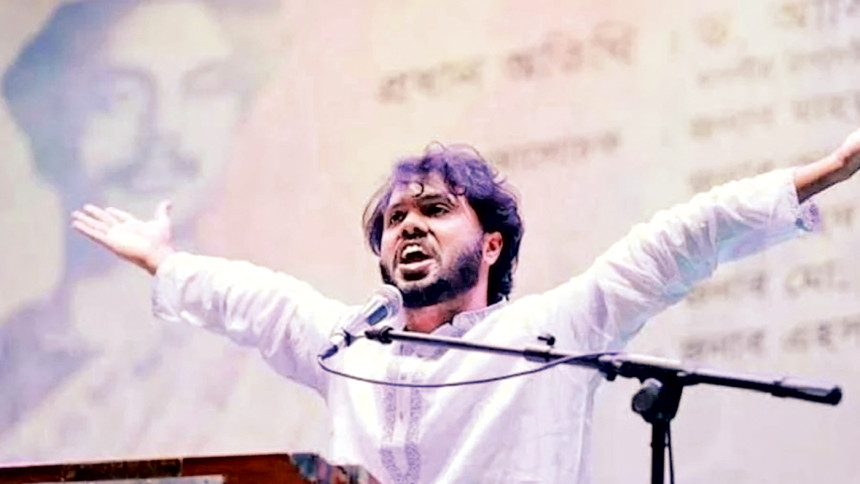
Osman Hadi took a bullet in the service of the people of Bangladesh, standing unwavering in his commitment to building a just nation where citizens can live with dignity, free from fear, subjugation, and oppression. His act of courage was not born of personal ambition or political gain, but of an unshakeable belief in justice, equality, and the moral responsibility that true leadership demands.
At a time when silence is often rewarded and conformity is convenient, Hadi chose conviction over comfort and principle over personal safety. We remember Osman Hadi not merely as a young leader of his time, but as a moral force whose ideas now belong to history and whose vision points toward the future of Bangladesh. His legacy is all-pervasive: moral, political, and societal and will endure far beyond the brevity of his life.Hadi re-centred the national conscience on Insaf: justice, dignity, and fairness not as rhetorical slogans, but as non-negotiable ethical foundations of state and society. At a moment of moral drift, he reminded the nation that no political order can endure without justice at its core.
Hadi ignited a generation with civic courage and moral responsibility. Free from fear, patronage, or transactional politics, young people saw in Hadi a new model of leadership: ethical, principled, and accountable. In doing so, he reshaped the future political character of Bangladesh.
Hadi helped move national thinking beyond entrenched legacy power structures toward people-centric, principled governance. He challenged the inevitability of corruption and coercion, insisting instead that politics could be reclaimed as a moral vocation.
In life, and now in memory, Hadi stands as a symbol of moral resistance: proof that clarity of conscience can confront even the most entrenched systems of injustice. His name has become a quiet but powerful rebuke to oppression and moral compromise.
Transcending party lines, class interests, and social divisions, Hadi offered the nation a shared ethical horizon. His vision of Insaf Bangladesh spoke to the common humanity of all citizens and remains a rare point of unity in a fractured political landscape.
By the integrity he embodied, Hadi set a higher moral standard by which future leaders will inevitably be judged. His life poses an enduring question to those who seek power: Will you serve justice, or merely rule?
The flame that refuses to be extinguished

What was intended to silence Osman Hadi has instead magnified his voice. His sacrifice ignited a moral awakening, stirring millions of consciences inspired by his courage, resilience, and unwavering dedication to the dignity, security, and sovereignty of the nation.
His struggle has transcended the individual and transformed into a collective resolve, an enduring flame sustained by conscience, courage, and an unyielding demand for justice. In this sense, Hadi no longer stands alone; he is reflected in the hearts of countless citizens who refuse to surrender hope for a just society and who are determined to dismantle the toxic political and social disorder that has long drained the nation’s vitality.
The voice of a nation’s emancipation
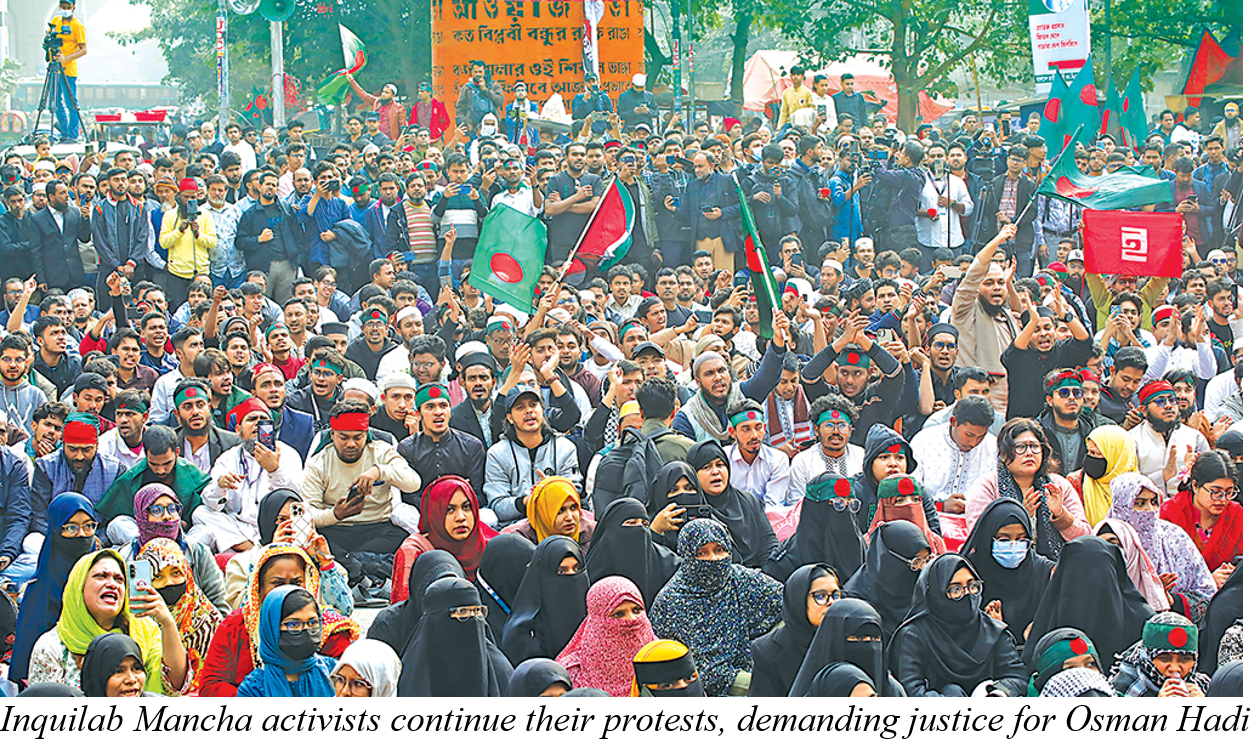
Osman Hadi’s voice has consistently echoed the deepest and most authentic aspirations of the people of Bangladesh: the longing for genuine emancipation from inequality, injustice, discrimination, and fear. He articulated what millions feel yet often hesitate to express, transforming silent frustration into a principled call for moral governance and social justice.
Through clarity and courage, he bridged the long-standing gap between popular suffering and political accountability.
Redefining political leadership through service
As an authentic voice of the people, Hadi championed the ethos of public service, public welfare, and the public good, a refreshingly hopeful and principled departure from entrenched self-serving and partisan politics that have long neglected ordinary citizens, particularly the poor and marginalized.
His genuine care for the common people redefined the very meaning of political leadership in the country. This stands as a salutary legacy of Osman Hadi, setting a higher moral standard for what it truly means to be a leader of the people.
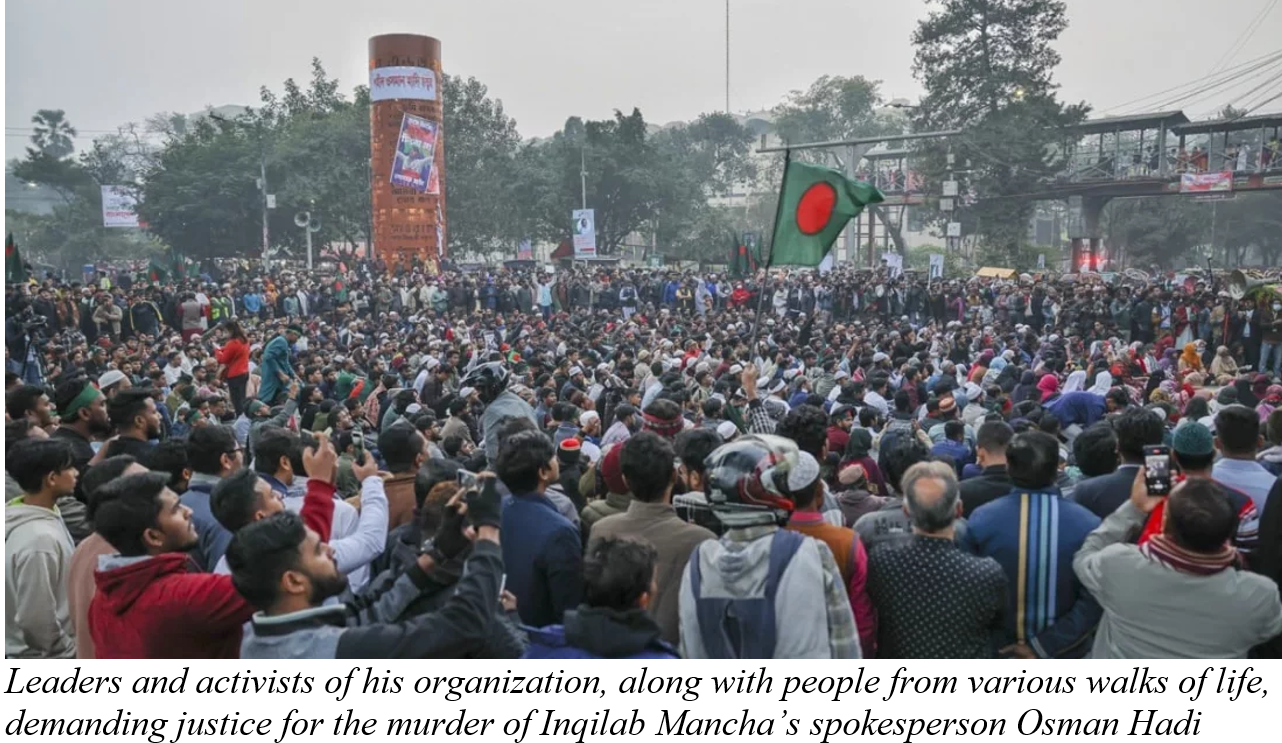
A moral vanguard for justice and governance
In an era marked by cynicism, expediency, and transactional politics, Osman Hadi stands as a moral vanguard in the struggle for justice. His life and leadership reaffirm a timeless truth: where there is moral will, politics can still be grounded in ethics, selflessness, and service to the common good defying the popular belief that politics is inherently amoral.
His courageous voice has shaken the foundations of a political culture long dominated by extortion, greed, and entrenched corruption. His insistence on truth and accountability threatens those who profit from disorder and moral decay, precisely why the attack on him provoked such profound outrage.
Hadi redefined courage not as domination or coercion, but as steadfast commitment to truth, accountability, and the dignity of ordinary people.
A nation indebted to Hadi’s sacrifice
The struggle and sacrifice of Osman Hadi have placed the nation in profound moral debt. This debt cannot be repaid through speeches, slogans, or symbolic tributes. It demands something far more enduring.
The only meaningful way to honour Hadi is to realize the vision for which he stood, a just Bangladesh where citizens live with dignity, free from fear and corruption, and where governance is guided by integrity, accountability, and moral purpose. The responsibility to fulfil this vision now rests collectively upon the people.
As the Chief Advisor, Nobel Laureate said during Hadi’s funeral (Janazah) attended by more than 1.2 million people,
“Hadi, we didn’t come here to bid you farewell; but to make a collective commitment. Today, we have come to promise you that we will fulfil what you stood for. Not just us, but the people of Bangladesh will carry that responsibility. You gave us the mantra. Our heads will never bow. We will carry this spirit in all our work and walk with dignity before the world.”
Honouring Osman Hadi requires more than remembrance. It demands structural reform: rule of law, independent institutions, and accountability. Without translating sacrifice into systemic change, reverence risks becoming ritual rather than renewal.
Only by translating Hadi’s sacrifice into sustained moral and political renewal can the nation repay its debt to Hadi and reclaim its conscience.
Guardians of the nation’s soul: From one Hadi to millions

Hadi’s story stands as a solemn reminder that the soul of a nation is safeguarded by those willing to stand for justice, even at the highest personal cost. This is what Hadi unleashed: a moral awakening that has turned one act of courage into a shared national resolve. Today, millions have become “Hadi” in spirit – citizens emboldened to surmount fear, confront injustice, and carry forward his dream of a Bangladesh founded on Insaf: justice rooted in fairness, accountability, and human dignity. This dream transcends politics; it is a moral commitment to restore the ethical foundations of the nation.
Hadi: The symbol of genuine patriotism
Osman Hadi symbolizes genuine patriotism defined not by slogans or spectacle, but by selflessness, integrity, resilience, and unwavering commitment to the people. His struggle and sacrifice for the welfare, sovereignty, and moral renewal of the nation transcend life itself, becoming an enduring legacy.
In moments when a nation stands at a moral crossroads, history is often shaped not by institutions or slogans, but by individuals whose courage awakens the collective conscience of the people. Osman Hadi’s life and sacrifice belong to such defining moments in Bangladesh’s journey.
His life reminds us that nations endure not because of power, but because of conscience. Hadi stands out for:
A sacrifice beyond the individual
Osman Hadi’s act of taking a bullet in the service of the people represents more than personal bravery. It marks a moral turning point in Bangladesh’s political history where conscience confronted coercion and sacrifice exposed the ethical decay of power sustained by fear and impunity. Hadi’s firm stand forces the nation to reflect on its values and responsibilities.
Moral courage in an age of silence
In a political culture long dominated by expediency, silence, and transactional loyalty where injustice is often normalized, Hadi reaffirmed a timeless truth: politics can still be grounded in ethics, selflessness, and service to the common good. His courage shattered the cynical belief that politics is inherently amoral and reminded the nation that principled resistance remains possible, even amid a bleak trajectory and formidable adversaries.
Rejecting fear, reclaiming politics
Hadi’s courage places a duty on citizens to reject fear and intimidation as a political norm. Silence cannot be the price of survival in a just society. Politics must be reclaimed as public service, grounded in responsibility rather than patronage or power.
The nation’s living conscience
By placing himself in harm’s way for the collective good, Osman Hadi became a living conscience for Bangladesh. His sacrifice compels society to confront uncomfortable questions about complicity, silence, and moral responsibility. In doing so, he transformed personal suffering into a national ethical reckoning.
Bridging the Unfinished Promises of 1971 and the July Uprising
Hadi’s sacrifice bridges the unfulfilled promises of the 1971 Liberation War with the moral awakening of the July uprising. He symbolizes the struggle for a second liberation, not from external rule, but from internal injustice, corruption, and fear. His vision is rooted in Insaf: justice, dignity, and equal citizenship.
Justice beyond partisanship: Insaf for all
Insaf cannot be selective. A just Bangladesh must defend the dignity and rights of all citizens, regardless of political identity. Justice that excludes opponents ceases to be justice at all.
In the lineage of history’s great leaders
Osman Hadi belongs to a lineage of transformative figures whose moral authority reshaped societies and awakened nations. Like Titu Mir, Subhas Chandra Bose, Martin Luther King Jr., and Maulana Bhashani, he embodies resistance rooted in principle, courage grounded in compassion, and leadership anchored in sacrifice.
`Such figures do not merely confront injustice; they redefine the moral boundaries of their time. With the passing of Osman Hadi, Bangladesh has lost not merely a man, but a guardian of democracy, integrity, and moral courage: a true vanguard of Insaf, justice rooted in conscience and equity. In an era marked by expediency and moral compromise, Hadi stood apart as a principled sentinel who refused to surrender ethics at the altar of power.
Osman Hadi represents the possibility of a Bangladesh governed by conscience rather than coercion. His sacrifice places a moral debt upon the nation that can only be repaid through sustained civic courage, ethical leadership, and commitment to justice for all. To fail in this duty would be the ultimate betrayal: acknowledging the sacrifice while abandoning its meaning in both spirit and action.
Osman Hadi embodied an unrelenting struggle against inequality, injustice, and oppression. His life was a testament to the belief that a nation cannot be truly free unless its people live with dignity, fairness, and equal protection under the law. He challenged entrenched injustices not for personal gain, but out of a profound sense of duty to the marginalized and voiceless.
The enduring legacy of an indomitable spirit
Though Osman Hadi is no longer with us, his indomitable spirit endures in the hearts and minds of countless citizens across Bangladesh. His moral clarity, courage, and sacrifice continue to inspire a collective resolve to realize his vision of a Bangladesh founded on Insaf: a nation where justice prevails over fear, and integrity triumphs over impunity.
In life and in death, Hadi remains a legend: an enduring icon of principled leadership who bore the torch of probity and human dignity with unwavering resolve. His legacy is not confined to memory alone; it lives on as a moral imperative for the nation. To honour and to pay debt owed to Hadi is to uphold the values he embodied: justice over expediency, integrity over fear, and service over self-interest. Until those principles are fully realized in the life of the Republic, the conscience he awakened will continue to guide Bangladesh toward the just and humane future he envisioned.
Hadi is history: more precisely, he defines it.
Hadi is humanity in its truest form.
Hadi is an institution grounded in integrity and sacrifice.
Hadi is a revolution of conscience and moral courage.
Hadi is the promise of a new Bangladesh.
That is the enduring legacy of Hadi.
A man of peace and ethical resolve
At his core, Hadi was a man of peace. His call for Insaf sought to reconcile the political, social, and economic contradictions of our nation through justice rather than force. This noble philosophy rooted in fairness and human dignity will remain a guiding light for generations to come.
In essence, Hadi’s legacy lies not only in what he did, but in the ethical compass he left behind, one that continues to guide Bangladesh at a decisive moment in its history.
At the heart of Hadi’s political philosophy was the idea of Insaf Bangladesh: a vision of a nation where no one is left behind in progress, prosperity, and development, and where dignity and justice are shared equally by all citizens.
There is little doubt that Osman Hadi articulates what many believe to be the deepest aspirations of Bangladesh through his soulful ideology of “Insaf Bangladesh”. Hadi’s rapid rise in popularity driven by his deep emotional connection with the people speaks volumes. His vision resonates directly with the long-standing grievances of a population that has endured systemic injustice for 54 years since independence. If governance structures: policies, administrative practices, and institutional frameworks are genuinely built around Hadi’s Insaf-based ideology, they could offer pathways to resolving many of the country’s entrenched problems.
Once insaf: justice in its truest sense is firmly institutionalised, economic balance, social harmony, and political stability are more likely to follow organically. Justice becomes not merely a slogan but a governing principle, restoring public trust and recalibrating the relationship between the state and its citizens.
Hadi’s ideology also functions as a principled bulwark against external pressures, including hegemonic designs that undermine Bangladesh’s sovereignty. By grounding national politics in fairness, accountability, and self-respect, Insaf Bangladesh provides a moral framework through which external adversities can be confronted with confidence and clarity.
Hadi represents the best of Bangladesh’s moral and civic traditions, as well as the nation’s long-term interests. The future of the country increasingly depends on rallying around a moral compass that demands justice, accountability, equal opportunity, and equality before the law. His narrative offers a powerful counter to political opportunism and to insidious external influence and propaganda that seek to weaken Bangladesh from within.

Ghulam Rabbani
Freedom Fighter, Sector 9